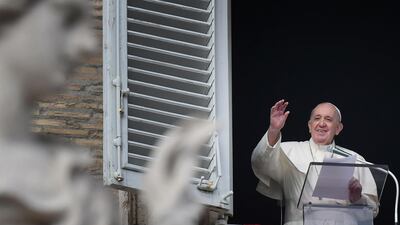
On Monday the Vatican announced that Pope Francis aims to make the first ever papal visit to Iraq in March next year. The four-day itinerary includes the capital Baghdad and the capital of the Iraqi Kurdistan Region, Erbil.
Perhaps most symbolically, Pope Francis also plans to visit Mosul and Qaraqosh. Both cities have historic Christian congregations, which were devastated by ISIS’s takeover of the areas in 2014. The trip will also include the ancient city of Ur, purportedly the birthplace of the prophet Abraham, who is revered by all Abrahamic faiths.
Other popes have tried to visit Iraq, including former pope John Paul II in 2000. But so far circumstances, or the Vatican itself, have deemed all such attempts too difficult to see through.
It is unsurprising that Pope Francis, with his desire to go out into the world to build tolerance, has revived the idea. In February 2019, he made history with his visit to the UAE, the first visit by a pope to the Arabian Peninsula. In co-signing the “document on human fraternity for world peace and living together” with the Grand Imam of Al-Azhar Ahmed Al Tayyeb, Pope Francis signaled his commitment to bringing people together.
Iraqi Christian children receive their First Communion. All Iraqis have been suffering under the pandemic and security situation in the country. AFP
The visit will not just be for the sake of the country's Christians but for all Iraqis, bringing them together around Pope Francis, an internationally recognised symbol of peace and tolerance
But he has also repeatedly highlighted Iraq's political situation as an issue of personal concern to him. In 2014, some were surprised by the force of his comments on the situation unfolding in the country, saying that it was “licit to stop unjust aggressors”. While he made clear he did not support “making war”, his answer to a question posed by a journalist showed he supported just use of force to protect the country and its citizens. In 2019, he told a group of leaders from Catholic aid agencies “I think constantly of Iraq – where I want to go next year – in the hope that it can face the future through the peaceful and shared pursuit of the common good on the part of all elements of society, including the religious, and not fall back into hostilities sparked by the simmering conflicts of the regional powers.” Earlier this year he also met President Barham Salih in the Vatican to discuss promoting stability and reconstruction in Iraq.
Pope Francis has also empowered Iraqi voices in the Vatican. In 2018 he appointed Chaldean Catholic Patriarch Louis Raphael I Sako, the president of Iraq’s Catholic bishops, to the senior Vatican position of cardinal. Cardinal Sako has described his appointment as being for the “whole of Iraq”.
This will also be true of the Pope’s upcoming visit in March. The well-being of Iraq’s Christian community is directly tied to that of all Iraq’s population. Cardinal Sako recognised this last year when he announced that his community would not hold public Christmas celebrations, in solidarity with Iraqis killed and wounded in anti-government protests at the time.
Iraq, like all nations, is suffering under the Covid-19 pandemic. But before this global catastrophe, all Iraqis were trying to recover from ISIS’s reign of terror, years of war, sanctions and internal strife. Therefore, the visit will not just be for the sake of the country’s Christians but for all Iraqis, bringing them together around Pope Francis, an internationally recognised symbol of peace and tolerance.
In 2015 the Pope made a statement, which for many has come to define his papacy, saying the Catholic Church must “leave her four walls” and go out to those on the “peripheries”. He was also the first pope in history to choose the papal name Francis, after St Francis of Assisi, who in the Christian tradition is particularly associated with helping the poor and dispossessed. Despite the fact many will view this unprecedented trip as risky, given the current state of the pandemic and security situation in Iraq, it fits the mission of today’s papacy.

The specs: 2018 Audi RS5
Price, base: Dh359,200
Engine: 2.9L twin-turbo V6
Transmission: Eight-speed automatic
Power: 450hp at 5,700rpm
Torque: 600Nm at 1,900rpm
Fuel economy, combined: 8.7L / 100km
Squad
Ali Kasheif, Salim Rashid, Khalifa Al Hammadi, Khalfan Mubarak, Ali Mabkhout, Omar Abdulrahman, Mohammed Al Attas, Abdullah Ramadan, Zayed Al Ameri (Al Jazira), Mohammed Al Shamsi, Hamdan Al Kamali, Mohammed Barghash, Khalil Al Hammadi (Al Wahda), Khalid Essa, Mohammed Shaker, Ahmed Barman, Bandar Al Ahbabi (Al Ain), Al Hassan Saleh, Majid Suroor (Sharjah) Walid Abbas, Ahmed Khalil (Shabab Al Ahli), Tariq Ahmed, Jasim Yaqoub (Al Nasr), Ali Saleh, Ali Salmeen (Al Wasl), Hassan Al Muharami (Baniyas)
1. Domestic VAT refund amendments: request your refund within five years
If a business does not apply for the refund on time, they lose their credit.
2. E-invoicing in the UAE
Businesses should continue preparing for the implementation of e-invoicing in the UAE, with 2026 a preparation and transition period ahead of phased mandatory adoption.
3. More tax audits
Tax authorities are increasingly using data already available across multiple filings to identify audit risks.
4. More beneficial VAT and excise tax penalty regime
Tax disputes are expected to become more frequent and more structured, with clearer administrative objection and appeal processes. The UAE has adopted a new penalty regime for VAT and excise disputes, which now mirrors the penalty regime for corporate tax.
5. Greater emphasis on statutory audit
There is a greater need for the accuracy of financial statements. The International Financial Reporting Standards standards need to be strictly adhered to and, as a result, the quality of the audits will need to increase.
6. Further transfer pricing enforcement
Transfer pricing enforcement, which refers to the practice of establishing prices for internal transactions between related entities, is expected to broaden in scope. The UAE will shortly open the possibility to negotiate advance pricing agreements, or essentially rulings for transfer pricing purposes.
7. Limited time periods for audits
Recent amendments also introduce a default five-year limitation period for tax audits and assessments, subject to specific statutory exceptions. While the standard audit and assessment period is five years, this may be extended to up to 15 years in cases involving fraud or tax evasion.
8. Pillar 2 implementation
Many multinational groups will begin to feel the practical effect of the Domestic Minimum Top-Up Tax (DMTT), the UAE's implementation of the OECD’s global minimum tax under Pillar 2. While the rules apply for financial years starting on or after January 1, 2025, it is 2026 that marks the transition to an operational phase.
9. Reduced compliance obligations for imported goods and services
Businesses that apply the reverse-charge mechanism for VAT purposes in the UAE may benefit from reduced compliance obligations.
10. Substance and CbC reporting focus
Tax authorities are expected to continue strengthening the enforcement of economic substance and Country-by-Country (CbC) reporting frameworks. In the UAE, these regimes are increasingly being used as risk-assessment tools, providing tax authorities with a comprehensive view of multinational groups’ global footprints and enabling them to assess whether profits are aligned with real economic activity.
Contributed by Thomas Vanhee and Hend Rashwan, Aurifer
Other IPL batting records
Most sixes: 292 – Chris Gayle
Most fours: 491 – Gautam Gambhir
Highest individual score: 175 not out – Chris Gayle (for Royal Challengers Bangalore against Pune Warriors in 2013)
Highest strike-rate: 177.29 – Andre Russell
Highest strike-rate in an innings: 422.22 – Chris Morris (for Delhi Daredevils against Rising Pune Supergiant in 2017)
Highest average: 52.16 – Vijay Shankar
Most centuries: 6 – Chris Gayle
Most fifties: 36 – Gautam Gambhir
Fastest hundred (balls faced): 30 – Chris Gayle (for Royal Challengers Bangalore against Pune Warriors in 2013)
Fastest fifty (balls faced): 14 – Lokesh Rahul (for Kings XI Punjab against Delhi Daredevils in 2018)
1. Never respond to e-mails, calls or messages asking for account, card or internet banking details
2. Never store a card PIN (personal identification number) in your mobile or in your wallet
3. Ensure online shopping websites are secure and verified before providing card details
4. Change passwords periodically as a precautionary measure
5. Never share authentication data such as passwords, card PINs and OTPs (one-time passwords) with third parties
6. Track bank notifications regarding transaction discrepancies
7. Report lost or stolen debit and credit cards immediately
The biog
Favourite car: Ferrari
Likes the colour: Black
Best movie: Avatar
Academic qualifications: Bachelor’s degree in media production from the Higher Colleges of Technology and diploma in production from the New York Film Academy
Gender equality in the workplace still 200 years away
It will take centuries to achieve gender parity in workplaces around the globe, according to a December report from the World Economic Forum.
The WEF study said there had been some improvements in wage equality in 2018 compared to 2017, when the global gender gap widened for the first time in a decade.
But it warned that these were offset by declining representation of women in politics, coupled with greater inequality in their access to health and education.
At current rates, the global gender gap across a range of areas will not close for another 108 years, while it is expected to take 202 years to close the workplace gap, WEF found.
The Geneva-based organisation's annual report tracked disparities between the sexes in 149 countries across four areas: education, health, economic opportunity and political empowerment.
After years of advances in education, health and political representation, women registered setbacks in all three areas this year, WEF said.
Only in the area of economic opportunity did the gender gap narrow somewhat, although there is not much to celebrate, with the global wage gap narrowing to nearly 51 per cent.
And the number of women in leadership roles has risen to 34 per cent globally, WEF said.
At the same time, the report showed there are now proportionately fewer women than men participating in the workforce, suggesting that automation is having a disproportionate impact on jobs traditionally performed by women.
And women are significantly under-represented in growing areas of employment that require science, technology, engineering and mathematics skills, WEF said.
The two riders are among several riders in the UAE to receive the top payment of £10,000 under the Thank You Fund of £16 million (Dh80m), which was announced in conjunction with Deliveroo's £8 billion (Dh40bn) stock market listing earlier this year.
The £10,000 (Dh50,000) payment is made to those riders who have completed the highest number of orders in each market.
There are also riders who will receive payments of £1,000 (Dh5,000) and £500 (Dh2,500).
All riders who have worked with Deliveroo for at least one year and completed 2,000 orders will receive £200 (Dh1,000), the company said when it announced the scheme.
A comparison of sending Dh20,000 from the UAE using two different routes at the same time - the first direct from a UAE bank to a bank in Germany, and the second from the same UAE bank via an online platform to Germany - found key differences in cost and speed. The transfers were both initiated on January 30.
Route 1: bank transfer
The UAE bank charged Dh152.25 for the Dh20,000 transfer. On top of that, their exchange rate margin added a difference of around Dh415, compared with the mid-market rate.
Total cost: Dh567.25 - around 2.9 per cent of the total amount
Total received: €4,670.30
Route 2: online platform
The UAE bank’s charge for sending Dh20,000 to a UK dirham-denominated account was Dh2.10. The exchange rate margin cost was Dh60, plus a Dh12 fee.
Total cost: Dh74.10, around 0.4 per cent of the transaction
Total received: €4,756
The UAE bank transfer was far quicker – around two to three working days, while the online platform took around four to five days, but was considerably cheaper. In the online platform transfer, the funds were also exposed to currency risk during the period it took for them to arrive.
Starring: Sam Worthington, Sigourney Weaver, Zoe Saldana
Rating: 4.5/5
Zakat definitions
Zakat: an Arabic word meaning ‘to cleanse’ or ‘purification’.
Nisab: the minimum amount that a Muslim must have before being obliged to pay zakat. Traditionally, the nisab threshold was 87.48 grams of gold, or 612.36 grams of silver. The monetary value of the nisab therefore varies by current prices and currencies.
Zakat Al Mal: the ‘cleansing’ of wealth, as one of the five pillars of Islam; a spiritual duty for all Muslims meeting the ‘nisab’ wealth criteria in a lunar year, to pay 2.5 per cent of their wealth in alms to the deserving and needy.
Zakat Al Fitr: a donation to charity given during Ramadan, before Eid Al Fitr, in the form of food. Every adult Muslim who possesses food in excess of the needs of themselves and their family must pay two qadahs (an old measure just over 2 kilograms) of flour, wheat, barley or rice from each person in a household, as a minimum.
