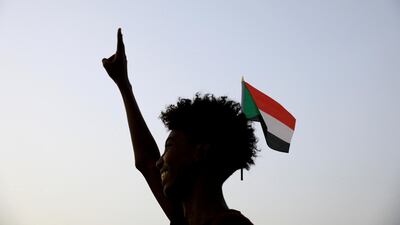
Despite the many challenges facing it, Sudan's revolution is still on track. Khartoum continues to move towards a sustainable political system, in a region where uprisings so often end in chaos.
On Wednesday, the nation's new cabinet was sworn in, with 25 members taking over from a caretaker government that had been in place since July. Today, the country is set to appoint provincial governors and next week, a 300-person legislature.
In a region not known for seamless transitions of power, this timetable inspires hope and is impressive.
So are its intentions. Officials are trying to create a system that represents the entire country, including Al Bashir-era rebel groups, which are set make up 25 per cent of the new legislature.
The country's leadership has understood that inclusion brings an unprecedented chance to brighten the nation's future.
Some aspects will be harder to reform than others. Sudan’s economy was left in ruins by the decades-long rule of Omar Al Bashir, during which cronyism, inflation, hard-currency shortage, US sanctions and a perfidious black market were rampant.
At a time when all eyes should be on reviving the economy, Khartoum's attention will be diverted by the pandemic and developments taking place on its south-eastern border given political instability in Ethiopia, as well as that same country's controversial project to build a huge dam on the Nile.
Sudan is building a new governing system, after 30 years of tyranny. AFP
The revolution did not create a security vacuum, often the deciding factor between prosperity or chaos
Recent protests by Sudanese against difficult financial conditions point to the pressing need for economic reform and job creation. This will be difficult, but starting from the low point left by Al Bashir's incompetent rule means that even a small improvement could benefit the lives of citizens.
Perhaps a harder legacy to address is the grievances of the groups that bore some of Al Bashir's worst brutality. Progress came four months ago when some of these factions, which were fighting government forces in the west and south of Sudan, signed a peace deal with Khartoum. Including opposition leaders in the Cabinet is a bold step that bodes well for creating a government that rises above sectarianism and, instead, chooses to address the many difficulties facing the country.
Even leadership with the best intentions can splinter. Lessons from the Arab uprisings a decade ago should remind the nation's new leadership that only effective action with a view to the long term will help deliver on the promises made.
Despite the difficulties, Khartoum has a number of elements in its favour. The enlightened leadership of Prime Minister Abdalla Hamdok prioritises pragmatism, fairness and inclusion. The revolution did not create a security vacuum, often the deciding factor between an uprising causing either prosperity or chaos. Most of all, it has a population whose potential has been bottled up for decades. Their satisfaction should be the new Cabinet's guiding principle.

How to donate
Send “thenational” to the following numbers or call the hotline on: 0502955999
2289 – Dh10
2252 – Dh 50
6025 – Dh20
6027 – Dh 100
6026 – Dh 200
Our legal columnist
Name: Yousef Al Bahar
Advocate at Al Bahar & Associate Advocates and Legal Consultants, established in 1994
Education: Mr Al Bahar was born in 1979 and graduated in 2008 from the Judicial Institute. He took after his father, who was one of the first Emirati lawyers
Dust and sand storms compared
Sand storm
Particle size: Larger, heavier sand grains
Visibility: Often dramatic with thick "walls" of sand
Duration: Short-lived, typically localised
Travel distance: Limited
Source: Open desert areas with strong winds
Dust storm
Particle size: Much finer, lightweight particles
Visibility: Hazy skies but less intense
Duration: Can linger for days
Travel distance: Long-range, up to thousands of kilometres
Source: Can be carried from distant regions
THE BIO
Bio Box
Role Model: Sheikh Zayed, God bless his soul
Favorite book: Zayed Biography of the leader
Favorite quote: To be or not to be, that is the question, from William Shakespeare's Hamlet
Favorite food: seafood
Favorite place to travel: Lebanon
Favorite movie: Braveheart
The studios taking part (so far)
Punch
Vogue Fitness
Sweat
Bodytree Studio
The Hot House
The Room
Inspire Sports (Ladies Only)
Cryo
The Limehouse Golem
Director: Juan Carlos Medina
Cast: Olivia Cooke, Bill Nighy, Douglas Booth
Three stars
Should late investors consider cryptocurrencies?
Wealth managers recommend late investors to have a balanced portfolio that typically includes traditional assets such as cash, government and corporate bonds, equities, commodities and commercial property.
They do not usually recommend investing in Bitcoin or other cryptocurrencies due to the risk and volatility associated with them.
“It has produced eye-watering returns for some, whereas others have lost substantially as this has all depended purely on timing and when the buy-in was. If someone still has about 20 to 25 years until retirement, there isn’t any need to take such risks,” Rupert Connor of Abacus Financial Consultant says.
He adds that if a person is interested in owning a business or growing a property portfolio to increase their retirement income, this can be encouraged provided they keep in mind the overall risk profile of these assets.
Match info
What: Fifa Club World Cup play-off Who: Al Ain v Team Wellington Where: Hazza bin Zayed Stadium, Al Ain When: Wednesday, kick off 7.30pm
Test
Director: S Sashikanth
Cast: Nayanthara, Siddharth, Meera Jasmine, R Madhavan
Star rating: 2/5
Shooting Ghosts: A U.S. Marine, a Combat Photographer, and Their Journey Back from War by Thomas J. Brennan and Finbarr O’Reilly
