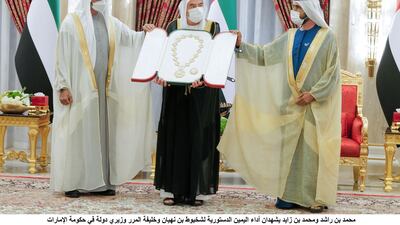
On Wednesday, Sheikh Mohammed bin Rashid, Vice President and Prime Minister of the UAE and Ruler of Dubai, announced important changes at the Ministry of Foreign Affairs. Described as "mini-shuffle", it nonetheless bids farewell from their long-standing portfolios to two of its biggest names, former minister of state for foreign affairs Dr Anwar Gargash and former minister of state Zaki Nusseibeh.
At the same time, the promotion of Sheikh Shakhbout bin Nahyan, the former UAE ambassador to Saudi Arabia and Khalifa Al Marar, previously assistant minister of political affairs, to Ministers of State was announced.
Dr Gargash and Mr Nusseibeh are both set to join the Presidential office as advisers on diplomatic and cultural affairs, respectively. Wishing them success in their new roles, Sheikh Mohamed bin Zayed, Crown Prince of Abu Dhabi and Deputy Supreme Commander of the UAE Armed Forces, said, "The UAE holds in high esteem its loyal sons. Long may your success continue." In recognition of the transformative achievements of Dr Gargash's time in his post over the past 13 years, the UAE's institution for envoys has been renamed the Anwar Gargash Diplomatic Academy.
Both men were also awarded the Order of the Union.
It is not easy to steer a nation safely and successfully through the diplomatic waters of the Middle East. Both men have done so, and strengthened their country in the process. It required striking an often elusive balance between long-term strategy and quick thinking. The UAE’s string of geopolitical achievements in recent years is a testament to the integrity with which Dr Gargash and Mr Nusseibeh sought peace and cultural progress.
The UAE has had a string of diplomatic successes in recent years. Reuters
It is not easy to navigate a nation safely and successfully through the diplomatic waters of the Middle East
Dr Gargash, an art-collecting polymath with a PhD from the University of Cambridge, filled the demanding job of one of the country's busiest ministerial positions. This year, the UAE’s diplomatic corps with Sheikh Abdullah bin Zayed, Minister of Foreign Affairs and International Co-operation, and Dr Gargash’s stewardship helped to heal rifts within the Gulf, returning the region to one in which cultural ties and hopes for a prosperous future triumph over political division. Months earlier and further afield, the old orthodoxies of the Palestine-Israel peace process, an issue that has plagued the Middle East for years, were given new dynamism with the Abraham Accords, making progress more attainable than it has been for decades. A security pact with Greece last year also presented a united front in the Mediterranean. A considered approach in Yemen meant that the UAE was able to withdraw its troops from the country and help lay the foundation for an eventual diplomatic solution there.
It is also the stories of the men themselves, not just their achievements, that make their contribution notable.
Mr Nusseibeh, who was born and educated in Jerusalem, started his service to the nation by accompanying the country's Founding Father, Sheikh Zayed, even before unification in 1971. With Mr Nusseibeh’s guidance, the UAE has become a cultural powerhouse in the Middle East, and a centre for tolerance and understanding. His ability to help build a bridge between Sheikh Zayed’s hopes for this country into the modern world has been invaluable, and his record of service extends to his family, with his daughter, Ambassador Lana Nusseibeh, today representing the UAE at the UN.
The legacies of these men highlight the important, but often unseen, work that public servants do for a nation. The rewards for their work extend beyond the country’s borders, and will be remembered for a long time to come.

1. Domestic VAT refund amendments: request your refund within five years
If a business does not apply for the refund on time, they lose their credit.
2. E-invoicing in the UAE
Businesses should continue preparing for the implementation of e-invoicing in the UAE, with 2026 a preparation and transition period ahead of phased mandatory adoption.
3. More tax audits
Tax authorities are increasingly using data already available across multiple filings to identify audit risks.
4. More beneficial VAT and excise tax penalty regime
Tax disputes are expected to become more frequent and more structured, with clearer administrative objection and appeal processes. The UAE has adopted a new penalty regime for VAT and excise disputes, which now mirrors the penalty regime for corporate tax.
5. Greater emphasis on statutory audit
There is a greater need for the accuracy of financial statements. The International Financial Reporting Standards standards need to be strictly adhered to and, as a result, the quality of the audits will need to increase.
6. Further transfer pricing enforcement
Transfer pricing enforcement, which refers to the practice of establishing prices for internal transactions between related entities, is expected to broaden in scope. The UAE will shortly open the possibility to negotiate advance pricing agreements, or essentially rulings for transfer pricing purposes.
7. Limited time periods for audits
Recent amendments also introduce a default five-year limitation period for tax audits and assessments, subject to specific statutory exceptions. While the standard audit and assessment period is five years, this may be extended to up to 15 years in cases involving fraud or tax evasion.
8. Pillar 2 implementation
Many multinational groups will begin to feel the practical effect of the Domestic Minimum Top-Up Tax (DMTT), the UAE's implementation of the OECD’s global minimum tax under Pillar 2. While the rules apply for financial years starting on or after January 1, 2025, it is 2026 that marks the transition to an operational phase.
9. Reduced compliance obligations for imported goods and services
Businesses that apply the reverse-charge mechanism for VAT purposes in the UAE may benefit from reduced compliance obligations.
10. Substance and CbC reporting focus
Tax authorities are expected to continue strengthening the enforcement of economic substance and Country-by-Country (CbC) reporting frameworks. In the UAE, these regimes are increasingly being used as risk-assessment tools, providing tax authorities with a comprehensive view of multinational groups’ global footprints and enabling them to assess whether profits are aligned with real economic activity.
Contributed by Thomas Vanhee and Hend Rashwan, Aurifer
The nearest international airport to the start of the Chuysky Trakt is in Novosibirsk. Emirates (www.emirates.com) offer codeshare flights with S7 Airlines (www.s7.ru) via Moscow for US$5,300 (Dh19,467) return including taxes. Cheaper flights are available on Flydubai and Air Astana or Aeroflot combination, flying via Astana in Kazakhstan or Moscow. Economy class tickets are available for US$650 (Dh2,400).
The Double Tree by Hilton in Novosibirsk ( 7 383 2230100,) has double rooms from US$60 (Dh220). You can rent cabins at camp grounds or rooms in guesthouses in the towns for around US$25 (Dh90).
The transport Minibuses run along the Chuysky Trakt but if you want to stop for sightseeing, hire a taxi from Gorno-Altaisk for about US$100 (Dh360) a day. Take a Russian phrasebook or download a translation app. Tour companies such as Altair-Tour ( 7 383 2125115 ) offer hiking and adventure packages.
UAE currency: the story behind the money in your pockets
