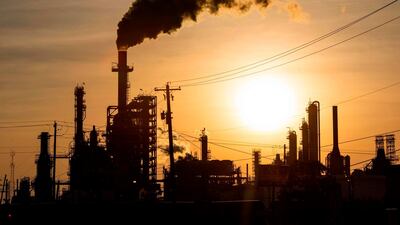
The coronavirus pandemic has shocked the global economy and Monday’s historic plunge in the US oil price is the latest twist in what has been a dramatic few months. The price of May futures contracts for one barrel of West Texas Intermediate oil, the US benchmark crude, sank to a record -$37.63 – an unprecedented lurch into negative pricing territory -- reaching a single-day drop of 306 per cent.
Soft demand due to worldwide coronavirus lockdowns and an earlier lack of agreement between major producers including Russia and Saudi Arabia on what action to take on output cuts (which was resolved only very recently) have contributed to an over-supply and storage space quickly filling up. Buyers and traders did not want to be left holding contracts for the physical delivery of oil that had nowhere to go. So they got rid of them as quickly as they could.
The negative price has largely puzzled the general public. Could producers really be offering to pay for the oil to be taken off their hands? In practice this is already happening in the physical market in the US for those who do not want to shut down their wells or who do not have their own storage space available. The New York Futures market trades financial contracts that are linked to the physical market. When contracts near their expiry the holder would be stuck with the financial exposure relating to the physical delivery of the oil. Normally financial players close out their position before expiry to avoid this. In this case, when May contracts neared their expiry on Monday, it seems they couldn't probably because there was no available storage space and so no-one to take the other side of the trade. So for the first time, the WTI benchmark turned negative. The negative pricing phenomenon could remain one that only affects American crude as long as there is an over-supply. WTI is only one of the three major grades used for global pricing. Brent Crude, which reflects pricing of output from the UK North Sea, and Dubai/Oman are still selling at a positive price – although the former has fallen nearly 70 per cent since the beginning of 2020. North American producers, especially those in Texas and other landlocked regions, are particularly at risk, as they are impacted by the limits of domestic infrastructure and do not have a marine route for export. Conversely, Saudi Arabia, the world's largest exporter of oil, has quickly managed to store its surplus crude in Egypt and is still able to sell abroad.
For the time being, the oil sector, especially in the US, is being buffeted by the unique circumstances of the pandemic
But while negative prices will not necessarily apply to crude exports from the Gulf region or many of the major international oil companies, the broader downturn is affecting all industries worldwide. Oil demand has understandably dropped significantly since the onset of the pandemic, and with uncertainty still surrounding the lifting of lockdowns around the world, the recovery may be equally drawn out. This unprecedented ordeal is a reminder that multilateralism is essential not only when it comes to diplomacy, but also for a response to soothe markets in times of crises. There will be better days for the whole economy as well as oil demand once the pandemic subsides and we are free to go out again. But for the time being, the oil sector, especially in the US, is being buffeted by the unique circumstances of the pandemic. Energy exporters like the UAE have successfully navigated crises over the years, most recently the last price slump of 2015-2016 and emerged stronger amid an industry transformed by technology and new efficiencies. This time around the coronavirus may be prompting some landmark moments but those that were strong and competitive before it hit will no doubt bounce back in similar fashion.

Position: legal consultant with Al Rowaad Advocates and Legal Consultants.
PRO BASH
Thursday’s fixtures
6pm: Hyderabad Nawabs v Pakhtoon Warriors
10pm: Lahore Sikandars v Pakhtoon Blasters
Teams
Chennai Knights, Lahore Sikandars, Pakhtoon Blasters, Abu Dhabi Stars, Abu Dhabi Dragons, Pakhtoon Warriors and Hyderabad Nawabs.
Squad rules
All teams consist of 15-player squads that include those contracted in the diamond (3), platinum (2) and gold (2) categories, plus eight free to sign team members.
Tournament rules
The matches are of 25 over-a-side with an 8-over power play in which only two fielders allowed outside the 30-yard circle. Teams play in a single round robin league followed by the semi-finals and final. The league toppers will feature in the semi-final eliminator.
Who's who in Yemen conflict
Houthis: Iran-backed rebels who occupy Sanaa and run unrecognised government
Yemeni government: Exiled government in Aden led by eight-member Presidential Leadership Council
Southern Transitional Council: Faction in Yemeni government that seeks autonomy for the south
Habrish 'rebels': Tribal-backed forces feuding with STC over control of oil in government territory
Saudi Cup race day
Schedule in UAE time
5pm: Mohamed Yousuf Naghi Motors Cup (Turf), 5.35pm: 1351 Cup (T), 6.10pm: Longines Turf Handicap (T), 6.45pm: Obaiya Arabian Classic for Purebred Arabians (Dirt), 7.30pm: Jockey Club Handicap (D), 8.10pm: Samba Saudi Derby (D), 8.50pm: Saudia Sprint (D), 9.40pm: Saudi Cup (D)
PROFILE
Name: Enhance Fitness
Year started: 2018
Based: UAE
Employees: 200
Amount raised: $3m
Investors: Global Ventures and angel investors
What is a robo-adviser?
Robo-advisers use an online sign-up process to gauge an investor’s risk tolerance by feeding information such as their age, income, saving goals and investment history into an algorithm, which then assigns them an investment portfolio, ranging from more conservative to higher risk ones.
These portfolios are made up of exchange traded funds (ETFs) with exposure to indices such as US and global equities, fixed-income products like bonds, though exposure to real estate, commodity ETFs or gold is also possible.
Investing in ETFs allows robo-advisers to offer fees far lower than traditional investments, such as actively managed mutual funds bought through a bank or broker. Investors can buy ETFs directly via a brokerage, but with robo-advisers they benefit from investment portfolios matched to their risk tolerance as well as being user friendly.
Many robo-advisers charge what are called wrap fees, meaning there are no additional fees such as subscription or withdrawal fees, success fees or fees for rebalancing.
THE CLOWN OF GAZA
Director: Abdulrahman Sabbah
Starring: Alaa Meqdad
Rating: 4/5
MATCH INFO
Europa League semi-final, second leg
Atletico Madrid (1) v Arsenal (1) Where: Wanda Metropolitano When: Thursday, kick-off 10.45pm Live: On BeIN Sports HD
Profile
Company: Libra Project
Based: Masdar City, ADGM, London and Delaware
Launch year: 2017
Size: A team of 12 with six employed full-time
Sector: Renewable energy
Funding: $500,000 in Series A funding from family and friends in 2018. A Series B round looking to raise $1.5m is now live.
Founders:Alhaan Ahmed, Alyina Ahmed and Maximo Tettamanzi
Sector:Sustainability
Total funding: Self funded
Number of employees:4
Generational responses to the pandemic
Devesh Mamtani from Century Financial believes the cash-hoarding tendency of each generation is influenced by what stage of the employment cycle they are in. He offers the following insights:
Baby boomers (those born before 1964): Owing to market uncertainty and the need to survive amid competition, many in this generation are looking for options to hoard more cash and increase their overall savings/investments towards risk-free assets.
Generation X (born between 1965 and 1980): Gen X is currently in its prime working years. With their personal and family finances taking a hit, Generation X is looking at multiple options, including taking out short-term loan facilities with competitive interest rates instead of dipping into their savings account.
Millennials (born between 1981 and 1996): This market situation is giving them a valuable lesson about investing early. Many millennials who had previously not saved or invested are looking to start doing so now.
- At 9.16pm, three suicide attackers killed one person outside the Atade de France during a foootball match between France and Germany - At 9.25pm, three attackers opened fire on restaurants and cafes over 20 minutes, killing 39 people - Shortly after 9.40pm, three other attackers launched a three-hour raid on the Bataclan, in which 1,500 people had gathered to watch a rock concert. In total, 90 people were killed - Salah Abdeslam, the only survivor of the terrorists, did not directly participate in the attacks, thought to be due to a technical glitch in his suicide vest - He fled to Belgium and was involved in attacks on Brussels in March 2016. He is serving a life sentence in France
Brief scores:
Manchester United 4
Young 13', Mata 28', Lukaku 42', Rashford 82'
Fulham 1
Kamara 67' (pen),
Red card: Anguissa (68')
Man of the match: Juan Mata (Man Utd)
Our legal consultant
Name: Hassan Mohsen Elhais
Position: legal consultant with Al Rowaad Advocates and Legal Consultants.
A High Court judge issued an interim order on Friday suspending a decision by Agriculture Minister Edwin Poots to direct a stop to Brexit agri-food checks at Northern Ireland ports.
Mr Justice Colton said he was making the temporary direction until a judicial review of the minister's unilateral action this week to order a halt to port checks that are required under the Northern Ireland Protocol.
Civil servants have yet to implement the instruction, pending legal clarity on their obligations, and checks are continuing.
