


If people harboured any lingering doubts about the threat climate change poses to the Middle East, two events this week should be more than enough to dispel them.
In Iraq, an enormous sandstorm struck the country’s southern and central regions leading to darkened cities shrouded in a dusty orange haze, as airports were forced to shut down and more than 1,800 people with respiratory problems were taken to hospital. Although sandstorms are a natural part of the region’s environment, their frequency and intensity are rising, fuelled by global warming and increasing desertification.
Across the Arabian Gulf, the focus was on a different kind of extreme weather. In Dubai, many residents were thinking about the day, one year ago, when 100mm of rain fell in 12 hours. This is the amount Dubai typically receives in a year and was the heaviest rainfall since records began in 1949. Scientists have suggested that downpours in the region have become 10 to 40 per cent heavier owing to climate change.
While it is one country among many that will inevitably be impacted by climate change, the UAE – with its demonstrable history of working hard on crisis management – is a good place to look for solutions, too.
As rainwater submerged cars and flooded roads for some hours, the authorities reacted nimbly by reviving strategies that proved their worth during the Covid-19 pandemic. Distance learning in Dubai and neighbouring Sharjah was swiftly introduced, government employees were told to work remotely and private sector companies were urged to let staff work from home. Since then, longer-term solutions have been taking shape. Two months after the floods, Sheikh Mohammed bin Rashid, Vice President and Ruler of Dubai, approved a Dh30 billion ($8.16 billion) project called Tasreef; this is aimed at increasing the capacity of the emirate’s rainwater drainage system by 700 per cent.
Infrastructure development has been accompanied by other long-term strategies that draw on the UAE’s growing expertise in advanced technology. G42, an Abu Dhabi technology group, has worked with global chip maker Nvidia to build a prediction system that is said to increase forecasting times from seven to 14 days. Artificial intelligence is another vital part of adapting to a changing climate as AI can simulate flood events, test urban planning scenarios and process data for faster and more effective decisions.
-
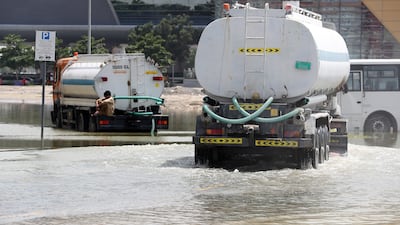
Tankers clearing waterlogged roads near Discovery Gardens metro station in Dubai on April 22. Pawan Singh / The National -

Many roads in Dubai have been flooded since last week's torrential rainfall. Pawan Singh / The National -
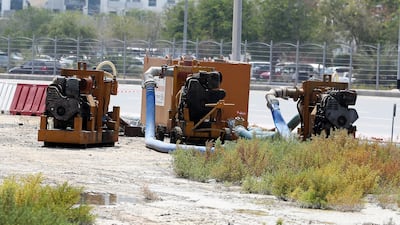
The tankers are pumping the water from the roads. Pawan Singh / The National -
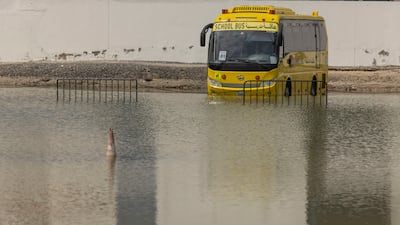
School buses on hand to drive pupils through the water after the flood. Antonie Robertson / The National -
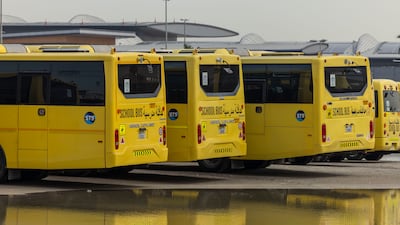
Pupils are returning to school after many were closed due to the heavy rain and flooding. Antonie Robertson / The National -

The clean-up is under way in District 5, Jumeirah Park. Antonie Robertson / The National -
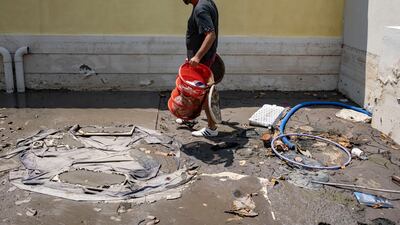
District 5 residents deal with the aftermath of the flooding one week on. Antonie Robertson / The National


Such know-how will be essential in the future. “Even if we reduce greenhouse-gas emissions today to zero, we would still be having the climate change we’re having today,” Prof Matthew Collins of the UK's University of Exeter told The National last October. More extreme weather – be it flooding or sandstorms – is coming whether we like it or not.
This will spur changes across many aspects of life, from urban planning and agriculture to transport and emergency response. Having learnt the lessons about responding to extreme weather events, the UAE is in a strong position to inform the global conversation as we move into a challenging future.

