
France's determined thrust to lead the global response to the horrific explosions in Beirut has quickly been followed by escalating French-Turkish tension in the eastern Mediterranean. It is little wonder that fresh and sometimes hostile attention is now being focused on the French President Emmanuel Macron's approach to foreign policy – and his intentions.
In the latest intensification of belligerence between Paris and Ankara, Turkey's Foreign Minister Mevlut Cavusoglu has accused France of acting like a "big shot" in the dispute between his country and Greece over hydrocarbon exploration. Mr Macron has stepped up French naval presence, saying that Turkey not only violates the sovereignty of Greece and Cyprus but bears "criminal responsibility" in the Libyan conflict, reneging on commitments made at the Berlin conference in January by re-importing extremist fighters from Syria.
But the immediate issue, when considering Mr Macron’s diplomatic strategy, remains his swift reaction to the double blast of ammonium nitrate that inflicted death, injury and massive destruction in Beirut.
-

A Lebanese youth hugs French President Emmanuel Macron during a visit to the Gemmayzeh neighbourhood, which has suffered extensive damage due to a massive explosion in the Lebanese capital. AFP -
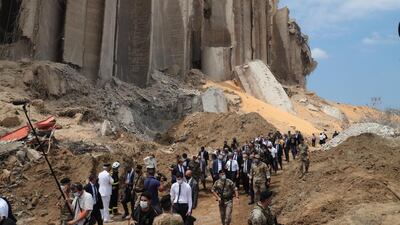
French President Emmanuel Macron (C) visiting the devastated site of the explosion at the port of Beirut, Lebanon. Macron arrived to Lebanon to show support after a massive explosion on 04 August -
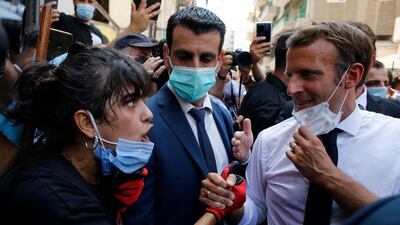
French President Emmanuel Macron listens to a resident as he visits a devastated street of Beirut. AP Photo -
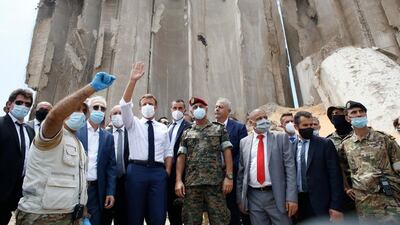
French President Emmanuel Macron gestures as he visits the devastated site of the explosion at the port of Beirut. EPA -
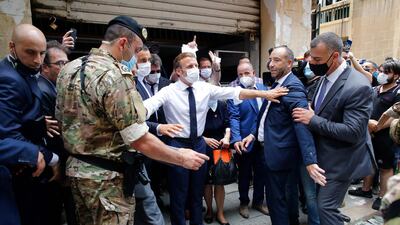
French President Emmanuel Macron gestures as he visits a devastated street of Beirut. AFP -
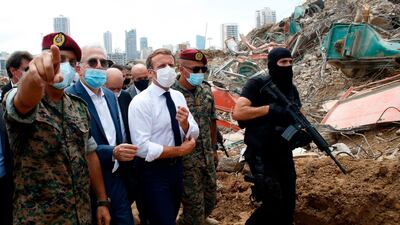
French President Emmanuel Macron surrounded by Lebanese servicemen, visits the devastated site of the explosion at the port of Beirut. AFP -

French President Emmanuel Macron, speaks with a woman as he visits the Gemayzeh neighborhood, which suffered extensive damage from an explosion on Tuesday. AP Photo -
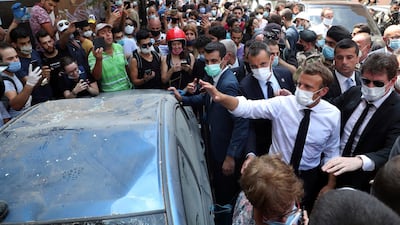
French President Emmanuel Macron visits the Gemayzeh neighborhood, which suffered extensive damage from an explosion on Tuesday that hit the seaport of Beirut. AP Photo -
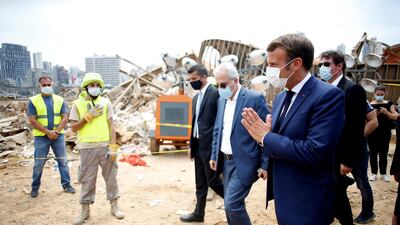
French President Emmanuel Macron gestures as he arrives at the devastated site of the explosion at the port of Beirut. REUTERS -
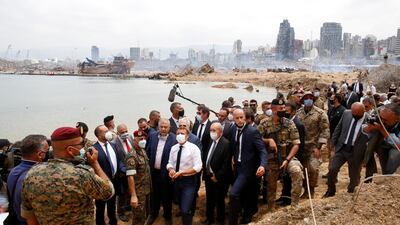
French President Emmanuel Macron visits the devastated site of the explosion at the port of Beirut. REUTERS -
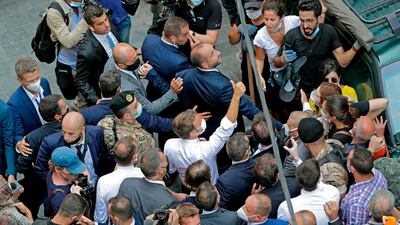
French President Emmanuel Macron greets people during a visit to the Gemmayzeh neighbourhood, which has suffered extensive damage due to a massive explosion in the Lebanese capital. AFP -
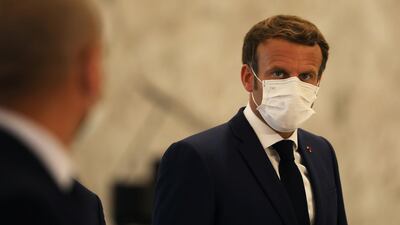
French President Emmanuel Macron wears a protective face mask as he meets Lebanon's President Michel Aoun following Tuesday's blast in Beirut's port area, at the presidential palace in Baabda, Lebanon. Reuters -
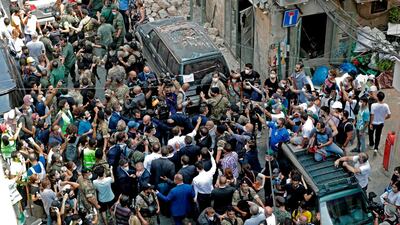
French President Emmanuel Macron greets people during a visit to the Gemmayzeh neighbourhood, which has suffered extensive damage due to a massive explosion in the Lebanese capital, on August 6, 2020. French President Emmanuel Macron visited shell-shocked Beirut, pledging support and urging change after a massive explosion devastated the Lebanese capital in a disaster that has sparked grief and fury. / AFP / ANWAR AMRO -
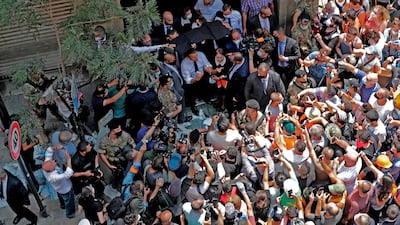
French President Emmanuel Macron speaks to the crowd during a visit to the Gemmayzeh neighbourhood, which has suffered extensive damage due to a massive explosion in the Lebanese capital, on August 6, 2020. French President Emmanuel Macron visited shell-shocked Beirut, pledging support and urging change after a massive explosion devastated the Lebanese capital in a disaster that has sparked grief and fury. / AFP / ANWAR AMRO -
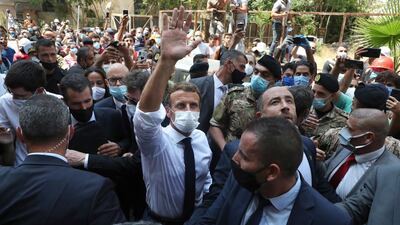
French President Emmanuel Macron, center, gestures as he visits the Gemayzeh neighborhood, which suffered extensive damage from an explosion on Tuesday that hit the seaport of Beirut, Lebanon, Thursday, Aug. 6, 2020. (AP Photo/Bilal Hussein) -

French President Emmanuel Macron gestures as he visits a devastated street of Beirut, Lebanon, on August 6, 2020 a day after a massive explosion devastated the Lebanese capital in a disaster that has sparked grief and fury. French President Emmanuel Macron visited shell-shocked Beirut Thursday, pledging support and urging change after a massive explosion devastated the Lebanese capital in a disaster that has sparked grief and fury. / AFP / POOL / Thibault Camus -
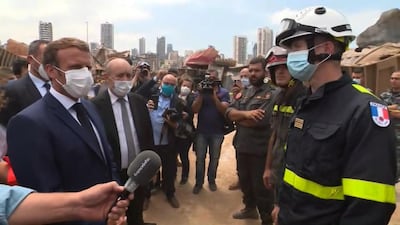
A video grab shows French President Emmmanuel Macron, left, speaking with a member of a French rescue team which arrived overnight to support relief efforts at the port of Lebanon's capital Beirut. AFP -
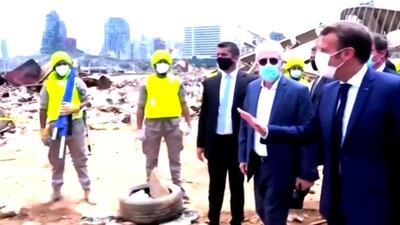
French President Emmanuel Macron visits the site of Tuesday's blast in Beirut. Tele Liban / Reuters -
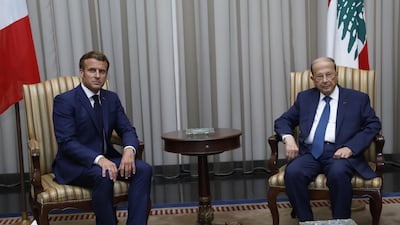
Lebanon's President Michel Aoun meets French President Emmanuel Macron on his arrival at the airport in Beirut. Dalati Nohra/Reuters -
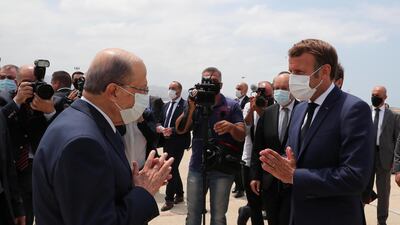
Lebanon's President Michel Aoun welcomes French President Emmanuel Macron on his arrival at the airport in Beirut. Dalati Nohra/Reuters -
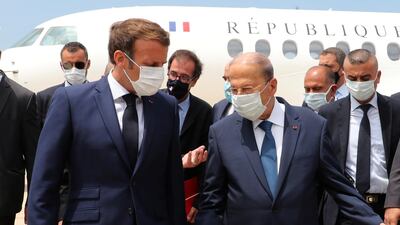
"Lebanon is not alone," Mr Macron tweeted shortly after landing. Dalati Nohra/Reuters -
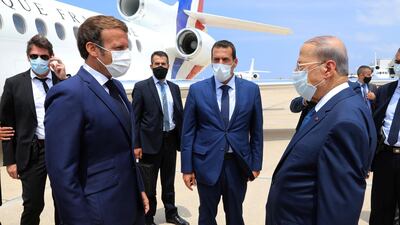
The French president is the first foreign leader to visit the Lebanese capital since an explosion on Tuesday killed at least 137 people. Dalati Nohra / Reuters -
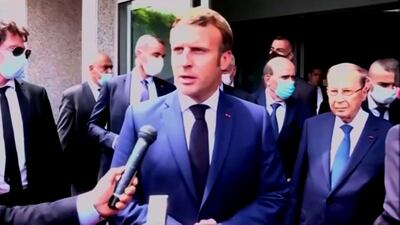
Mr Macron said Lebanon was facing a political and economic crisis, and that it would continue to suffer unless it enacted reforms. Reuters


Within two days of the catastrophe, he flew to the city once known as "the Paris of the Middle East", breaking his summer holiday in what was seen by many Lebanese as a gesture of solidarity and support.
The visit, in which the French President mingled with crowds – shaking hands and even lowering his mask – in a city ravaged by Covid-19 amid deepening economic crisis and rampant corruption, won much praise from admirers.
Three days later, he hosted a videoconference in which countries pledged aid of more than €250 million, a modest but useful emergency package.
Few politicians act without having an eye on the political implications. France has significant economic interests in Lebanon, where the oil giant Total is heavily involved in offshore gas exploration.
Even so, it is not difficult to imagine the furore Mr Macron would have faced had he simply got on with a welcome break at the superb presidential retreat of the Fort de Bregancon, close to the Mediterranean resorts of Le Lavandou and Bormes-les-Mimosas.
There would have been a resurgence of allegations of arrogance, a lack of empathy with the problems of ordinary people, not least those of a country where France was the colonial power from 1920 to 1944.
Yet the President’s struggle to win the hearts and minds of French voters, many of them bitterly disappointed by his performance since being swept to power in 2017, was reflected in a barrage of criticism from political enemies, as well as some observers with roots in the Mena region and wider Muslim world.

Some critics suggested that the visit to Beirut smacked more of “post-colonial theatre” and political showboating than genuine compassion.
In France, the far left and far right once again demonstrated that their differences are nuanced rather than absolute.
Jean-Louis Melenchon, leader of the left-wing France Insoumise, declared: “Lebanon is not a French protectorate.” Scoffing at the presidential visit, he referred to months of street protest and effectively urged the Lebanese to ignore Mr Macron and “protect the demands of their people’s revolution”.
From the extreme right National Rally, led by Mr Macron’s most dangerous rival, Marine Le Pen, came withering denunciation of an ”unwelcome and inappropriate” publicity stunt.
The party's spokesman, Julien Sanchez, accused the President of lecturing the Lebanese government, an action he likened to the US President Donald Trump demonstrating with the "gilets jaunes" – anti-government yellow vest protesters – on the Champs-Elysees in Paris.
Inconveniently for this analysis, the UN joined the clamour for fundamental change in Lebanon. Protests against the government resumed in Beirut and less than a week after the explosions, the prime minister Hassan Diab and his entire cabinet resigned.
Among those who regard France’s colonial history with dismay, or worse, opinion was mixed in debate on the sincerity of France’s response.
-
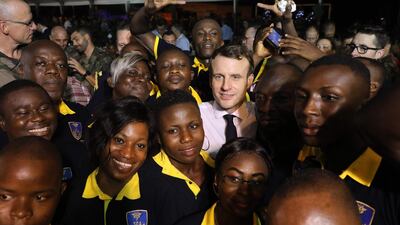
French President Emmanuel Macron poses with French soldiers and civilians during a Christmas dinner with French troops at the Port-Bouet military camp near Abidjan during his three day visit to West Africa. AFP -
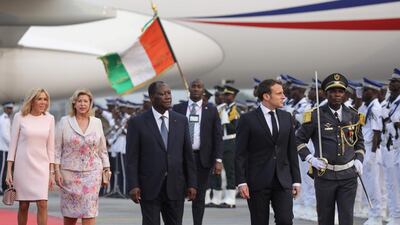
Emmanuel Macronis greeted by Ivory Coast's President Alassane Ouattara next to their wives Brigitte Macron and Dominique Folloroux-Ouattara in Abidjan. AFP -
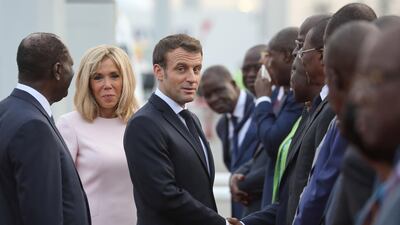
France's President Emmanuel Macron shakes hands as he is greeted by Ivory Coast's President Alassane Ouattara (L) next to his wive Brigitte Macron (2L) upon their arrival at the Felix Houphouet Boigny International Airport in Abidjan at the start of a three day visit to West Africa. AFP -
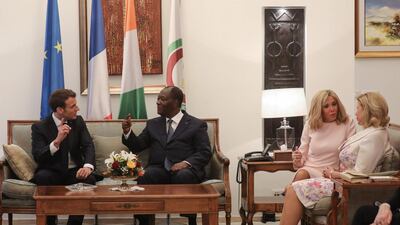
The Macrons meet Ivory Coast's President Alassane Ouattara and Ivorian First Lady Dominique Ouattara. AFP -
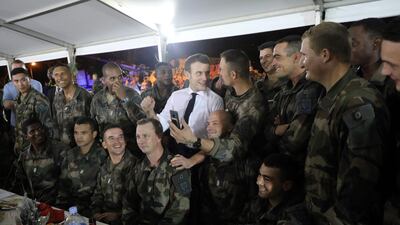
French President Emmanuel Macron (C) poses next to French soldiers during Christmas dinner with French troops at the Port-Bouet military camp near Abidjan, on the first day of his three day visit to West Africa. AFP -
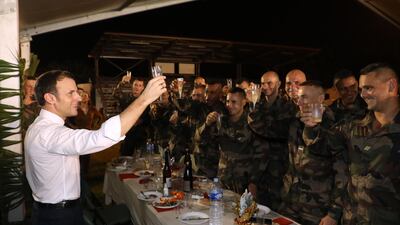
French President Emmanuel Macron celebrates his 42nd birthday with French soldiers. AFP -

French President Emmanuel Macron celebrates his 42nd birthday with French soldiers. AFP -

French President Emmanuel Macron celebrates his 42nd birthday with French soldiers. AFP -

A billboard announcing the visit of French President Emmanuel Macron in Abidjan, Ivory Coast. EPA


An online petition, calling unrealistically for a 10-year French mandate, attracted a respectable 61,000 signatures, though it was unclear how many respondents were in Lebanon or from the Lebanese diaspora.
In a Facebook discussion, complaints about French interference were balanced by the view of a “cautiously optimistic” US-Pakistani academic, Saleem Ali, professor of energy and the environment at Delaware University: “France has shown more willingness than others to at least consider Lebanon’s complexity. But we will need to monitor their interventions carefully given their terrible legacy in Africa.”
Prof Ali will have been thinking of such former French possessions as Algeria, and its bloody fight for independence. But if France shares with European neighbours a history of colonialism that is difficult to defend, Mr Macron has gone some way towards atonement.
In December last year, he went a step further than in previous declarations, which had already admitted that colonialism was a "crime against humanity". Gone were attempts to refrain from "sweeping away all of the past" or descending into a culture of self-guilt.

Mr Macron's tendency to crave the approval of all may be paying nominal dividends. His approval rating in one recent poll rose by several points to 50 per cent. His Mediterranean holiday has had other interruptions. He also has to deal with the impact on France's coronavirus-hit tourism industry of Britain's muddled decision – as the country with Europe's worst record on handling the pandemic – to impose quarantine restrictions at the height of summer.
But as the UK's influence in Europe appears at risk of waning, its economy threatened by not only Covid-19 but the impact of an entirely possible no-deal Brexit, Mr Macron may be eyeing a bigger prize.
On Thursday, another powerful European figure, the German Chancellor Angela Merkel, the de facto president of the European Union, is due at Bregancon to meet Mr Macron. It could be that France’s head of state sees himself, not her, as the natural leader of Europe, a statesman who can represent the continent’s interests, stand up when necessary – and depending on the outcome of the US presidential election – to Washington and deal fairly and effectively with the Middle East and Africa.
Like so many French presidents, he could end up being more effective and respected on the international stage than in his own country.
Colin Randall is a former executive editor of The National and writes from France and Britain

