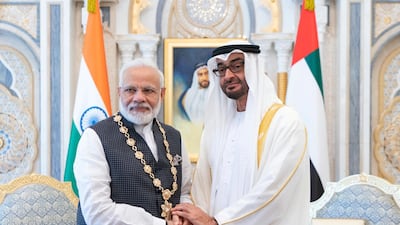
Ties between the UAE and India, founded on trade, go back decades. The UAE has welcomed generations of Indian families who have contributed to social and economic progress. India has supported the UAE’s transition from a pearl diving and fishing economy to one powered by oil. Today, we see a deep-rooted relationship, strengthened by Indian investment in the transition of the Emirates to a digital era.
This unparalleled relationship between the countries has only been strengthened in recent years, with the closer engagement to enhance business ties. The UAE has made significant investments in India, to support development in the country's physical but also digital infrastructure, that will lead to a next-generation economy.
India is home to 1.3 billion people. And as the country keeps moving into the digital era, its attractiveness as a destination for UAE foreign direct investment will continue to increase.
Trade between India and the UAE is valued at $59 billion, making the UAE India's third largest trading partner in 2019 – after China and US. And the UAE is India's second largest export partner, after the US.
The India-UAE High Level Joint Task Force on Investments continues to progress with both sides mutually agreeing on steps that remove trade barriers. In August 2020, India invited further investments from the UAE in sectors of the Indian economy such as infrastructure, logistics, food parks, highways, ports, airports, renewable energy and defence.
I met India's Prime Minister Narendra Modi late last year. From my meeting, it was clear that efforts to build UAE investor confidence come from the top. This is reassuring for any business person making initial forays into a new market.
Investments alone, however, will not drive the country's growth – without policy arms working in tandem
Here in the UAE, we can adopt lessons from our own development story. It started 49 years ago with the realisation that infrastructure investment is a critical part of a nation’s growth strategy. If it weren’t for the UAE's world-class roads, utility services, ports, renewable energy and even digital infrastructure investments, we would not have progressed at this pace.
Given the UAE's philosophy of long-term investments, its confidence in the India story is not deterred by periods of uncertainty. Mubadala invested over $2bn during the peak of the Covid-19 pandemic. As Indians build new innovative companies, they will be backed by capital from the UAE across sectors such as digital connectivity, district cooling and renewable energy.
Investments alone, however, will not drive the country's growth – without policy arms working in tandem. Like growth capital, policies and regulations must also be written for the long term. This is an opportunity for India to resolve challenges around licensing, dispute resolution, land acquisition, taxation and retrospective laws. This is particularly important in sectors like renewable energy and utilities, where there is a significant upfront investment. For a foreign investor, such forward-looking policy developments are measures that build confidence.
With investors assured of returns in the form of safe policy frameworks and new reforms, FDI inflow to India will increase. India's recent tax exemptions for federal and local UAE sovereign institutions that are investing in India's infrastructure sector is a positive step, one that will harness the expertise of UAE businesses and build momentum for investing in India.
With India building cities, investors from the UAE will provide capital and forge a system of knowledge sharing. These systems will come in handy while planning approaches to the use of urban energy that are climate resilient and cost-effective. Doing so will help advance the entire nation in an inclusive manner.
India’s young population is optimistic, aspirational and willing to work hard to realise the potential of their country. And the country's government has an ambitious vision for its people. Given India's commitment to rebuild confidence, investment in the country's infrastructure – both digital and physical – will go a long way to transform its economic trajectory.
Khaled Al Qubaisi is chief executive, real estate and infrastructure investments and investment committee member, Mubadala Investment Company

Russia's Muslim Heartlands
Dominic Rubin, Oxford
Ten tax points to be aware of in 2026
1. Domestic VAT refund amendments: request your refund within five years
If a business does not apply for the refund on time, they lose their credit.
2. E-invoicing in the UAE
Businesses should continue preparing for the implementation of e-invoicing in the UAE, with 2026 a preparation and transition period ahead of phased mandatory adoption.
3. More tax audits
Tax authorities are increasingly using data already available across multiple filings to identify audit risks.
4. More beneficial VAT and excise tax penalty regime
Tax disputes are expected to become more frequent and more structured, with clearer administrative objection and appeal processes. The UAE has adopted a new penalty regime for VAT and excise disputes, which now mirrors the penalty regime for corporate tax.
5. Greater emphasis on statutory audit
There is a greater need for the accuracy of financial statements. The International Financial Reporting Standards standards need to be strictly adhered to and, as a result, the quality of the audits will need to increase.
6. Further transfer pricing enforcement
Transfer pricing enforcement, which refers to the practice of establishing prices for internal transactions between related entities, is expected to broaden in scope. The UAE will shortly open the possibility to negotiate advance pricing agreements, or essentially rulings for transfer pricing purposes.
7. Limited time periods for audits
Recent amendments also introduce a default five-year limitation period for tax audits and assessments, subject to specific statutory exceptions. While the standard audit and assessment period is five years, this may be extended to up to 15 years in cases involving fraud or tax evasion.
8. Pillar 2 implementation
Many multinational groups will begin to feel the practical effect of the Domestic Minimum Top-Up Tax (DMTT), the UAE's implementation of the OECD’s global minimum tax under Pillar 2. While the rules apply for financial years starting on or after January 1, 2025, it is 2026 that marks the transition to an operational phase.
9. Reduced compliance obligations for imported goods and services
Businesses that apply the reverse-charge mechanism for VAT purposes in the UAE may benefit from reduced compliance obligations.
10. Substance and CbC reporting focus
Tax authorities are expected to continue strengthening the enforcement of economic substance and Country-by-Country (CbC) reporting frameworks. In the UAE, these regimes are increasingly being used as risk-assessment tools, providing tax authorities with a comprehensive view of multinational groups’ global footprints and enabling them to assess whether profits are aligned with real economic activity.
Contributed by Thomas Vanhee and Hend Rashwan, Aurifer
The five pillars of Islam
In-demand jobs and monthly salaries
- Technology expert in robotics and automation: Dh20,000 to Dh40,000
- Energy engineer: Dh25,000 to Dh30,000
- Production engineer: Dh30,000 to Dh40,000
- Data-driven supply chain management professional: Dh30,000 to Dh50,000
- HR leader: Dh40,000 to Dh60,000
- Engineering leader: Dh30,000 to Dh55,000
- Project manager: Dh55,000 to Dh65,000
- Senior reservoir engineer: Dh40,000 to Dh55,000
- Senior drilling engineer: Dh38,000 to Dh46,000
- Senior process engineer: Dh28,000 to Dh38,000
- Senior maintenance engineer: Dh22,000 to Dh34,000
- Field engineer: Dh6,500 to Dh7,500
- Field supervisor: Dh9,000 to Dh12,000
- Field operator: Dh5,000 to Dh7,000
The biog
Most memorable achievement: Leading my first city-wide charity campaign in Toronto holds a special place in my heart. It was for Amnesty International’s Stop Violence Against Women program and showed me the power of how communities can come together in the smallest ways to have such wide impact.
Favourite film: Childhood favourite would be Disney’s Jungle Book and classic favourite Gone With The Wind.
Favourite book: To Kill A Mockingbird for a timeless story on justice and courage and Harry Potters for my love of all things magical.
Favourite quote: “We make a living by what we get, but we make a life by what we give.” — Winston Churchill
Favourite food: Dim sum
Favourite place to travel to: Anywhere with natural beauty, wildlife and awe-inspiring sunsets.
SPECS
%3Cp%3E%3Cstrong%3EEngine%3A%3C%2Fstrong%3E%201.5-litre%204-cylinder%3Cbr%3E%3Cstrong%3EPower%3A%3C%2Fstrong%3E%20101hp%3Cbr%3E%3Cstrong%3ETorque%3A%3C%2Fstrong%3E%20135Nm%3Cbr%3E%3Cstrong%3ETransmission%3C%2Fstrong%3E%3A%20Six-speed%20auto%3Cbr%3E%3Cstrong%3EPrice%3A%3C%2Fstrong%3E%20From%20Dh79%2C900%3Cbr%3E%3Cstrong%3EOn%20sale%3A%3C%2Fstrong%3E%20Now%3C%2Fp%3E%0A
Who's who in Yemen conflict
Houthis: Iran-backed rebels who occupy Sanaa and run unrecognised government
Yemeni government: Exiled government in Aden led by eight-member Presidential Leadership Council
Southern Transitional Council: Faction in Yemeni government that seeks autonomy for the south
Habrish 'rebels': Tribal-backed forces feuding with STC over control of oil in government territory
Charlotte Gainsbourg
Rest
(Because Music)
The specs
Engine: 3.8-litre, twin-turbo V8
Transmission: eight-speed automatic
Power: 582bhp
Torque: 730Nm
Price: Dh649,000
On sale: now
Company Profile
Name: Thndr
Started: 2019
Co-founders: Ahmad Hammouda and Seif Amr
Sector: FinTech
Headquarters: Egypt
UAE base: Hub71, Abu Dhabi
Current number of staff: More than 150
Funds raised: $22 million
Pakistanis%20at%20the%20ILT20%20
%3Cp%3EThe%20new%20UAE%20league%20has%20been%20boosted%20this%20season%20by%20the%20arrival%20of%20five%20Pakistanis%2C%20who%20were%20not%20released%20to%20play%20last%20year.%20%0D%3Cbr%3E%0D%0D%0D%3Cbr%3E%3Cstrong%3EShaheen%20Afridi%20(Desert%20Vipers)%20%3C%2Fstrong%3E%0D%3Cbr%3ESet%20for%20at%20least%20four%20matches%2C%20having%20arrived%20from%20New%20Zealand%20where%20he%20captained%20Pakistan%20in%20a%20series%20loss.%20%0D%3C%2Fp%3E%0A%3Cp%3E%3Cstrong%3EShadab%20Khan%20(Desert%20Vipers)%20%3C%2Fstrong%3E%0D%3Cbr%3E%0DThe%20leg-spin%20bowling%20allrounder%20missed%20the%20tour%20of%20New%20Zealand%20after%20injuring%20an%20ankle%20when%20stepping%20on%20a%20ball.%20%0D%3C%2Fp%3E%0A%3Cp%3E%3Cstrong%3EAzam%20Khan%20(Desert%20Vipers)%20%3C%2Fstrong%3E%0D%3Cbr%3EPowerhouse%20wicketkeeper%20played%20three%20games%20for%20Pakistan%20on%20tour%20in%20New%20Zealand.%20He%20was%20the%20first%20Pakistani%20recruited%20to%20the%20ILT20.%20%0D%3C%2Fp%3E%0A%3Cp%3E%3Cstrong%3EMohammed%20Amir%20(Desert%20Vipers)%20%3C%2Fstrong%3E%0D%3Cbr%3EHas%20made%20himself%20unavailable%20for%20national%20duty%2C%20meaning%20he%20will%20be%20available%20for%20the%20entire%20ILT20%20campaign.%20%0D%3C%2Fp%3E%0A%3Cp%3E%3Cstrong%3EImad%20Wasim%20(Abu%20Dhabi%20Knight%20Riders)%20%3C%2Fstrong%3E%0D%3Cbr%3EThe%20left-handed%20allrounder%2C%2035%2C%20retired%20from%20international%20cricket%20in%20November%20and%20was%20subsequently%20recruited%20by%20the%20Knight%20Riders.%26nbsp%3B%3C%2Fp%3E%0A
