This is a big week for American politics, arguably just like every other week in the years since the 2016 election of President Donald Trump. On Thursday, Mr Trump debates his Democratic challenger Joe Biden in the last such exchange before election day on November 3. It may not be a game-changer.
By last weekend, 30 million ballots had already been cast in early voting across the US. It represents nearly 20 per cent of total votes cast in 2016. Accordingly, a presidential debate may prove less than decisive in changing voters’ minds or the outcome of the election. Instead, another political contest on Thursday – one for decisive ideological control of America’s highest court – may be more significant by far.
The Senate Judiciary Committee votes on Thursday on the nomination of Judge Amy Coney Barrett to a lifetime appointment on the Supreme Court. By next week, the full Senate will have pronounced as well.
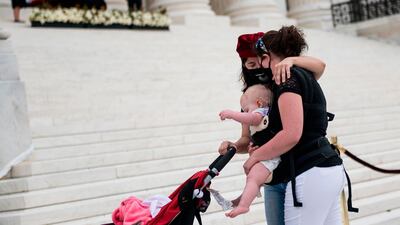
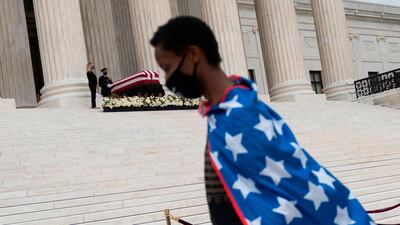
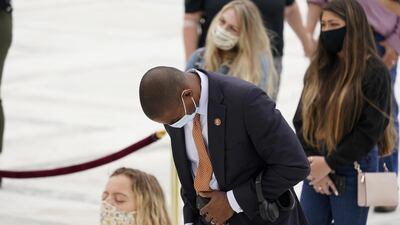
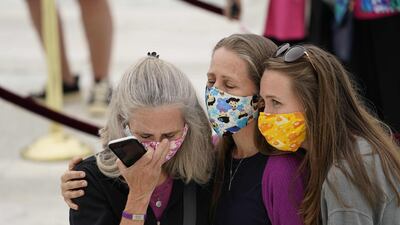
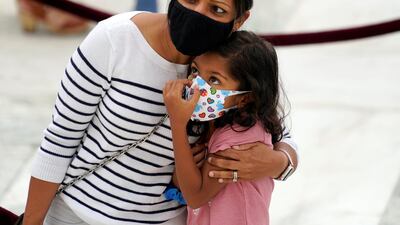
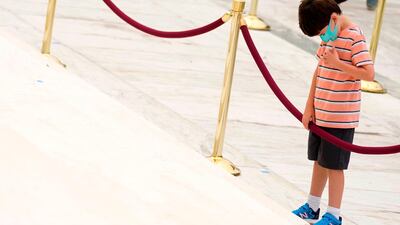
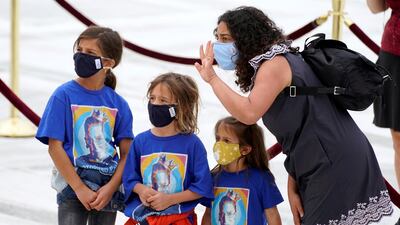
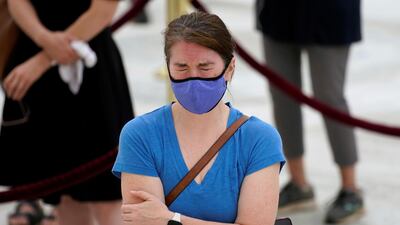
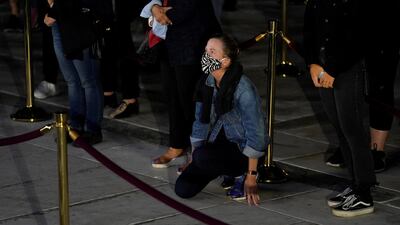
Mourners pay their respects as Justice Ruth Bader Ginsburg lies in repose in front of the US Supreme Court building in Washington on September 24, 2020. AP Photo
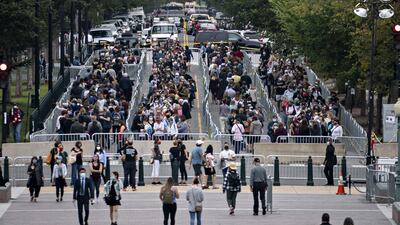
Thousands of mourners queued to pay their respects to Justice Ginsburg, a champion of women's and civil rights, at the US Supreme Court building before her casket was taken to lie in state at the US Capitol on September 25, 2020. Bloomberg
AFP
Reuters
Reuters
AFP
Reuters
Reuters
Reuters
Reuters
Bloomberg
Pool via Reuters
AFP
Pool via Reuters
AFP
Bloomberg
AP Photo
Reuters
Reuters
Reuters
AFP
AFP
Reuters
Reuters
The issue is being closely watched around the world. Ms Barrett is championed by conservatives for her religious views while critics say her confirmation would shift America’s highest court firmly to the right and add to the country’s polarising cultural divide.
Ms Barrett's confirmation is all but certain – the Republican-dominated Senate is pushing for it – and she will take the Supreme Court seat held by the late liberal heroine Ruth Bader Ginsburg. The newest justice will be the youngest and only the fifth woman ever on the bench.
Interest in the somewhat arcane appointment of a Supreme Court judge is at fever pitch with Women’s March protesters taking to the streets of the US capital at the weekend to express their opposition to Ms Barrett’s nomination. One protester said it was “really scary what the future of women in this country looks like”. The marchers came up against a counterprotest in support of Ms Barrett, who was described by a conservative activist as “a role model for young women everywhere”.
Both sides are entrenched. Liberals and conservatives alike expect Ms Barrett to be a judicial activist, working to dismantle laws that govern health care, abortion rights and gun control. It’s fair to say that as a Catholic conservative woman, Ms Barrett faces demonisation on the left and lionisation on the right.
But perhaps the real issues are slightly different than framed by the noisy ongoing debate.
Supporters of Amy Coney Barrett rally outside the Supreme Court building during the Women's March in Washington on Saturday. AP Photo
First, is it fair to focus so heavily on Ms Barrett’s individual beliefs? She is a practising Catholic with a demonstrably strong personal opposition to abortion. When pregnant with the last of her seven children, Ms Barrett reportedly learned of her son’s Down syndrome through prenatal testing but chose to have the baby. She has written academic articles about her views. She also has connections to a tightly knit religious community called the People of Praise, which frequently takes conservative positions on social issues as well as women’s place within the family unit.
That said, religious bigotry and stereotypes are to be deplored when considering anyone for any job, regardless of the faith or tradition the candidate belongs to. Harrying Ms Barrett for her faith is as unfair as the attempt by conservative bloggers back in 2011 to smear Sohail Mohammed, a Muslim originally from India, when he was appointed to a New Jersey state court. At the time, Mr Mohammed was routinely described as a “mouthpiece for radical Islamists", prompting then New Jersey governor Chris Christie to protest about how “unnecessary” it was “to be accusing this guy of things just because of his religious background".
Superior Court Judge Sohail Mohammed tapped into his electrical engineering and technology background from @NJIT to help attorneys adapt to the virtual courtrooms the NJ Judiciary is now using during the #COVID19 pandemic. courtesy: New Jersey Courts twitter account
As American lawyer Wajahat Ali recently pointed out, passing judgement on a person solely because of their faith can smack of religious bias. Mr Mohammed, a former electrical engineer who specialised in immigration law before his appointment as a judge, may have been victim to this even more than Ms Barrett. The kerfuffle over his elevation appears to have centred around the religion of his birth rather than any particular opinions he held.
Perhaps the larger issue thrown up by Ms Barrett’s near-certain ascent to America’s apex court is older and more complex than the culture wars between conservatives and liberals. There is an age-old perceived conflict between faith and reason, something that philosophers have long struggled to reconcile. Demonstrable knowledge is infallible and universal; belief, they argue, is not. Writing in 10th century Baghdad, Al Farabi, one of the Muslim world’s key philosophers, highlighted the need to use reasoning to justify actions and opinions in a belief system. He took his cue from Greek philosopher Plato, who championed “the beauty of reason”, which produces the capacity for justice.
By next week, the US Supreme Court could have a supermajority of judges with conservative views. AFP
Clearly, the main question that will hang over Ms Barrett in her new role is the ability to navigate between faith and reason. This is a valid issue and it would be appropriate to scrutinise her actions as a Supreme Court justice for logic and the idea of the greater common good.
Last month, American law professors Lee Epstein and Eric Posner diagnosed the country's polarisation over the Supreme Court as the outcome of an attempt by the conservative bloc to promote religious rights and push back on more than half a century of socially liberal judicial rulings.
But the issue of religious rights is contentious. Whose rights deserve primacy? The dispensing of justice should not be subservient to religious rights in a secular democracy.
Perhaps the answer lies in the words of the founders of the American experiment nearly 300 years ago. They declared that the state should favour no religion.
Rashmee Roshan Lall is a columnist for The National

Salman Khan’s father, Salim Khan, is one of Bollywood’s most legendary screenwriters. Through his partnership with co-writer Javed Akhtar, Salim is credited with having paved the path for the Indian film industry’s blockbuster format in the 1970s. Something his son now rules the roost of. More importantly, the Salim-Javed duo also created the persona of the “angry young man” for Bollywood megastar Amitabh Bachchan in the 1970s, reflecting the angst of the average Indian. In choosing to be the ordinary man’s “hero” as opposed to a thespian in new Bollywood, Salman Khan remains tightly linked to his father’s oeuvre. Thanks dad.
Air France offer flights from Dubai and Abu Dhabi to Cayenne, connecting in Paris from Dh7,300.
The tour
Cox & Kings (coxandkings.com) has a 14-night Hidden Guianas tour of Guyana, Suriname and French Guiana. It includes accommodation, domestic flights, transfers, a local tour manager and guided sightseeing. Contact for price.
A new relationship with the old country
Treaty of Friendship between the United Kingdom of Great Britain and Northern Ireland and the United Arab Emirates
The United kingdom of Great Britain and Northern Ireland and the United Arab Emirates; Considering that the United Arab Emirates has assumed full responsibility as a sovereign and independent State; Determined that the long-standing and traditional relations of close friendship and cooperation between their peoples shall continue; Desiring to give expression to this intention in the form of a Treaty Friendship; Have agreed as follows:
ARTICLE 1 The relations between the United Kingdom of Great Britain and Northern Ireland and the United Arab Emirates shall be governed by a spirit of close friendship. In recognition of this, the Contracting Parties, conscious of their common interest in the peace and stability of the region, shall: (a) consult together on matters of mutual concern in time of need; (b) settle all their disputes by peaceful means in conformity with the provisions of the Charter of the United Nations.
ARTICLE 2 The Contracting Parties shall encourage education, scientific and cultural cooperation between the two States in accordance with arrangements to be agreed. Such arrangements shall cover among other things: (a) the promotion of mutual understanding of their respective cultures, civilisations and languages, the promotion of contacts among professional bodies, universities and cultural institutions; (c) the encouragement of technical, scientific and cultural exchanges.
ARTICLE 3 The Contracting Parties shall maintain the close relationship already existing between them in the field of trade and commerce. Representatives of the Contracting Parties shall meet from time to time to consider means by which such relations can be further developed and strengthened, including the possibility of concluding treaties or agreements on matters of mutual concern.
ARTICLE 4 This Treaty shall enter into force on today’s date and shall remain in force for a period of ten years. Unless twelve months before the expiry of the said period of ten years either Contracting Party shall have given notice to the other of its intention to terminate the Treaty, this Treaty shall remain in force thereafter until the expiry of twelve months from the date on which notice of such intention is given.
IN WITNESS WHEREOF the undersigned have signed this Treaty.
DONE in duplicate at Dubai the second day of December 1971AD, corresponding to the fifteenth day of Shawwal 1391H, in the English and Arabic languages, both texts being equally authoritative.
There are different types of travel available for pets:
Manifest cargo
Excess luggage in the hold
Excess luggage in the cabin
Each option is safe. The feasibility of each option is based on the size and breed of your pet, the airline they are traveling on and country they are travelling to.
2. What is the difference between my pet traveling as manifest cargo or as excess luggage?
If traveling as manifest cargo, your pet is traveling in the front hold of the plane and can travel with or without you being on the same plane. The cost of your pets travel is based on volumetric weight, in other words, the size of their travel crate.
If traveling as excess luggage, your pet will be in the rear hold of the plane and must be traveling under the ticket of a human passenger. The cost of your pets travel is based on the actual (combined) weight of your pet in their crate.
3. What happens when my pet arrives in the country they are traveling to?
As soon as the flight arrives, your pet will be taken from the plane straight to the airport terminal.
If your pet is traveling as excess luggage, they will taken to the oversized luggage area in the arrival hall. Once you clear passport control, you will be able to collect them at the same time as your normal luggage. As you exit the airport via the ‘something to declare’ customs channel you will be asked to present your pets travel paperwork to the customs official and / or the vet on duty.
If your pet is traveling as manifest cargo, they will be taken to the Animal Reception Centre. There, their documentation will be reviewed by the staff of the ARC to ensure all is in order. At the same time, relevant customs formalities will be completed by staff based at the arriving airport.
4. How long does the travel paperwork and other travel preparations take?
This depends entirely on the location that your pet is traveling to. Your pet relocation compnay will provide you with an accurate timeline of how long the relevant preparations will take and at what point in the process the various steps must be taken.
In some cases they can get your pet ‘travel ready’ in a few days. In others it can be up to six months or more.
5. What vaccinations does my pet need to travel?
Regardless of where your pet is traveling, they will need certain vaccinations. The exact vaccinations they need are entirely dependent on the location they are traveling to. The one vaccination that is mandatory for every country your pet may travel to is a rabies vaccination.
Other vaccinations may also be necessary. These will be advised to you as relevant. In every situation, it is essential to keep your vaccinations current and to not miss a due date, even by one day. To do so could severely hinder your pets travel plans.
Ahmad El Sayed is Senior Associate at Charles Russell Speechlys, a law firm headquartered in London with offices in the UK, Europe, the Middle East and Hong Kong.
Experience: Commercial litigator who has assisted clients with overseas judgments before UAE courts. His specialties are cases related to banking, real estate, shareholder disputes, company liquidations and criminal matters as well as employment related litigation.
Education: Sagesse University, Beirut, Lebanon, in 2005.