

Although the hearings weren't remotely interesting, the most consequential development in Washington these days is the confirmation process for Judge Amy Coney Barrett, nominated to replace the late liberal hero Justice Ruth Bader Ginsburg on the US Supreme Court. As President Donald Trump inches closer to possible defeat in the November 3 election, the Republican party finds itself poised for a massive generational victory, finally securing a solid 6-3 conservative majority on the high court.
This apparently unstoppable Senate confirmation realises a project that began in the 1970s. Outraged by 20 years of judicial hammer blows – beginning with Brown versus Board of Education, which effectively prohibited racial segregation in 1954, and culminating with Roe versus Wade's guarantee of abortion and privacy rights in 1973 – conservatives sought a right-wing court majority.
The gold standard for conservatives was Ms Barrett's mentor, the late justice Antonin Scalia, but she seems even more right-wing.
For example, Scalia, an ardent opponent of gun control, allowed that, perhaps, the government can bar convicted felons from owning weapons. Not so, says Ms Barrett. Gun ownership rights are so fundamental that the government must prove a significant, imminent public danger in every case. That puts her on the most extreme wing of an already extremely pro-gun constituency.
-

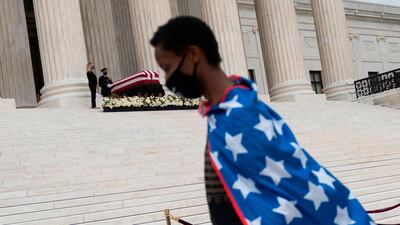
Mourners pay their respects as Justice Ruth Bader Ginsburg lies in repose in front of the US Supreme Court building in Washington on September 24, 2020. AP Photo -

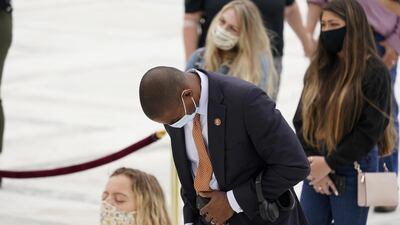
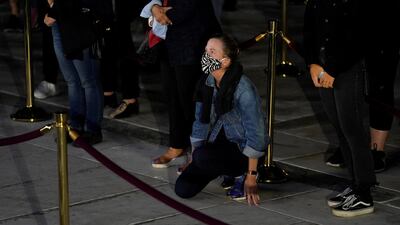
Thousands of mourners queued to pay their respects to Justice Ginsburg, a champion of women's and civil rights, at the US Supreme Court building before her casket was taken to lie in state at the US Capitol on September 25, 2020. Bloomberg -

AFP -

Reuters -

Reuters -
AFP -

Reuters -

Reuters -

Reuters -

Reuters -

Bloomberg -
Pool via Reuters -

AFP -

Pool via Reuters -

AFP -

Bloomberg -

AP Photo -

Reuters -

Reuters -

Reuters -

AFP -

AFP -
Reuters -

Reuters


Both political parties are guilty of putting up nominees who refuse to discuss anything substantial on the ridiculous grounds that it might somehow compromise their independence. So, like all her recent predecessors, Ms Barrett declined any meaningful colloquy.
She refused to opine on whether the President could delay the election (he can't), or whether it is unlawful to intimidate voters (it is). If asked whether the sky looks blue, she would have probably cited the need to hear arguments and research relevant litigation before commenting.
But the Senators were little better.
Timorous Democrats avoided any mention of Ms Barrett's membership in a religious group that emphasises male supremacy, speaking in tongues, prophesying and other potentially relevant beliefs. Much as Mr Trump is counterfactually calling the moderate Mr Biden a "socialist", Senate Republicans denounced Democrats for attacking her faith though they never mentioned it.
All Senators burbled tinned speeches, generally totally unconnected to constitutional law.
It's a pity, because Ms Barrett is a champion of "Originalism", a specious doctrine central to the programmatic conservative legal agenda. She said that it means: “I interpret the Constitution as a law, I understand it to have the meaning that it had at the time people ratified it.”
That’s plainly convenient for the political right. But it is absurd. It assumes there is a fixed or identifiable “public meaning" that is somehow defined during the ratification process (although by whom, precisely, and how, exactly, is undefined or contested) when obviously there almost never is.

Clearly, even when different people agree on the same language, they typically have radically different motivations and understandings of what they want it to mean.
Moreover, such legal "Originalists" usually ignore historians, as if only their own legal scholarship provides a genuine grasp of mindsets from the distant past. Common sense and bitter experience strongly suggest otherwise.
It’s also unlikely that the “original” constitutional understandings of 1787 survived the post-Civil War reconstruction and amendments from 1866-1877 that, as president Abraham Lincoln vowed, redefined the country, enshrined equality for all citizens and made the federal government – and not the states – the guarantor of that equality.
Democrats didn't engage any of this, presumably because there aren't many votes in methodology. But there are in health care, so Democrats insisted she is being rushed through for a case against the popular Obamacare health insurance law scheduled for arguments on November 10. But that case is so ridiculous that she and a majority will probably reject it.
Instead, Democrats should have emphasised what Mr Trump openly says he wants from Ms Barrett: support in rulings immediately after the election to affect the outcome. If Mr Trump tries to use courts as the primary means to stay in power despite the voters, Democrats may regret not having highlighted it and pressed her more strongly to recuse herself from any 2020 election issues, as would be ethical.
In the long run, all eyes will be on the Roe ruling, which she has strongly denounced, and a set of potential coming liberal reforms.
Washington may soon find itself reliving the 1930s, where a leftover, pre-Depression, ultra-conservative Supreme Court majority consistently blocked president Franklin Roosevelt's economic restructuring until he threatened to expand its membership. Both sides ultimately backed down.
The potential for revisited "court packing" is the one campaign issue that Democratic nominee Joe Biden has severely mishandled. While "let's see if she gets confirmed" would have sufficed, he has been repeating: “I'll tell you my policy after the election" – a mystifyingly clumsy position.

Republicans are focused on controlling courts not only because they remember the liberal gains accrued between the 1950s through the 70s, but also because that’s the least democratic and accountable branch of government. That is bound to appeal to the party mainly of white, non-college-educated, and non-urban Americans, a constituency that is transitioning from being a solid majority to much greater potential vulnerability.
Democrats already see several of the Supreme Court's conservative justices as illegitimate.
There is a much stronger case today against Clarence Thomas than in 1991, when a former subordinate named Anita Hill stood alone accusing him of improprieties during his confirmation hearing. Many believe Brett Kavanaugh similarly perjured himself. Neil Gorsuch is only on the bench because Republicans blocked Barack Obama's nominee, Merrick Garland, claiming that it would be "improper" given a mere 10 months left in the president's term.

Now Ms Barrett's nomination is being rammed through while voting is already under way. And all of it is being done by a President and Senate majority elected without majority support.
What the Barrett hearings suggest is that a huge American train wreck over the Supreme Court, and other federal appellate courts, is likely if – as many suspect – Democrats consolidate elected executive and legislative authority in coming years.
If Ms Barrett enters the arena of power as Mr Trump exits it, perhaps even bringing down the Republican Senate majority down with him, she and her conservative colleagues on the Supreme Court may be the most politically powerful and relevant Republicans in Washington for many years.
Hussein Ibish is a senior resident scholar at the Arab Gulf States Institute and a US affairs columnist for The National

