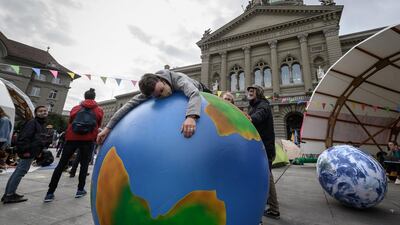
A climate activist lays on an inflatable world globe in front of the Swiss House of Parliament at the start of a week of demonstrations called "Rise up for change" on September 21, in Bern. Fabrice Coffrini / AFP
A climate activist lays on an inflatable world globe in front of the Swiss House of Parliament at the start of a week of demonstrations called "Rise up for change" on September 21, in Bern. Fabrice Co
This is officially Climate Week and it's brought to the world by the United Nations and New York City, on the sidelines of the ongoing, virtual 75th UN General Assembly. Unofficially, climate week now runs throughout the year in some form or other, somewhere – an extreme weather event, a call to action, or a heated argument about whether global warming is a fact.
But this Climate Week is arguably different. A firestorm is sweeping the usual debates about climate change, as the US presidential campaign, America in general and the world as a whole is confronted with new visions of apocalypse – on the TV news and on the internet. America’s west coast is burning.
So is Siberia, as far north as the Arctic Circle. And so are Brazil’s Pantanal wetlands, one of the most bio-diverse areas in the world. In July, forest fires caused an Indonesian province on Borneo island to declare a state of emergency. Earlier this year, enormous tracts of the Australian continent were ablaze.
Each seems like the local chapter of an increasingly familiar global story, one in which large parts of the world are on fire. And in 2020, which is expected to be among the five warmest years on record, each raging fire appears to show that the planet is getting hotter, drier and more inhospitable.
Consider California’s customary fire season. It has become the state’s most destructive in modern memory and it is still only halfway done. Six of the state’s 10 largest wildfires have happened since 2018 and five were just this year. Millions of acres have burned, with the fires spreading into neighbouring Oregon and Washington, wreaking destruction on businesses and homes and leaving landscapes akin to Hawaii’s famous black sand beaches, except that these are charred and smoking. Even though the world’s most polluted cities are typically in Asia, in the past week, Portland, Oregon had significantly worse air quality than any other city in the world.
Smoke over neighbourhoods in Monrovia, California, September 13. California wildfires that have already incinerated a record 2.3 million acres this year and are expected to continue till December. David McNew/Getty Images/AFP
David McNew/Getty Images/AFP
The fires pumped an estimated 110 million tonnes of carbon dioxide into the atmosphere and the smoke blew all the way from the west to cities on America’s east coast, creating hazy conditions and weirdly orange skies in Washington, DC and New York. According to satellite data from the European Union’s Copernicus atmospheric monitoring services, the smoke travelled as far as northern Europe. Meanwhile, the towering fires forced the evacuation of tens of thousands of people. With the Red Cross on the ground and struggling to find shelter for more displaced people than there were hotel rooms, the volunteers were often heard using a word that might seem odd in the richest country in the world. “Refugees”, they called the Americans displaced by the historic blaze.
Refugees is the right word but it has entered public consciousness way too late. Back in 2015, then US secretary of state John Kerry was warning a foreign ministers’ conference in Alaska to prepare for “climate refugees”.
It will keep getting worse, as long as we keep adding greenhouse gases to the atmosphere
That was the year an estimated two million people fleeing the Syrian civil war would pour into Europe. But that migration, according to a 2015 paper in the ‘Proceedings of the National Academy of Sciences’, an American journal, was initially from the hinterland into Syrian cities.
Syrians in rural areas were desperate after “the worst three-year drought in the instrumental record”, the researchers wrote, identifying “a long-term drying trend” as well as a “warming trend in the Eastern Mediterranean (caused by the increase in greenhouse gases)”.
Decades of state-decreed, water-intensive agricultural practices had led to the unsustainable depletion of groundwater and the drying of the Khabur river in north-eastern Syria. Crops failed and the farmers moved to the cities.
As with all migration, this triggered tensions and eventually, massive unrest. So, when Mr Kerry declared that “we as leaders of countries will begin to witness what we call climate refugees”, he was using the wrong tense. The world was already witnessing climate refugees. The phenomenon was not in the future.
In any case, Mr Kerry was five years late in drawing attention to the issue of climate refugees. In 2010, Frank Bierman, an environmental policy professor at the Vrije Universiteit Amsterdam, led controversial research that warned there may be as many as 200 million climate refugees by 2050. He recommended the creation of an international resettlement fund. An ambitious but poorly funded nest egg of sorts was subsequently set up by the UN Framework Convention on Climate Change.
But it was only in 2018 that the UN negotiated a global migration treaty that became the first to recognise climate as a cause of future displacement. The US refused to join 164 other countries in signing it.
The myopia of America, led by US President Donald Trump, is both outrageous and tragic as its burning west coast is creating climate refugees, albeit those seeking haven within their country’s borders.
Last year was the first time in a decade that more people left California for other US states than arrived. And however high the walls that America builds to keep foreign climate refugees out, there will continue to be an inexorable flow from water-stressed, hungry parts of central America towards the vast, rich country next door.
New projections for global climate-induced migration range from 50 million to 300 million in the next few decades. It is telling that Philip Duffy, head of the Woodwell Climate Research Centre in Massachusetts, recently rejected the idea that raging fires, melting Arctic sea ice, simultaneous hurricanes in the Atlantic Ocean and the hottest summer in the northern hemisphere could be described as “the new normal”. It is not, he said, because “it will keep getting worse, as long as we keep adding greenhouse gases to the atmosphere”.
A giant inflatable model of the Earth during European Sustainable Development Week, as well on World Clean Up day, at the garden of Czech Ministry of Foreign Affairs in Prague, Czech Republic, September 19. Martin Divisek / EPA
So climate week seems doomed to stretch into decades. Sometimes, it is novelists who tell the future. Margaret Atwood ended her acclaimed ‘MaddAddam’ trilogy about a dystopian post-pandemic world on fire as follows: “The people in the chaos cannot learn. They cannot understand what they are doing to the sea and the sky and the plants and the animals. They cannot understand that they are killing them, and that they will end by killing themselves.”
Fiction is becoming fact before our eyes.
Rashmee Roshan Lall is a columnist for The National

Name: Thndr Started: 2019 Co-founders: Ahmad Hammouda and Seif Amr Sector: FinTech Headquarters: Egypt UAE base: Hub71, Abu Dhabi Current number of staff: More than 150 Funds raised: $22 million
Investors: Class 5 Global, Equitrust, Gulf Islamic Investments, Kairos K50 and William Zeqiri
WHAT IS A BLACK HOLE?
1. Black holes are objects whose gravity is so strong not even light can escape their pull
2. They can be created when massive stars collapse under their own weight
3. Large black holes can also be formed when smaller ones collide and merge
4. The biggest black holes lurk at the centre of many galaxies, including our own
5. Astronomers believe that when the universe was very young, black holes affected how galaxies formed
Kamindu Mendis bio
Full name: Pasqual Handi Kamindu Dilanka Mendis
Born: September 30, 1998
Age: 20 years and 26 days
Nationality: Sri Lankan
Major teams Sri Lanka's Under 19 team
Batting style: Left-hander
Bowling style: Right-arm off-spin and slow left-arm orthodox (that's right!)
Mercer, the investment consulting arm of US services company Marsh & McLennan, expects its wealth division to at least double its assets under management (AUM) in the Middle East as wealth in the region continues to grow despite economic headwinds, a company official said.
Mercer Wealth, which globally has $160 billion in AUM, plans to boost its AUM in the region to $2-$3bn in the next 2-3 years from the present $1bn, said Yasir AbuShaban, a Dubai-based principal with Mercer Wealth.
“Within the next two to three years, we are looking at reaching $2 to $3 billion as a conservative estimate and we do see an opportunity to do so,” said Mr AbuShaban.
Mercer does not directly make investments, but allocates clients’ money they have discretion to, to professional asset managers. They also provide advice to clients.
“We have buying power. We can negotiate on their (client’s) behalf with asset managers to provide them lower fees than they otherwise would have to get on their own,” he added.
Mercer Wealth’s clients include sovereign wealth funds, family offices, and insurance companies among others.
From its office in Dubai, Mercer also looks after Africa, India and Turkey, where they also see opportunity for growth.
Wealth creation in Middle East and Africa (MEA) grew 8.5 per cent to $8.1 trillion last year from $7.5tn in 2015, higher than last year’s global average of 6 per cent and the second-highest growth in a region after Asia-Pacific which grew 9.9 per cent, according to consultancy Boston Consulting Group (BCG). In the region, where wealth grew just 1.9 per cent in 2015 compared with 2014, a pickup in oil prices has helped in wealth generation.
BCG is forecasting MEA wealth will rise to $12tn by 2021, growing at an annual average of 8 per cent.
Drivers of wealth generation in the region will be split evenly between new wealth creation and growth of performance of existing assets, according to BCG.
Another general trend in the region is clients’ looking for a comprehensive approach to investing, according to Mr AbuShaban.
“Institutional investors or some of the families are seeing a slowdown in the available capital they have to invest and in that sense they are looking at optimizing the way they manage their portfolios and making sure they are not investing haphazardly and different parts of their investment are working together,” said Mr AbuShaban.
Some clients also have a higher appetite for risk, given the low interest-rate environment that does not provide enough yield for some institutional investors. These clients are keen to invest in illiquid assets, such as private equity and infrastructure.
“What we have seen is a desire for higher returns in what has been a low-return environment specifically in various fixed income or bonds,” he said.
“In this environment, we have seen a de facto increase in the risk that clients are taking in things like illiquid investments, private equity investments, infrastructure and private debt, those kind of investments were higher illiquidity results in incrementally higher returns.”
The Abu Dhabi Investment Authority, one of the largest sovereign wealth funds, said in its 2016 report that has gradually increased its exposure in direct private equity and private credit transactions, mainly in Asian markets and especially in China and India. The authority’s private equity department focused on structured equities owing to “their defensive characteristics.”
This article is part of a guide on where to live in the UAE. Our reporters will profile some of the country’s most desirable districts, provide an estimate of rental prices and introduce you to some of the residents who call each area home.
Carbon sink: Seagrass sequesters carbon up to 35X faster than tropical rainforests
Marine nursery: Crucial habitat for juvenile fish, crustations, and invertebrates
Biodiversity: Support species like sea turtles, dugongs, and seabirds
Coastal protection: Reduce erosion and improve water quality
The biog
Favourite books: 'Ruth Bader Ginsburg: A Life' by Jane D. Mathews and ‘The Moment of Lift’ by Melinda Gates
Favourite travel destination: Greece, a blend of ancient history and captivating nature. It always has given me a sense of joy, endless possibilities, positive energy and wonderful people that make you feel at home.
Favourite pastime: travelling and experiencing different cultures across the globe.
Favourite quote: “In the future, there will be no female leaders. There will just be leaders” - Sheryl Sandberg, COO of Facebook.
Favourite Movie: Mona Lisa Smile
Favourite Author: Kahlil Gibran
Favourite Artist: Meryl Streep
Other IPL batting records
Most sixes: 292 – Chris Gayle
Most fours: 491 – Gautam Gambhir
Highest individual score: 175 not out – Chris Gayle (for Royal Challengers Bangalore against Pune Warriors in 2013)
Highest strike-rate: 177.29 – Andre Russell
Highest strike-rate in an innings: 422.22 – Chris Morris (for Delhi Daredevils against Rising Pune Supergiant in 2017)
Highest average: 52.16 – Vijay Shankar
Most centuries: 6 – Chris Gayle
Most fifties: 36 – Gautam Gambhir
Fastest hundred (balls faced): 30 – Chris Gayle (for Royal Challengers Bangalore against Pune Warriors in 2013)
Fastest fifty (balls faced): 14 – Lokesh Rahul (for Kings XI Punjab against Delhi Daredevils in 2018)
