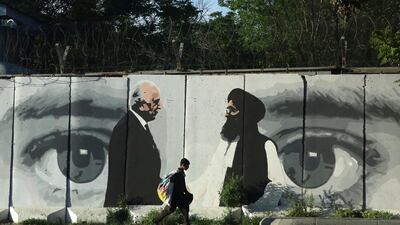
A graffiti depicts Washington's peace envoy Zalmay Khalilzad, left, and Mullah Abdul Ghani Baradar, the leader of the Taliban delegation, in Kabul. Is the Taliban that the US made peace with last year different from the Taliban of the past? AP Photo
A graffiti depicts Washington's peace envoy Zalmay Khalilzad, left, and Mullah Abdul Ghani Baradar, the leader of the Taliban delegation, in Kabul. Is the Taliban that the US made peace with last year

What it's like to live under the Taliban in 2021


  • English
  • Arabic

Many Afghans predict that the Taliban will return to formal power in Afghanistan, either through a peace settlement or a bloody military takeover once foreign troops are gone. But it remains a mystery to what extent the Islamist militant group has moderated its extremist beliefs and is willing to embrace major change.

During its brutal rule from 1996 to 2001, the Taliban established a fundamentalist regime that oppressed women, massacred religious and ethnic minorities and banned free speech. It has adopted a more conciliatory public image in recent years, claiming that it is not seeking a monopoly on power, nor does it want to re-establish its rule of the 1990s, which even it now describes as “harsh”.

But the Taliban’s desire to establish a “truly Islamic” system in Afghanistan remains vague on many issues, including women’s rights, freedom of expression and the country’s future political structure. The group’s former regime was a theocracy, in which power was centralised in the hands of a so-called "Commander of the Faithful”. This supreme leader was the head of state and had ultimate authority. The regime’s governance was based on what it claimed was a strict interpretation of Sharia.

“Apart from a few statements, the Taliban has barely revealed its positions or plans on important issues,” Rahmatullah Amiri, an Afghan researcher who studies the Taliban, has told me.

The Taliban’s ambiguity on key issues could be down to strategy or reflect divisions within the group. Many Afghans have interpreted their ambivalence as proof that the militants intend to roll back democratic gains made in Afghanistan since they were toppled from power in 2001. Experts say the best way to gauge future Taliban behaviour is by looking at how the militant group administers areas under its command in Afghanistan, where it controls or contests around half of the country.

My colleagues and I spent several days this year interviewing Afghans who live in areas currently under Taliban rule. Many of them told us that the group continues to preserve its radical ideology and many of its draconian laws. They recounted to us the ways in which the Taliban has not changed.

The Kabul administration controls all provincial capitals and major cities while the Taliban commands swaths of the countryside. Written permission from the Taliban is needed to visit areas under their control. But the militants restrict where reporters go and to whom they speak. They are often at pains to show Taliban rule in a positive light.

My colleagues in the field had to meet many of the interviewees at bus stops in government-held areas as they were returning to their villages in Taliban territory. Some agreed to speak on the phone. They all spoke on the condition of anonymity, out of fear of retribution from the Taliban. Even then, the fear was palpable in their voices.

When the Taliban first ruled Afghanistan, it banned TV and music, forced men to pray and grow beards, compelled women to cover themselves from head to toe and prevented most women and girls from working or going to school. It amputated the hands of thieves, publicly flogged people for drinking alcohol, and stoned to death those who engaged in adultery. Executions were common.

Little of that has changed. Today, locals say public executions and floggings are still common in Taliban-controlled areas. Women remain largely confined to their homes, many girls are still denied schooling and free speech remains a punishable offence.

An Afghan national flag flies at half-mast in Kabul last week during a national day of mourning to condemn the recent terrorist attacks. While the government still runs Afghanistan's urban areas, the countryside is largely under Taliban control. AFP

Afghans living under the Taliban’s thumb describe an intensely religious group that still rules by fear and intimidation and crushes dissent.

Women are still largely banned from working outside the home, locals say. In some areas, there are exceptions for those working as teachers, doctors or nurses. Even then, male and female patients have to be segregated and female medical staff must comply with strict dress codes. All women must still be accompanied by a male relative when they leave their homes.

The Taliban continues to curtail girls’ education severely. In some districts under its control, there is not a single school for girls. In other districts, the Taliban restricts education to prepubescent girls.

Ironically, the government or foreign organisations pay the salaries of teachers at schools in Taliban-controlled areas. Even then, the Taliban sets the curriculum. Often, subjects such as science and English are replaced by Islamic studies.

In some areas where there are no girls’ schools, locals, on rare occasions, have successfully lobbied for the militants to permit education.

But brutal public punishments are also still commonplace in Taliban-held areas. The group’s courts continue to use draconian interpretations of Sharia, relying on punishments such as stoning. Thieves often have their faces blackened and are paraded in public before they are beaten. In many Taliban-controlled areas, men or women found guilty of having a relationship outside of marriage or an extramarital affair are publicly lashed or executed.

Afghan girls attend a school in Herat, Afghanistan. The Taliban continues to severely curtail girls’ education. EPA

The Taliban also suppresses free speech in areas under its rule. Smart phones and social media are banned to prevent access to independent information. Some Afghans have said they were beaten by the Taliban for posting critical comments on Facebook. Members of civil society groups in Taliban areas have been intimidated and detained.

The Taliban has also killed dozens of journalists and targeted independent media outlets that report critically about them. Eleven journalists and media workers have been murdered this year alone, with many of the killings blamed on the Taliban. On May 5, the Taliban accused independent media outlets of "one-sided propaganda" and threatened journalists with “consequences”.

Four of my colleagues have been killed in recent years in attacks attributed to the Taliban. Threats and intimidation by militants have forced other colleagues to quit their jobs or seek safety abroad. During reporting assignments in Kabul, my own movements are restricted. I often change my routes to and from the office, use different means of transport and try to avoid peak traffic, when suicide bombers often strike to inflict maximum casualties. For visitors, the dread of bombings in the overpopulated city is often overwhelming. Many Afghans, though, have become numb to the threat of danger after more than 40 years of grinding war.

The killing of reporters has forced local media outlets to adopt new security measures and self-censor over fears their stories could have security implications. Some employers have even offered journalists weapons to protect themselves. A growing number of them, especially women, are quitting their jobs or fleeing abroad.

Television journalist Nemat Rawan was shot dead in Kandahar this month. Although Taliban has denied killing him, Afghan journalists are being targeted by extremists in the country. AFP
Taliban's desire to establish a 'truly Islamic' system in Afghanistan remains vague on many issues

But while the Taliban’s red lines on its notion of religion and morality appear to be intact, the group has changed in other ways. It has toned down at least some of its repressive laws. Afghans living under Taliban rule say listening to music or watching television is tolerated in some areas. Rules on the length of one’s beard have been relaxed in some areas.

“They are more diplomatically engaged,” Ibraheem Bahiss, an independent Afghan researcher, has told me. “They are also technologically savvier, utilising new tools to amplify their message and undermine that of their rivals.”

The Taliban’s governance has also become more decentralised and ad hoc, says Mr Bahiss. It has even expanded its co-operation with foreign aid groups, allowing them to provide health care and educational services to areas under its command.

The Taliban’s religious teachings and promotion of tribal codes local to their rural heartland have struck a chord with some currently living under the group’s thumb in the countryside, which has borne the brunt of the war and where life has improved little since 2001. But those ideas are largely alien in Afghanistan’s major urban centres, which have witnessed major social, economic and democratic gains over the past 20 years.

As Mr Amiri puts it: “The Taliban has changed compared to pre-2001, but whether these changes go far enough for the international community and the Afghan population, in particular for women, minorities, and the educated, is the question.”

Frud Bezhan is a correspondent covering Afghanistan for Radio Free Europe/Radio Liberty

GAC GS8 Specs

Engine: 2.0-litre 4cyl turbo

Power: 248hp at 5,200rpm

Torque: 400Nm at 1,750-4,000rpm

Transmission: 8-speed auto

Fuel consumption: 9.1L/100km

On sale: Now

Price: From Dh149,900

Manchester United's summer dealings

In

Victor Lindelof (Benfica) £30.7 million

Romelu Lukaku (Everton)  £75 million

Nemanja Matic (Chelsea)  £40 million


Out

Zlatan Ibrahimovic Released

Wayne Rooney (Everton) Free transfer

Adnan Januzaj (Real Sociedad) £9.8 million


Specs

Engine: 51.5kW electric motor

Range: 400km

Power: 134bhp

Torque: 175Nm

Price: From Dh98,800

Available: Now

FIXTURES

All times UAE ( 4 GMT)

Saturday
Fiorentina v Torino (8pm)
Hellas Verona v Roma (10.45pm)

Sunday
Parma v Napoli (2.30pm)
Genoa v Crotone (5pm)
Sassuolo v Cagliari (8pm)
Juventus v Sampdoria (10.45pm)

Monday
AC Milan v Bologna (10.45om)

Playing September 30

Benevento v Inter Milan (8pm)
Udinese v Spezia (8pm)
Lazio v Atalanta (10.45pm)

Libya's Gold

UN Panel of Experts found regime secretly sold a fifth of the country's gold reserves. 

The panel’s 2017 report followed a trail to West Africa where large sums of cash and gold were hidden by Abdullah Al Senussi, Qaddafi’s former intelligence chief, in 2011.

Cases filled with cash that was said to amount to $560m in 100 dollar notes, that was kept by a group of Libyans in Ouagadougou, Burkina Faso.

A second stash was said to have been held in Accra, Ghana, inside boxes at the local offices of an international human rights organisation based in France.

While you're here
Timeline

2012-2015

The company offers payments/bribes to win key contracts in the Middle East

May 2017

The UK SFO officially opens investigation into Petrofac’s use of agents, corruption, and potential bribery to secure contracts

September 2021

Petrofac pleads guilty to seven counts of failing to prevent bribery under the UK Bribery Act

October 2021

Court fines Petrofac £77 million for bribery. Former executive receives a two-year suspended sentence 

December 2024

Petrofac enters into comprehensive restructuring to strengthen the financial position of the group

May 2025

The High Court of England and Wales approves the company’s restructuring plan

July 2025

The Court of Appeal issues a judgment challenging parts of the restructuring plan

August 2025

Petrofac issues a business update to execute the restructuring and confirms it will appeal the Court of Appeal decision

October 2025

Petrofac loses a major TenneT offshore wind contract worth €13 billion. Holding company files for administration in the UK. Petrofac delisted from the London Stock Exchange

November 2025

180 Petrofac employees laid off in the UAE

Who's who in Yemen conflict

Houthis: Iran-backed rebels who occupy Sanaa and run unrecognised government

Yemeni government: Exiled government in Aden led by eight-member Presidential Leadership Council

Southern Transitional Council: Faction in Yemeni government that seeks autonomy for the south

Habrish 'rebels': Tribal-backed forces feuding with STC over control of oil in government territory

The%20specs
%3Cp%3E%0D%3Cstrong%3EEngine%3A%20%3C%2Fstrong%3E4.0-litre%20twin-turbo%20V8%0D%3Cbr%3E%3Cstrong%3EPower%3A%20%3C%2Fstrong%3E666hp%20at%206%2C000rpm%0D%3Cbr%3E%3Cstrong%3ETorque%3A%20%3C%2Fstrong%3E850Nm%20at%202%2C300-4%2C500rpm%0D%3Cbr%3E%3Cstrong%3ETransmission%3A%20%3C%2Fstrong%3E8-speed%20auto%0D%3Cbr%3E%3Cstrong%3EOn%20sale%3A%20%3C%2Fstrong%3EQ1%202023%0D%3Cbr%3E%3Cstrong%3EPrice%3A%20%3C%2Fstrong%3Efrom%20Dh1.15%20million%20(estimate)%3C%2Fp%3E%0A
COMPANY%20PROFILE
%3Cp%3E%3Cstrong%3ECompany%20name%3A%3C%2Fstrong%3E%20Switch%20Foods%3Cbr%3E%3Cstrong%3EStarted%3A%3C%2Fstrong%3E%202022%3Cbr%3E%3Cstrong%3EFounder%3A%3C%2Fstrong%3E%20Edward%20Hamod%3Cbr%3E%3Cstrong%3EBased%3A%3C%2Fstrong%3E%20Abu%20Dhabi%2C%20UAE%3Cbr%3E%3Cstrong%3EIndustry%3A%3C%2Fstrong%3E%20Plant-based%20meat%20production%3Cbr%3E%3Cstrong%3ENumber%20of%20employees%3A%3C%2Fstrong%3E%2034%3Cbr%3E%3Cstrong%3EFunding%3A%3C%2Fstrong%3E%20%246.5%20million%3Cbr%3E%3Cstrong%3EFunding%20round%3A%3C%2Fstrong%3E%20Seed%3Cbr%3E%3Cstrong%3EInvestors%3A%3C%2Fstrong%3E%20Based%20in%20US%20and%20across%20Middle%20East%3C%2Fp%3E%0A

Mercer, the investment consulting arm of US services company Marsh & McLennan, expects its wealth division to at least double its assets under management (AUM) in the Middle East as wealth in the region continues to grow despite economic headwinds, a company official said.

Mercer Wealth, which globally has $160 billion in AUM, plans to boost its AUM in the region to $2-$3bn in the next 2-3 years from the present $1bn, said Yasir AbuShaban, a Dubai-based principal with Mercer Wealth.

Within the next two to three years, we are looking at reaching $2 to $3 billion as a conservative estimate and we do see an opportunity to do so,” said Mr AbuShaban.

Mercer does not directly make investments, but allocates clients’ money they have discretion to, to professional asset managers. They also provide advice to clients.

“We have buying power. We can negotiate on their (client’s) behalf with asset managers to provide them lower fees than they otherwise would have to get on their own,” he added.

Mercer Wealth’s clients include sovereign wealth funds, family offices, and insurance companies among others.

From its office in Dubai, Mercer also looks after Africa, India and Turkey, where they also see opportunity for growth.

Wealth creation in Middle East and Africa (MEA) grew 8.5 per cent to $8.1 trillion last year from $7.5tn in 2015, higher than last year’s global average of 6 per cent and the second-highest growth in a region after Asia-Pacific which grew 9.9 per cent, according to consultancy Boston Consulting Group (BCG). In the region, where wealth grew just 1.9 per cent in 2015 compared with 2014, a pickup in oil prices has helped in wealth generation.

BCG is forecasting MEA wealth will rise to $12tn by 2021, growing at an annual average of 8 per cent.

Drivers of wealth generation in the region will be split evenly between new wealth creation and growth of performance of existing assets, according to BCG.

Another general trend in the region is clients’ looking for a comprehensive approach to investing, according to Mr AbuShaban.

“Institutional investors or some of the families are seeing a slowdown in the available capital they have to invest and in that sense they are looking at optimizing the way they manage their portfolios and making sure they are not investing haphazardly and different parts of their investment are working together,” said Mr AbuShaban.

Some clients also have a higher appetite for risk, given the low interest-rate environment that does not provide enough yield for some institutional investors. These clients are keen to invest in illiquid assets, such as private equity and infrastructure.

“What we have seen is a desire for higher returns in what has been a low-return environment specifically in various fixed income or bonds,” he said.

“In this environment, we have seen a de facto increase in the risk that clients are taking in things like illiquid investments, private equity investments, infrastructure and private debt, those kind of investments were higher illiquidity results in incrementally higher returns.”

The Abu Dhabi Investment Authority, one of the largest sovereign wealth funds, said in its 2016 report that has gradually increased its exposure in direct private equity and private credit transactions, mainly in Asian markets and especially in China and India. The authority’s private equity department focused on structured equities owing to “their defensive characteristics.”

Ibrahim's play list

Completed an electrical diploma at the Adnoc Technical Institute

Works as a public relations officer with Adnoc

Apart from the piano, he plays the accordion, oud and guitar

His favourite composer is Johann Sebastian Bach

Also enjoys listening to Mozart

Likes all genres of music including Arabic music and jazz

Enjoys rock groups Scorpions and Metallica 

Other musicians he likes are Syrian-American pianist Malek Jandali and Lebanese oud player Rabih Abou Khalil

COMPANY%20PROFILE
%3Cp%3E%3Cstrong%3EName%3A%20%3C%2Fstrong%3ESmartCrowd%0D%3Cbr%3E%3Cstrong%3EStarted%3A%20%3C%2Fstrong%3E2018%0D%3Cbr%3E%3Cstrong%3EFounder%3A%20%3C%2Fstrong%3ESiddiq%20Farid%20and%20Musfique%20Ahmed%0D%3Cbr%3E%3Cstrong%3EBased%3A%20%3C%2Fstrong%3EDubai%0D%3Cbr%3E%3Cstrong%3ESector%3A%20%3C%2Fstrong%3EFinTech%20%2F%20PropTech%0D%3Cbr%3E%3Cstrong%3EInitial%20investment%3A%20%3C%2Fstrong%3E%24650%2C000%0D%3Cbr%3E%3Cstrong%3ECurrent%20number%20of%20staff%3A%3C%2Fstrong%3E%2035%0D%3Cbr%3E%3Cstrong%3EInvestment%20stage%3A%20%3C%2Fstrong%3ESeries%20A%0D%3Cbr%3E%3Cstrong%3EInvestors%3A%20%3C%2Fstrong%3EVarious%20institutional%20investors%20and%20notable%20angel%20investors%20(500%20MENA%2C%20Shurooq%2C%20Mada%2C%20Seedstar%2C%20Tricap)%3C%2Fp%3E%0A
Past winners of the Abu Dhabi Grand Prix

2016 Lewis Hamilton (Mercedes-GP)

2015 Nico Rosberg (Mercedes-GP)

2014 Lewis Hamilton (Mercedes-GP)

2013 Sebastian Vettel (Red Bull Racing)

2012 Kimi Raikkonen (Lotus)

2011 Lewis Hamilton (McLaren)

2010 Sebastian Vettel (Red Bull Racing)

2009 Sebastian Vettel (Red Bull Racing)


Company profile

Name: Dukkantek 

Started: January 2021 

Founders: Sanad Yaghi, Ali Al Sayegh and Shadi Joulani 

Based: UAE 

Number of employees: 140 

Sector: B2B Vertical SaaS(software as a service) 

Investment: $5.2 million 

Funding stage: Seed round 

Investors: Global Founders Capital, Colle Capital Partners, Wamda Capital, Plug and Play, Comma Capital, Nowais Capital, Annex Investments and AMK Investment Office  

PROFILE OF INVYGO

Started: 2018

Founders: Eslam Hussein and Pulkit Ganjoo

Based: Dubai

Sector: Transport

Size: 9 employees

Investment: $1,275,000

Investors: Class 5 Global, Equitrust, Gulf Islamic Investments, Kairos K50 and William Zeqiri

UAE currency: the story behind the money in your pockets
The Bio

Favourite holiday destination: Either Kazakhstan or Montenegro. I’ve been involved in events in both countries and they are just stunning.

Favourite book: I am a huge of Robin Cook’s medical thrillers, which I suppose is quite apt right now. My mother introduced me to them back home in New Zealand.

Favourite film or television programme: Forrest Gump is my favourite film, that’s never been up for debate. I love watching repeats of Mash as well.

Inspiration: My late father moulded me into the man I am today. I would also say disappointment and sadness are great motivators. There are times when events have brought me to my knees but it has also made me determined not to let them get the better of me.

Ad Astra

Director: James Gray

Stars: Brad Pitt, Tommy Lee Jones

Five out of five stars 

What can victims do?

Always use only regulated platforms

Stop all transactions and communication on suspicion

Save all evidence (screenshots, chat logs, transaction IDs)

Report to local authorities

Warn others to prevent further harm

Courtesy: Crystal Intelligence

Why it pays to compare

A comparison of sending Dh20,000 from the UAE using two different routes at the same time - the first direct from a UAE bank to a bank in Germany, and the second from the same UAE bank via an online platform to Germany - found key differences in cost and speed. The transfers were both initiated on January 30.

Route 1: bank transfer

The UAE bank charged Dh152.25 for the Dh20,000 transfer. On top of that, their exchange rate margin added a difference of around Dh415, compared with the mid-market rate.

Total cost: Dh567.25 - around 2.9 per cent of the total amount

Total received: €4,670.30 

Route 2: online platform

The UAE bank’s charge for sending Dh20,000 to a UK dirham-denominated account was Dh2.10. The exchange rate margin cost was Dh60, plus a Dh12 fee.

Total cost: Dh74.10, around 0.4 per cent of the transaction

Total received: €4,756

The UAE bank transfer was far quicker – around two to three working days, while the online platform took around four to five days, but was considerably cheaper. In the online platform transfer, the funds were also exposed to currency risk during the period it took for them to arrive.

MATCH INFO

Syria v Australia
2018 World Cup qualifying: Asia fourth round play-off first leg
Venue: Hang Jebat Stadium (Malacca, Malayisa)
Kick-off: Thursday, 4.30pm (UAE)
Watch: beIN Sports HD

* Second leg in Australia scheduled for October 10
