

As Canada’s first Jewish female Ambassador to the UAE and a representative of Canada’s feminist foreign policy, I am a strong advocate of gender equality, diversity and tolerance. I welcome the opportunities that the Abraham Accords bring to both the UAE and to Israel, and see myself as uniquely positioned to be a champion for the values that underpin peace and prosperity in the region. I am delighted to share Canada’s viewpoints and commitment to support and foster opportunities for enhanced diplomacy in the region.
Further to Canada’s announcement to welcome the news of normalisation of relations between the UAE and Israel in August, a discussion with the UAE Ambassador to the United States of America, Yousef Al Otaiba, was organized earlier this month by our partner, the Canada-UAE Business Council, to bring together Canadian and UAE business leaders and officials. The discussion was an opportunity to reflect on the significance of the Accords, highlighting the many opportunities for collaboration and common aspirations that the US, UAE and Canada share.
For Canada, the Accords are a reflection of a core Canadian value that we share with the UAE: that diversity and inclusion are our strength. Tolerance, inclusion and diversity were core principles of the vision of Sheikh Zayed, the UAE’s Founding Father, for this country. They have been a part of the Emirati DNA since the UAE’s founding 50 years ago. Like Emiratis, Canadians believe that diversity is a driver of solutions and innovation, and an accelerator of peace and security in the world. We will work side by side with the UAE to continue to advocate for the importance of diversity and inclusion in the UAE and beyond.

We are certain that this historic development will foster people-to-people ties between the UAE and Israel, as the UAE has signalled its preference to create a “warm peace”. Normalisation will increase the opportunities for the exchange of citizens through tourism and education, which will further serve to enhance the understanding of each other’s values and cultures.
Canada has seen first-hand how welcoming the world increases tolerance and serves to build those people-to-people ties, which promote understanding. We frequently hear from international students in Canada how much they appreciate the benefits of living in a pluralistic society and how it shapes their future. We will continue to forge a common dialogue around the resilience and cohesion created in societies that put people-to-people exchanges at the centre of their approach.
The normalisation of relations between the UAE and Israel may also help advance gender equality in the region. As a proud ambassador of Canada’s feminist foreign policy, I see many areas where Canada can partner with the UAE to make a difference in diplomacy, security, business, science and beyond. As our Ambassador for Women, Peace and Security stated recently, Canada and the UAE know that women play an integral role in building prosperous, peaceful and secure societies and that the future we are trying to build is not achievable without women’s full and meaningful inclusion at every decision-making table. Canada’s global leadership in the area of women, peace and security is at the heart of our feminist foreign policy and commitment to the world. Through collaboration with the UN and with other states and actors, Canada continues to strengthen partnerships with regional friends such as the UAE.
-
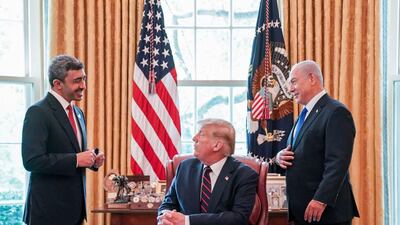
Sheikh Abdullah bin Zayed, UAE Minister of Foreign Affairs and International Co-operation, speaks to Donald Trump, US president at the time, and Israeli Prime Minister Benjamin Netanyahu in the Oval Office in September 2020. Ministry of Foreign Affairs and International Co-operation -
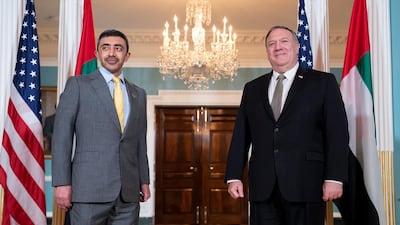
Sheikh Abdullah bin Zayed, UAE Minister of Foreign Affairs and International Co-operation, meets Mike Pompeo, US secretary of state at the time. Wam -
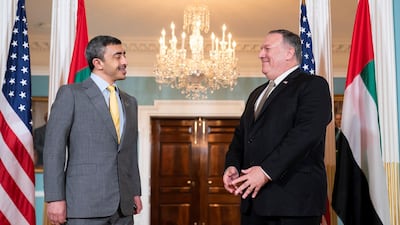
Sheikh Abdullah and Mr Pompeo in Washington. Wam -
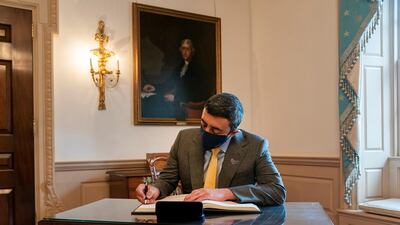
Sheikh Abdullah visits Washington in September last year. Wam -
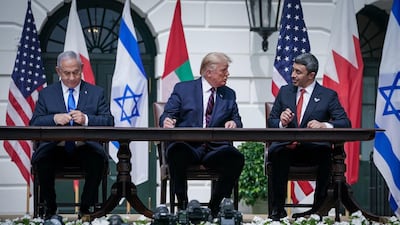
Sheikh Abdullah, UAE Minister of Foreign Affairs and International Co-operation, US President Donald Trump, centre, and Israeli Prime Minister Benjamin Netanyahu sign the Abraham Accord at the White House South Lawn. MOFAIC -
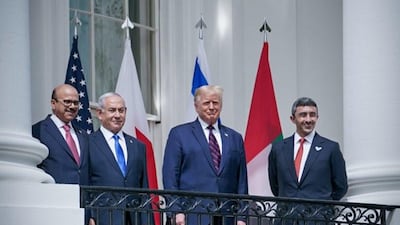
Sheikh Abdullah and, from left, Bahrain's Foreign Minister Abdullatif Al Zayani, Israeli Prime Minister Benjamin Netanyahu and US President Donald Trump at the White House. MOFAIC -
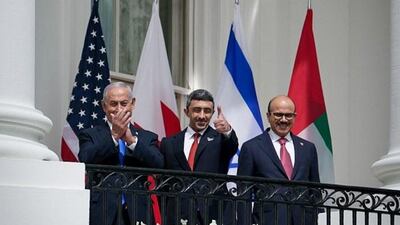
Sheikh Abdullah, Mr Al Zayani and Mr Netanyahu at the White House during the Abraham Accord signing ceremony. MOFAIC -
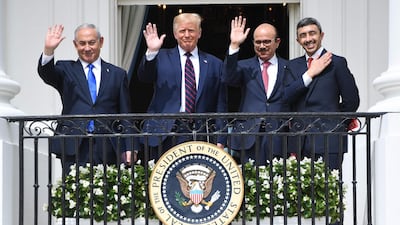
Sheikh Abdullah and, from left, Mr Netanyahu, Mr Trump and Mr Al Zayani wave from the Truman Balcony at the White House. AFP -
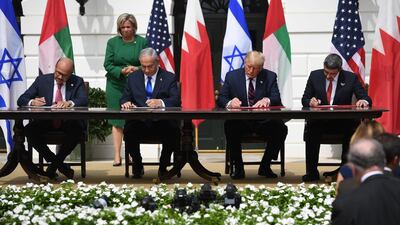
Sheikh Abdullah and, from left, Mr Al Zayani, Mr Netanyahu and Mr Trump sign the Abraham Accord. AFP -
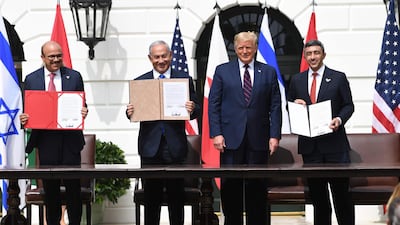
Sheikh Abdullah and, from left, Mr Al Zayani, Mr Netanyahu and Mr Trump after the signing ceremony. AFP -
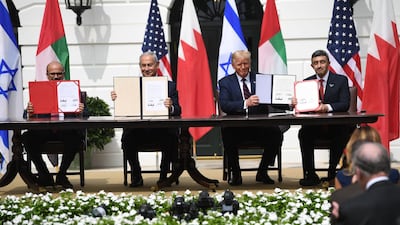
Sheikh Abdullah and, from left, Mr Al Zayani, Mr Netanyahu and Mr Trump after the signing ceremony. AFP -
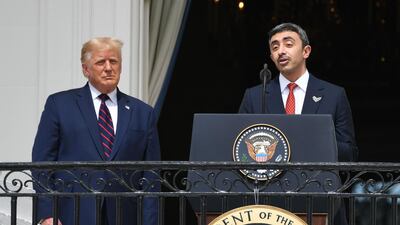
Sheikh Abdullah speaks from the Truman Balcony at the White House during the signing ceremony of the Abraham Accord. AFP -
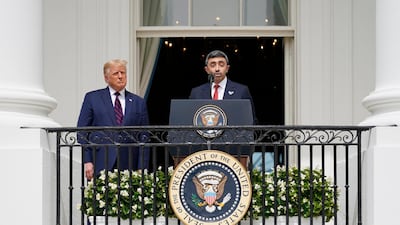
Sheikh Abdullah speaks as Mr Trump looks on before the signing of Abraham Accord on the South Lawn of the White House. AP -
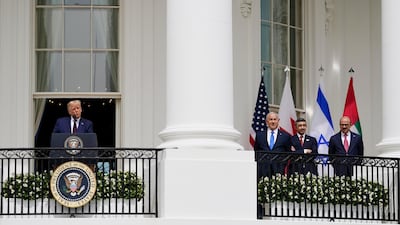
Sheikh Abdullah looks on from the White House as Mr Trump speaks at the Abraham Accord signing ceremony, also attended by Mr Al Zayani and Mr Netanyahu. AP -

Sheikh Abdullah bin Zayed, UAE Minister of Foreign Affairs and International Co-operation, Israeli Prime Minister Benjamin Netanyahu, left, and Bahraini Foreign Minister Abdullatif Al Zayani stand on the Blue Room Balcony during the signing ceremony. AP -
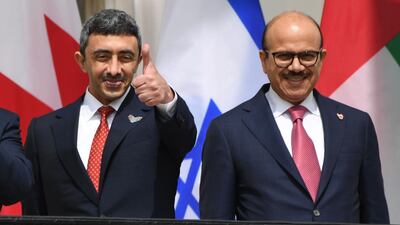
Sheikh Abdullah and Mr Al Zayani shortly before participating in the signing of the Abraham Accord. AFP -
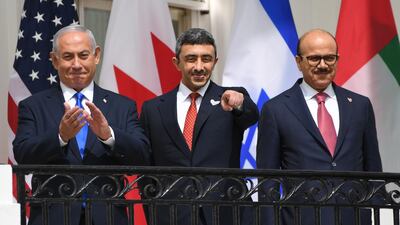
Sheikh Abdullah, with Mr Netanyahu, left, and Mr Al Zayani at the signing of the Abraham Accord on the South Lawn of the White House. AFP -
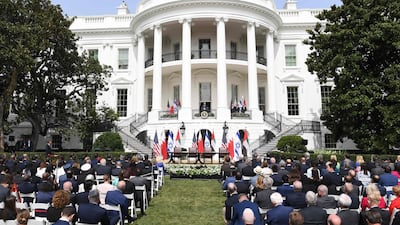
US President Donald Trump speaks from the Truman Balcony at the White House during the signing ceremony of the Abraham Accord. AFP -
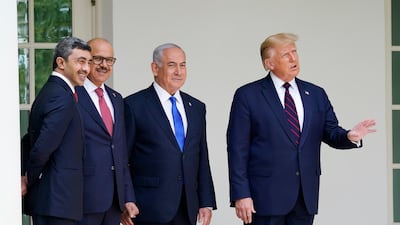
President Donald Trump walks to the Abraham Accord signing ceremony at the White House with Sheikh Abdullah bin Zayed, UAE Minister of Foreign Affairs and International Co-operation, Israeli Prime Minister Benjamin Netanyahu, and Bahrain's Foreign Minister Abdullatif Al Zayani. AP -
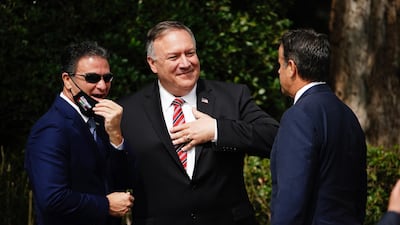
US Secretary of State Mike Pompeo arrives at the White House to attend the Abraham Accord signing ceremony hosted by President Donald Trump. EPA -
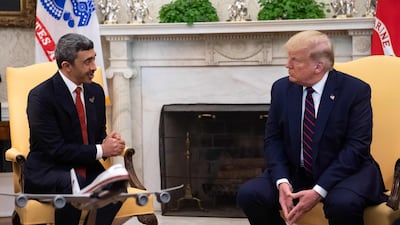
Sheikh Abdullah bin Zayed, UAE Minister of Foreign Affairs and International Co-operation, meets US President Donald Trump in the Oval Office of the White House before the signing of Abraham Accord. AFP -
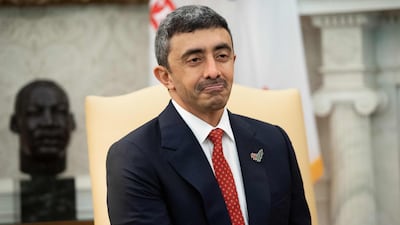
Sheikh Abdullah bin Zayed, UAE Minister of Foreign Affairs and International Co-operation, in the Oval Office. AFP -
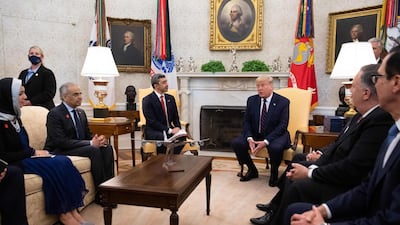
Sheikh Abdullah bin Zayed, UAE Minister of Foreign Affairs and International Co-operation, meets US President Donald Trump in the Oval Office of the White House. AFP -
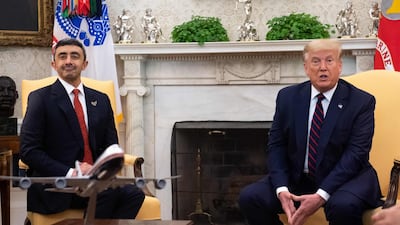
Sheikh Abdullah with Mr Trump in the Oval Office. AFP -
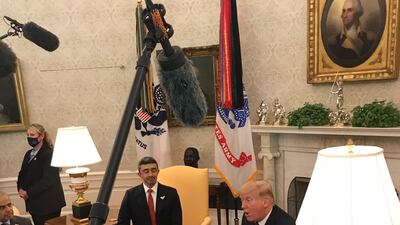
Sheikh Abdullah bin Zayed, UAE Minister of Foreign Affairs and International Co-operation, with by President Donald Trump at the White House. Mustafa Alrawi / The National -
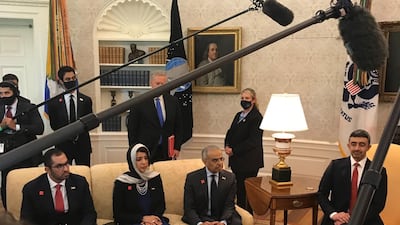
The UAE delegation led by Sheikh Abdullah bin Zayed, Minister of Foreign Affairs and International Co-operation, with US President Donald Trump at the White House. Mustafa Alrawi / The National -
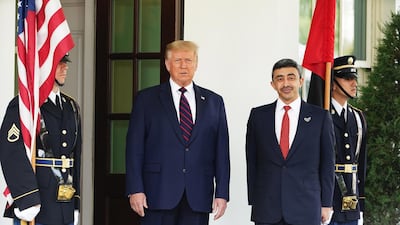
Sheikh Abdullah bin Zayed, UAE Minister of Foreign Affairs and International Co-operation, is welcomed to the White House by US President Donald Trump. EPA -
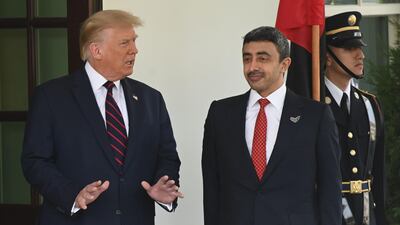
Sheikh Abdullah and Mr Trump outside the White House. AFP -
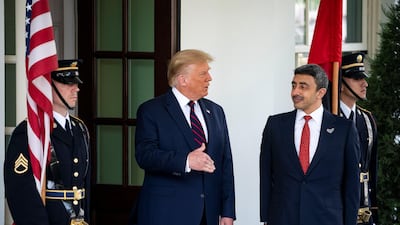
Sheikh Abdullah bin Zayed speaks to Mr Trump after arriving at the White House. Reuters -
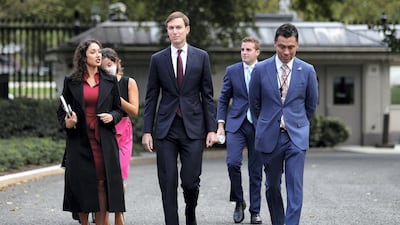
White House Senior Adviser Jared Kushner walks away following a television interview on the North Lawn at the White House in Washington. Reuters -
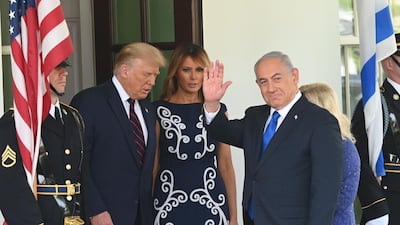
US President Donald Trump and First Lady Melania Trump welcome the arrival of Prime Minister of Israel Benjamin Netanyahu and his wife Sara on the North Lawn of the White House in Washington DC. AFP -
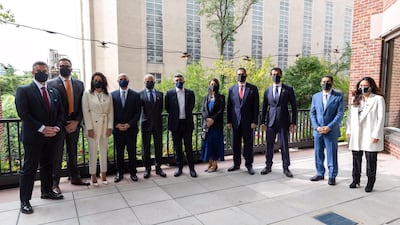
A delegation of senior UAE officials led by Sheikh Abdullah bin Zayed, UAE Minister of Foreign Affairs and International Co-operation, prepares to depart for the White House to sign the Abraham Accord. MOFAIC -
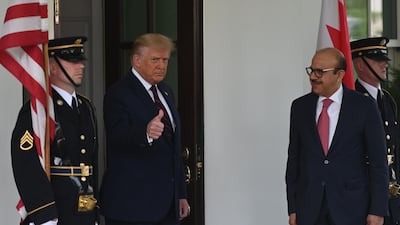
US President Donald Trump welcomes Bahraini Foreign Minister Abdullatif Al Zayani. AFP -

Bahraini Foreign Minister Abdullatif Al Zayani arrives at the White House in Washington DC. AFP -
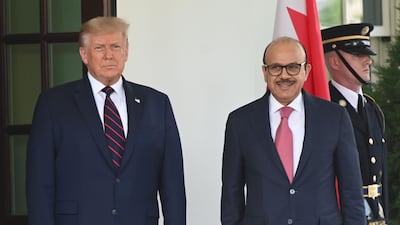
US President Donald Trump welcomes Bahraini Foreign Minister Abdullatif Al Zayani on the North Lawn of the White House in Washington, DC. AFP -
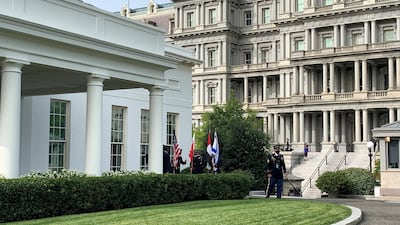
Preparations at the White House for the signing of the Abraham Accord. -
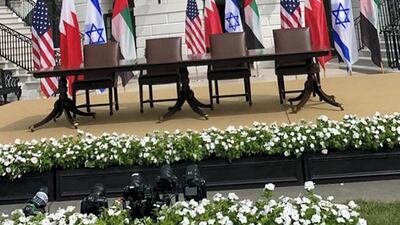
Preparations under way at the White House for the signing of the Abraham Accord. -
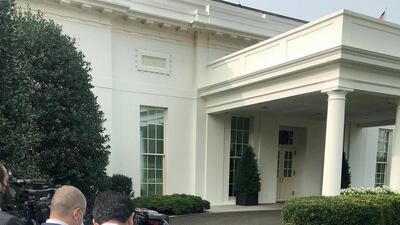
Preparations under way at the White House for the signing of the Abraham Accord. -

Preparation at the White House for the signing of the Abraham Accord. The National


We also welcome the focus of the Strategic Agenda for the Middle East highlighted in the Abraham Accords: the expansion of trade co-operation. This presents vast new opportunities for businesses and scientific collaboration in the region and around the world. As a longstanding friend to both the UAE and Israel, Canada will build upon its strong trade partnerships between both countries in order to continue to put forward to our partners the best that Canada has to offer. With expertise in agriculture and food security, energy and clean technology, health care and emerging technologies such as artificial intelligence, I invite Canadian businesses to seize this moment of opening as an opportunity to diversify and expand their businesses here in the UAE and the region. I look forward to engaging with many of you in the coming months.
Expo 2020 Dubai will be an opportunity for Canada to highlight to a global audience our innovation, culture and values. In the post-Covid context, Expo 2020 Dubai has moved beyond being simply a physical destination to an occasion convening people, businesses and organisations, in-person and virtually. The addition of a virtual facet to the event will permit participation beyond the initially expected 25 million physical participants. We are excited about showcasing Canada’s best in technology and expertise. This is key to accelerating global economic recovery and building a more sustainable, peaceful and prosperous future. With the future in mind, Canada is committed to creating a better future, exploring the next dimension and investing in generating solutions to common issues facing our planet.
Marcy Grossman is the Canadian ambassador to the UAE

