
With Abu Dhabi Festival’s Children’s Biennale now open at Umm Al Emarat Park, I find myself thinking of Antoine de Saint-Exupery's legendary book The Little Prince. This book has many layers, but one of the aspects I have always found compelling is the notion that children have as much to teach us, as we them. This is particularly true with art.
Children look at art unencumbered with self-consciousness, over-interpretation, or social norms. Such freedom deserves our respect.
Abu Dhabi Festival, held under the patronage of Sheikh Abdullah bin Zayed, Deputy Prime Minister and Minister of Foreign Affairs, and the patronage of Sheikha Shamsa bint Hamdan Al Nahyan, has always been keen to innovate and to serve the youth. In presenting the first outdoor Children's Biennale in the Middle East, it aims to give a fertile ground to the imaginations of children, but also to spark family conversations about the shared experience of art. It is Abu Dhabi Festival’s way of celebrating the Year of Family, declared for 2026 by President Sheikh Mohamed.

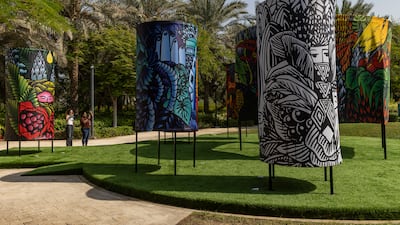
The Children's Biennale, under the title “How the World Feels”, invites families to discover seven new installations by UAE artists, commissioned for the Biennale, alongside Kenangan Kunang-Kunang (Memories of Fireflies) by Indonesian artist Eko Nugroho. It is a beautiful immersive work inspired by traditional Javanese lanterns, presented through Abu Dhabi Music and Arts Foundation's partnership with the National Gallery Singapore.
Every work in the park is designed to awaken children's curiosities and engagements with art through touch, sound, movement and light. Children grasp the world through play. Our curator, Dana Al Mazrouei, and the artists built each work around that. What they have made is most beautiful – although it is not for me to say, but for the children.
Any innovation is something of a leap of faith. With this Children’s Biennale, our faith was well placed. By the time it closes, we expect the Biennale to have welcomed more than 4,500 visitors and over 1,300 students from more than 30 public, private and charter schools. These numbers fill me with joy, not for their own sake, but because I know that each student, each family who visits is a promise. In them, I see our shared cultural landscape grow richer, with the audiences, artists and thinkers of tomorrow.
How? Let’s look at the Children's Biennale’s bigger picture – although I often find myself wondering why art should require any bigger picture to justify itself. After all, a song, a painting, or a lantern glowing among the trees are worth having for their own sake. As an individual, I always feel it is important to remember that there should be such a thing as "Ars gratia artis" (art for the sake of art). As the Founder of the ADMAF, however, it is my responsibility to never apply those aspirations to our own work. We owe it to our partners, our stakeholders, to the youth and artists we serve to do things for a reason. And we do.
The thinking behind the Children's Biennale is quite simple: with the extraordinary constellation of museums Abu Dhabi has today, the third sector has a duty to build as many pathways as possible leading to the halls of the Zayed National Museum, the Louvre Abu Dhabi, teamLab Phenomena and very soon Guggenheim Abu Dhabi.
The Biennale takes art out, into a place children already know and love, where families come to walk, to rest and to play, and where art, beside a shaded alley or among the trees, becomes part of everyday life. It is not the museum. Simply a preamble to it: a path in the park can become the first step towards the Louvre Abu Dhabi.
Art is a shared experience. The park we chose – Umm Al Emarat Park – says exactly that. It carries the name of Sheikha Fatima bint Mubarak, Mother of the Nation, whose life's work has been the family and the child. As this park marks a milestone, over a decade bringing families and children together, our Children's Biennale could only be here. As it brings art closer to children and families, it tries to be worthy of Sheikha Fatima's legacy.
Of course, as the Children's Biennale creates a new pathway for children towards art, one must honestly ask the question: why is it so important that children be exposed to and educated in art? Let's travel to Houston, Texas to find an answer. There, 10,000 pupils in schools chosen by lottery received more arts education. In that group, writing improved and children showed more empathy, while disciplinary problems fell. These additional arts education classes take nothing away from other subjects: results in mathematics, reading and science remained unchanged. They may even give something to science. Einstein, himself a violinist and pianist, once remarked that "the greatest scientists are artists as well". How right he was: Robert Root-Bernstein's research shows that Nobel-winning scientists are nine times more likely than the typical scientist to have trained in crafts or the fine arts.
So yes, this Biennale – as most art initiatives for children – is useful. It is backed by science. But I will always find its true usefulness in the words of the Little Prince. He meets a lamplighter who, alone on his planet spinning faster and faster, keeps on lighting and putting out his lamppost. Of this work, the Little Prince says: "Since it is beautiful, it is truly useful." Whether it is a lamp on a small planet or Javanese lanterns in Umm Al Emarat Park, I too find it truly useful, since it is beautiful.