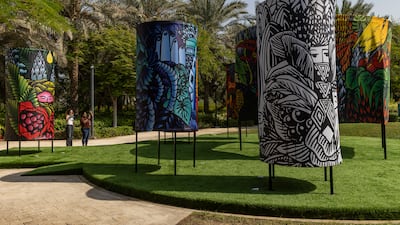

Brightly coloured hexagons stand among the greenery, the shapes inspired by beehives. Elsewhere, colourful ribbons hang from a constructed wishing tree, inviting visitors to write down their hopes and tie them to its branches.
They are among the installations that can be found at the Children's Biennale, which opens on Friday at Abu Dhabi's Umm Al Emarat Park. Unlike a traditional art exhibition, this one encourages children to touch, play, explore and even help shape the artworks in front of them.
Presented by Abu Dhabi Festival under the theme "How the World Feels", the month-long outdoor event brings together artists working across sculpture, textiles and interactive installations, all designed with children in mind.

For curator Dana Almazrouei, the aim was to create an exhibition where children can interact with art rather than simply look at it from a distance.
"The ability to touch sculptures, kids don't get that chance in contemporary art," she says. "They're always told to keep their hands behind their backs or look at artworks with their eyes, not with their hands, and that is so hard. It's really difficult to actually interact together."

Almazrouei has spent more than a decade exploring how children and families engage with culture. With a doctorate in museum education, she has previously curated past editions of the Sharjah Children's Biennial. For this event, she wanted to give children the freedom to make their own discoveries, rather than follow experiences determined by adults.
"When you see kids play together, they create their own worlds, right? And they create their own narrative. There are no adults dictating that story. They just do it themselves," she says.
While developing the biennale, Almazrouei visited Umm Al Emarat Park to consider how children might experience the space and what would encourage them to stop and explore rather than simply walk through it.
"The promenade is just a means of access," she says. "It's a place that you go through and you leave, but where do we pause and look at things?"
That thinking also influenced which artists were invited to participate. She wanted those willing to consider how children would interact with their work, even if it meant they would be broken or destroyed.
The free rein is evident in Common Thread, Common Ground, an installation by Egyptian artist Hana El-Sagini. Its large sculptures resemble coral, rocks and bones, with ropes that children can braid, twist and tie together, changing the artwork as they play.

Creating such experiences required discussions about everything from materials and safety to whether parents would feel comfortable allowing their children to engage with the installations.
"The process was challenging because we had to wear so many hats," Almazrouei says. "As an educator, I would think about: what would they learn? How will they learn? How will they be engaged? Is it engaging enough?"
Art without instructions
For Palestinian-American artist Sarah Afaneh, allowing children to develop their own interpretations is central to her work, The Patient Land, The Gracious Sun, The Enchanting Sea.
The three woven tapestries draw on natural elements that frequently appear in children's literature, with the sun representing warmth and hope, the land offering care and nourishment, and the sea encouraging curiosity.
Afaneh says the idea came partly from her love of reading and the symbols that stayed with her from childhood, as well as her experiences of spending time outdoors.

"When you're a kid, or when I was a kid at least, you learn a lot by being in the park, or being in the sea," she says. "You learn a lot about how to move through the world and how to ground yourself in the world from nature itself."
Rather than telling children what each tapestry represents, she hopes they will develop their own stories. "I want each different kid to come up and see this and have a different story in mind," she says. "What is a story without words?"
The installation includes an interactive weaving area where children can use yarn to create their own contributions. Afaneh will also continue weaving one of the tapestries throughout the biennale, allowing visitors to watch the work evolve.
Learning from nature
Emirati artist and chef Moza Almatrooshi has spent several years developing the ideas behind her installation, which explores the relationship between bees, biodiversity and traditional beekeeping practices in the UAE.
Her installation, The Agriculture School – The Pollinators Play Museum is inspired by bees and how they experience the world. Its brightly coloured hexagonal structures draw on the shape of beehives, while plants and palm fronds connect the work to the surrounding park. "The installation actually has been brewing in my mind for the last three years," she says.

A certified beekeeper herself, Almatrooshi spent time learning from local beekeepers and researching traditional honey harvesting in the Hajar Mountains as part of the project.
When the children's biennale was announced, the opportunity aligned with her original vision to always have artwork in a park for children.
Her installation invites children to explore how bees see, communicate, forage and build through colour, form and sensory experiences. Workshops also allow them to create artworks that can be displayed within the hexagonal structures. And the experience shouldn't be about memorising facts, says Almatrooshi, but rather "just a sense of wonder".
The installation is also designed to be temporary, with log hives returning to the beekeeper, plants to the earth or park, and wooden elements recycled.
Seeing the world as a child
For Palestinian creative practitioner Nada Almosa and UT-R Studio, founded by Tasnim Tinawi and Uthra Varghese, designing for children meant considering not only what they might do, but how they would physically experience the work.
Their installation, Where Wishes Grow, explores the past, present and future through three interconnected structures.

A flower-shaped table invites visitors to write down memories of parks, while a blossoming shrub holds artworks children created while exploring their relationship with green spaces. A wishing tree encourages visitors to write down their hopes for parks and tie them to its branches.
Almosa says the intention was to put children's voices at the forefront, allowing them to express their own experiences rather than having adults speak for them. The installation also changes as more visitors contribute.
"There are a lot of elements that children can add to this installation over time, and it just becomes something that grows thanks to their contributions throughout the biennale," says Tinawi.
For Varghese, one of the biggest considerations was scale. Although UT-R Studio has experience creating outdoor public art, this was its first installation specifically designed for children.
"One of the main things was size, like everything is much smaller, like the height of the wishing tree, the height of the shrub," she says. "It's not practical for an adult to view those things. You really have to bend, but that's the point.”

For Almosa, what makes the event different is that children aren't simply being accommodated, but they are at the centre of the experience.
"What I think is very important and that differentiates the Children's Biennale from other art fairs or exhibitions is that it's not just 'oh, we're making space and accessibility for children', but it's actually just for them. It's about them," she says.
That emphasis on giving children a space of their own is particularly meaningful to Almosa. "I wish we had these kind of events and spaces when I was a child," she says. "If we had these types of experiences and spaces as children, we would be better empowered and inspired to pursue creative work."
The Children's Biennale is on at Umm Al Emarat Park in Abu Dhabi until December 6

