
The story of the Environment Agency – Abu Dhabi began long before its establishment. Its roots lie in the vision of the UAE’s Founding Father, the late Sheikh Zayed bin Sultan Al Nahyan, who believed that human prosperity and the health of the natural world were inseparable, and that protecting the environment was a responsibility owed to future generations.
Long before sustainability became a global priority, Sheikh Zayed recognised the environment not simply as a resource to be used, but as a legacy to be safeguarded for future generations. He understood early on that a nation’s progress is measured not only by what it builds, but also by the natural resources it preserves and its ability to balance the needs of the present with the rights of generations to come.
He understood early on that a nation’s progress is measured not only by what it builds, but also by the natural resources it preserves and its ability to balance the needs of the present with the rights of generations to come. At a time when environmental issues were only beginning to emerge on the global agenda, he was already taking pioneering steps to protect wildlife, plant trees, establish protected areas and launch breeding programmes for endangered species.
The establishment of the EAD in 1996 transformed this vision into an enduring institutional commitment and reflected a philosophy of governance rooted in the belief that natural resources are a trust. Over three decades, the agency has demonstrated that environmental protection and economic development are not competing priorities, but complementary foundations of a prosperous future.
These achievements have been more than figures on a page. They tell stories of lasting significance on land and at sea. The agency has become a leading environmental institution, regionally and globally, helping to protect biodiversity, restore ecosystems, expand the network of protected areas, improve air and water quality and manage natural resources in line with scientific best practice.
The Zayed Protected Areas Network, for example, now encompasses 24 terrestrial and marine protected areas; 100 new invertebrate species have been recorded in the emirate for the first time. The Sustainable Fishing Index rose from 8.9 per cent in 2018 to 100 per cent in 2025, while the air quality monitoring network has expanded to 22 stations. The Groundwater Atlas has documented close to 117,900 wells. The agency has also strengthened Abu Dhabi’s standing as a global platform for environmental dialogue and a trusted partner in addressing the environmental and climate challenges facing the world.
The science underpinning these achievements is a key factor in their success. One example is the conservation of the houbara bustard. In the mid-1980s, the specialised scientific knowledge available today did not yet exist, and there were no established models to follow. The agency faced many challenges, but its commitment to protecting this bird was stronger than the challenges. We learnt as much from nature as we did from our laboratories and came to understand that protecting endangered species requires patience and determination as much as it requires science.
-

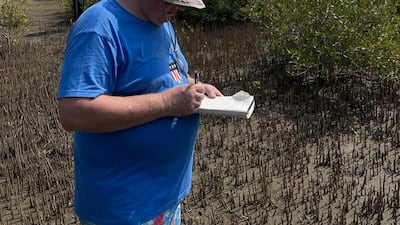
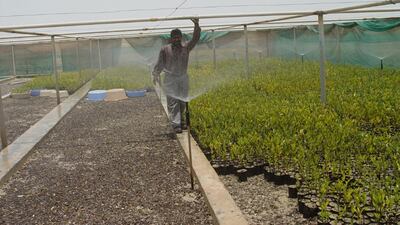
Australian researcher Ronald Loughland moved to Abu Dhabi in 1993 as a PhD student who went on to study the mangroves along the Arabian coast. All photos: Dr Ronald Loughland -
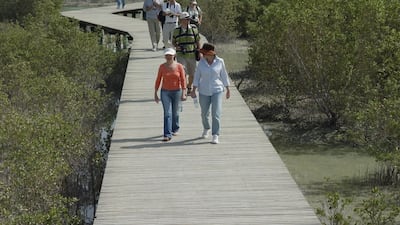
Dr Loughland, 60, has worked as an environmental consultant for 30 years and claims to have planted millions of mangroves in Abu Dhabi in the 1990s -
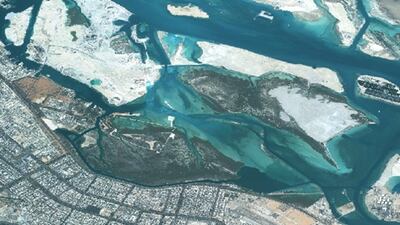
Dr Loughland was one of a handful of start-up staff at the Environment Agency Abu Dhabi who did the initial surveys on the flora and fauna of Abu Dhabi -

Mangrove forest areas in Abu Dhabi were increasing in the 1990s at a time when the tropical wetland plants were being destroyed globally, Dr Loughland said -
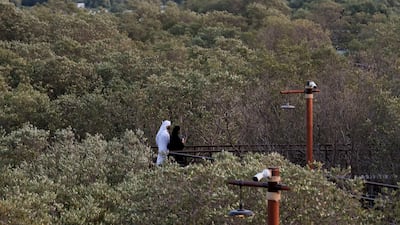
Dr Loughland said he witnessed first hand the keen interest in ecological conservation taken by the UAE's Founding Father, the late Sheikh Zayed bin Sultan Al Nahyan -
Part of Dr Loughland's research involved the study of satellite imagery and understanding changes in mangrove vegetation -

Dr Loughland was also involved in training local students in planting techniques and studying mangrove species and characteristics -

Dr Loughland says he believes Abu Dhabi is on track with its plans to plant 100 million mangroves by 2030


Today, the progress made in breeding houbara and releasing them back into their natural habitat demonstrates that investment in science is the most sustainable investment we can make. When determination is supported by knowledge, even the most difficult challenges can become inspiring success stories. The lessons of this experience have become integral to the approach the EAD takes across its programmes and initiatives.
The achievements of the past three decades give us reason for pride, but they also bring greater responsibility. The world faces unprecedented environmental challenges, from climate change, biodiversity loss and declining natural resources to the mounting pressures of population growth and urban expansion. Addressing them requires us to continually improve the tools we use and move from responding to problems after they arise to anticipating them before they escalate.
The past three decades have established firm foundations for environmental action based on science and partnership. The next phase calls on us to build on this legacy with more advanced tools and a greater capacity to anticipate change and make informed decisions.
We are ready for a future founded on knowledge, data and innovation. Artificial intelligence, alongside other advanced technologies, will play a central role in reshaping environmental action in the years ahead. Already, we can interpret environmental indicators with greater precision, predict risks before they materialise and detect changes in ecosystems before they develop into crises. These capabilities enable us to make scientific decisions that are more decisive and effective.
Our 30th anniversary is an occasion not only to celebrate our achievements but also to renew our commitment to this enduring legacy. We will continue to build upon it with greater ambition, guided by science and driven by innovation. The EAD will remain true to the principles established by Sheikh Zayed: respecting nature, embracing science and working together to ensure that future generations inherit a nation that is more prosperous, balanced and sustainable. Protecting the future is not a responsibility for tomorrow; it is a commitment we must uphold every day.