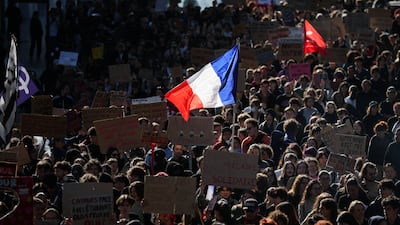

Last week, on my way through the Latin Quarter, a neighbourhood in Paris, I passed the gates of Lycee Henri-IV. It is one of the most elite schools in France, the kind of place that produces philosophers, scientists and presidents – the equivalent of getting into Harvard or Yale universities, but for high-school students. A cluster of teenagers in hoodies stood outside holding signs. They were very young and very annoyed.
Today, near Boulevard Raspail, I came across more students. “If we are old enough for you to use violence against us, we’re old enough for you to listen to us,” said a 17-year-old marching through the leafy district of the French capital.
Violence has not reached this wealthy neighbourhood bordering the Jardin du Luxembourg. But students at the Institut Catholique, which Pope Leo XIV visited two weeks ago, are joining in solidarity and resistance against President Emmanuel Macron’s government, calling for change.
The protests began on September 21 at Lycee Saint-Exupery in Creteil, a suburb in the Val-de-Marne, south-east of Paris. Many other schools in the Ile-de-France region quickly joined, followed by Marseille, Lille, Rennes and Strasbourg. As the days pass, the students’ demands have grown. At first, the protests were about the lack of resources in public schools: teacher shortages, classes of 35 or more, leaking buildings and long days that start at 8am and run into the evening.
Now the rallying cry is about a generation that feels unheard and is inheriting a dysfunctional world it did not create.
I have spent three decades watching young people take to the streets: in Cairo, in Aleppo, in Belgrade, in Ramallah, in Kyiv. Some, like in Belgrade, were successful – the students overthrew Slobodan Milosevic. My first year as a new mother in France, 2005, brought the riots triggered by the electrocution of two teenagers. They later spread across the country’s suburbs, with burning cars and real violence. The deaths of the teenagers were the trigger, but the real causes were unemployment, discrimination and broken relations with the police.
The first thing I learnt about the protests in France is that the stated grievance is rarely the whole story. What is happening now is no exception. The French are exceptional at protesting. Their protests are effective, and the protesters know they work. The country has a culture of dissent that goes back to the French Revolution, and taking to the streets is seen as a civic duty rather than a disruption. That legacy runs through May 1968, when a general strike drew in between seven and 10 million workers. It all began with a handful of students at Nanterre, whose early grievances included dormitory rules.
The grievances behind this latest movement should embarrass the government. On October 1, according to the Interior Ministry, 1,027 of France’s roughly 3,700 lycees were affected, 222 of them blockaded. Bins burned in Toulouse and Rennes. There was tear gas in Strasbourg and Lille, and a school in Nantes was firebombed. The Justice Minister, Gerald Darmanin, says about 2,000 people have been arrested since the movement began, the majority of them minors. More than 400 schools were closed the following day. The student who lives with me and studies at Institut Catholique just came home disgruntled because protesters were blocking the streets.
The government’s response is predictable: condemnation, a crisis meeting, protest bans outside closed schools. Next come the endless TV and radio shows looking for a scapegoat. Prime Minister Sebastien Lecornu’s office called it a manoeuvre organised by La France Insoumise, the hard-left party. LFI’s Manuel Bompard replied that the government was sliding into conspiracy theory. Bally Bagayoko, the LFI mayor of Saint-Denis and France’s answer to New York City’s Zohran Mamdani, put himself between riot police and students and was tear-gassed for it, an amazing moment caught on camera and widely shared this week.
Remember that all this is happening in the run-up to a presidential election that fills most of us with dread. Mr Macron, whom I voted for, is on his way out. He is barred from running again next May, because Article 6 of the Constitution limits a president to two consecutive terms.
-
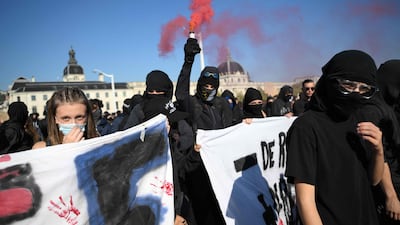
A protester lights a flare during a demonstration by French youths, part of a nationwide protest movement over education conditions, in Lyon. AFP -
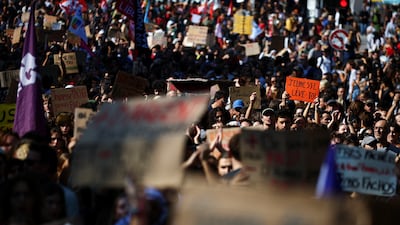
French high school pupils and university students attend a demonstration in Marseille. Reuters -
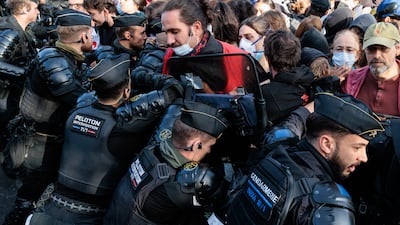
French riot police intervene in Paris during a national day of protest. EPA -
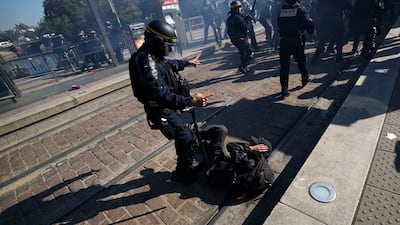
Police and activists clash in Strasbourg. Reuters -
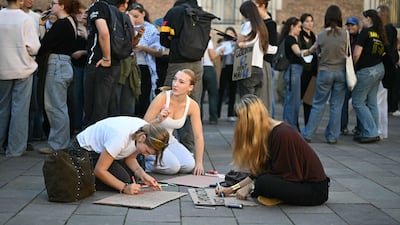
Students prepare placards before a demonstration in Toulouse. AFP -
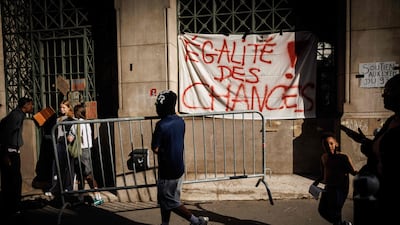
Preparations for a protest outside a high school in central Paris. AFP


Personally, I like Mr Macron, but I’m in a minority. He is credited with being strong on foreign policy, less so on domestic issues. Meanwhile, the National Rally, the far-right party founded by the late Jean-Marie Le Pen in 1972, is on the rise. With Mr Macron close to the end of his term next year, the RN believes the Elysee is finally within reach. Jordan Bardella, its 31-year-old president, has spent years cultivating young voters even as he faces allegations, which he strongly denies, of anti-Semitic messages from the 2010s.
LFI is finding a niche, particularly among the young. It’s no coincidence that the protests came to a head in the same week the government unveiled a budget built on spending cuts and tax rises to bring down France’s deficit. The teenagers did not miss the timing, and neither should we.
“Most of all, we’re fed up with the high cost of living,” an 18-year-old political science student told me. She ran through the cost of food, cell phones, metro transport and drinks in a cafe. It’s not Manhattan or London, but salaries in France are lower.
I expect the protests to be put down fairly soon, but it will be telling to see who benefits most. Marine Le Pen, daughter of Jean-Marie, blamed LFI for stoking the unrest, and her officials have demanded damage reports and crisis meetings. RN supporters aren’t on the streets, and they don’t need to be. They are content to watch France lose control of its schools and its young. This plays nicely into the party’s education platform, which promises a “big bang of authority”: phone bans, uniforms and sanctions that reach families’ benefits.
They are standing back, watching the left fall on its face.

It remains to be seen whether the RN will win young supporters once the protests actually end. But the real story here is generational, and it began long before the protests.
In 2023, Mr Macron forced through pension reform raising the retirement age from 62 to 64. Millions marched against it, many of them young people who saw that the changes meant they would have to work longer. I remember watching French TV and being amazed how many young people were protesting against pensions. But they saw it as their future being crushed. France’s wealth sits disproportionately with older owners of property and savings. Its debt, and now its austerity, will fall on the young.
Whether French teenagers are reading budget tables and spread sheets, or not, they do understand that their classrooms are cold because a radiator has not been fixed for a year. They do understand that their teachers are exhausted and cannot give them the time or attention they need. They do understand that they are being handed a world threatened by war in Eastern Europe, with Russia’s latest hybrid war, a mounting national debt and high unemployment for recent graduates.
Mr Macron came to power in 2017 as the young man who would modernise France. It was his youth that attracted so many of us: youth and energy which the older politicians lack. But he is leaving office a middle-aged weary man with teenagers in the streets demanding a better world.
At the very least, he has to listen to them before deciding who to blame.