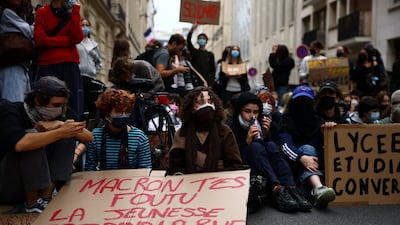

The French government has made a series of conciliatory moves towards a student protest movement amid public uproar over police violence during demonstrations.
Several teaching unions on Wednesday called for another day of action on Thursday, while Prime Minister Sebastien Lecornu said the “voice of high school students is precious and must be heard” and would feed into “a concrete action plan”. He said dialogue would be held in every school, but must come with pupils returning to class.
After weeks of school blockades, protesters took to the streets across the country for the first time on Tuesday, with 266,000 participants, including 56,000 in Paris, the Interior Ministry said. They largely featured secondary school pupils, university students, teachers, parents and left-wing political representatives. Some protests ended in violence, with 488 arrests and 43 injured among security forces as police resorted to using tear gas.

French schools are blighted by dilapidated infrastructure, including overcrowded classrooms, inadequate heating and cooling systems and collapsing ceilings.
France has a high number of pupils per class – 29 compared to an average of 26 in the Organisation for Economic Co-operation and Development – and among the longest hours due to a condensed teaching schedule, with longer holidays. School days start at 8am and end at 6pm, often with gaps during the day.
Yet the cabinet has little leeway to respond with financial incentives, as tough parliamentary debates on the budget begin this week. State expenditure to service the national debt surpasses what is spent on education.
An online consultation platform has now been launched alongside a promise to simplify complicated university application procedures.
The government has suggested a half-day of dialogue is held in secondary schools, a proposal rejected on Wednesday by the main union for school principals, which supports the protest movement, along with a number of other workers' unions. The school principals' union called for more resources and teachers.
Some school and university blockades continued on Wednesday, including at Sciences Po University in Paris, where police dispersed people with tear gas.
However, 86 per cent of schools were operating normally, according to Education Minister Edouard Geffray.
Speaking to RTL radio, Interior Minister Laurent Nunez said he has banned the use of stun grenades after a 15 year old had his hand blown off last week.
“For the moment, I am suspending its use – only for the high-school student movement – for the time it takes to understand what happened,” Mr Nunez said.

'Life stolen'
Student protests are not new to France but the level of violence in recent clashes with police has shocked the public. Former political leaders, including then-president Nicolas Sarkozy, urged police to avoid physical confrontation with teenagers during 2006 protests.
Some parents, who joined student demonstrations wearing white bands round their arms, said they were there to protect their children from the police. The mother of the teenager who had his hand blown off has rejected rumours he had tried to pick it up to throw at security forces. “His life was stolen from him, it's over – he no longer has a hand,” she told BFMTV.

Mr Lecornu has blamed hard-left political party France Unbowed for stirring the crisis. Speaking in parliament on Tuesday, he rejected the phrase “police violence,” saying it “would suggest that there are political instructions for police repression”. He said the police response had been proportionate despite some “accidents”.
'Show empathy'
Mr Nunez defended security forces, highlighting violent attacks by protesters against them, which have left hundreds injured.
“It’s not simple when you have some people telling you we’re too soft, that we aren’t being forceful enough, that it’s chaos and things are getting out of hand everywhere, while others tell you the police are intervening with extreme brutality and violence,” he said.
-
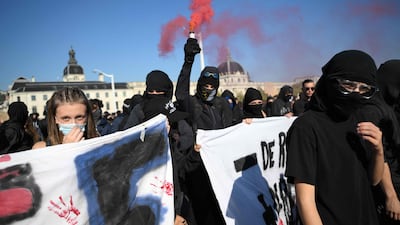
A protester lights a flare during a demonstration by French youths, part of a nationwide protest movement over education conditions, in Lyon. AFP -
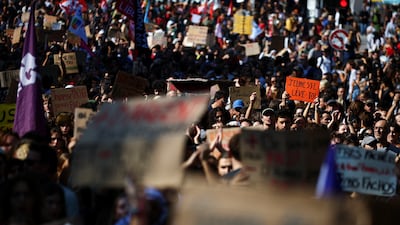
French high school pupils and university students attend a demonstration in Marseille. Reuters -
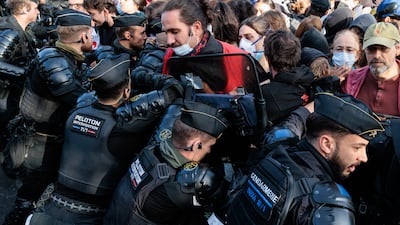
French riot police intervene in Paris during a national day of protest. EPA -
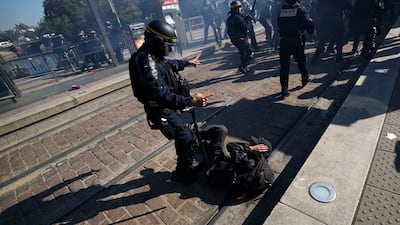
Police and activists clash in Strasbourg. Reuters -
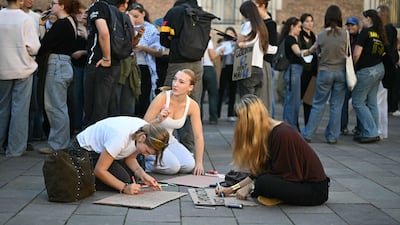
Students prepare placards before a demonstration in Toulouse. AFP -
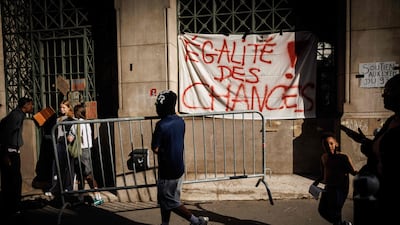
Preparations for a protest outside a high school in central Paris. AFP


In a signal of the urgency of the situation, Mr Nunez was among the ministers convened on Tuesday evening at the Elysee Palace by President Emmanuel Macron, who for the first time held a meeting with a restricted number of ministers to address the student movement.
Mr Nunez said Mr Macron had asked his ministers to “do a bit more explaining” and to “show empathy”.
“Above all,” Mr Nunez said, the President asked them to “explain our doctrine regarding interventions by security and internal affairs forces – specifically, when serious violence occurs.” He added “there is no reason for police intervention” as long as “protests are peaceful”.