
Tens of thousands of young people took to the streets of France on Tuesday as protests persisted across the country following weeks of violent clashes near schools.
Protesters spoke of anxiety about the future, fear of worsening social inequality and a feeling of being ignored by a generation of politicians that benefitted from the post-Second World War economic boom.
“We are neglected. We are abandoned,” 18-year-old Elisha told The National in Paris. “We are a generation facing war, conflict, and precariousness, with no safety net to fall back on.”

Organised demonstrations were largely peaceful by midafternoon in Paris, Marseille, Nantes and Toulouse. Scenes in Strasbourg, Lyon and Rennes turned far more violent, with police firing tear gas and protesters lighting fires in the streets and hurling projectiles.
An estimated 200,000 people took part in protest marches around the country on Tuesday, Interior Minister Laurent Nunez said. An afternoon protest in Paris attracted 56,000 participants.

Speaking to France Inter radio earlier in the day, Mr Nunez described the recent clashes as “urban violence” and backed the police's tough response which he described as “proportionate” in the vast majority of cases.
The view from a central square in Paris was that school pupils students had the right to demand change. Elisha, a student at Pantheon-Sorbonne University, criticised politicians who had access to cheap housing and easy access to the labour market and failed to understand her generation's anger.
“They’re cutting our housing benefits – which are going to be frozen – and taking away our scholarships. Young people no longer have access to anything. It’s a disaster.”
'Black Tuesday'
Juliette, 17, lambasted a political class more preoccupied about France's reputational standing in the world than young people's future. “No one else is doing anything, so we’re stepping up and taking action because things need to change,” she said.
Referring to France's ballooning debt crisis, her friend Mai-Lan, deplored that “young people are inheriting an indebted France”.
Both girls attend Lycee Victor Hugo high school in the upmarket third arrondissement of Paris. “We are privileged but we're also here to defend students from less privileged areas in the suburbs,” Mai-Lan said.
The street demonstrations, organised by student unions and teachers after weeks of protests at schools, were dubbed “Black Tuesday”.
-
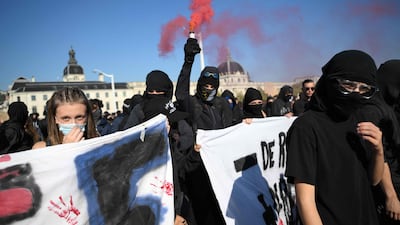
A protester lights a flare during a demonstration by French youths, part of a nationwide protest movement over education conditions, in Lyon. AFP -
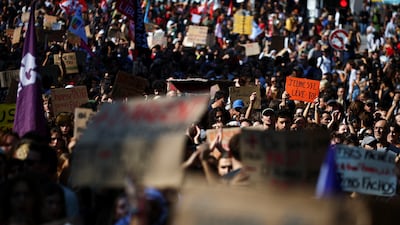
French high school pupils and university students attend a demonstration in Marseille. Reuters -
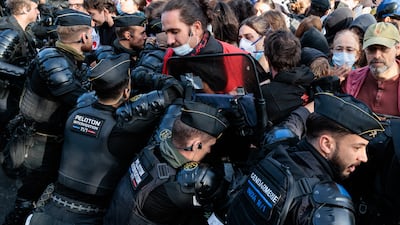
French riot police intervene in Paris during a national day of protest. EPA -
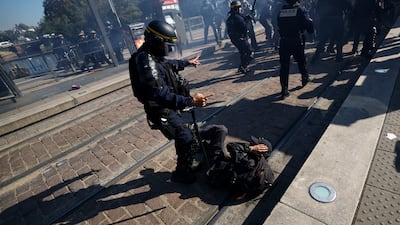
Police and activists clash in Strasbourg. Reuters -
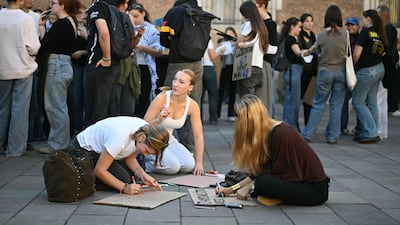
Students prepare placards before a demonstration in Toulouse. AFP -
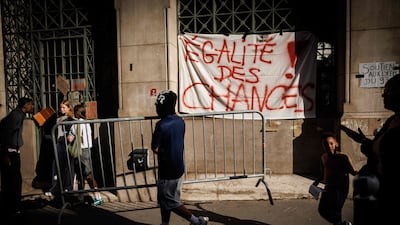
Preparations for a protest outside a high school in central Paris. AFP


The High School Students Union said more than half of France's secondary schools were blockaded or would close for the day. Some local education authorities tried to move classes online.
The protests started in a Paris suburb in mid-September in solidarity with a teachers' strike over a lack of staff and resources. They rapidly spread to schools across the country, with pupils complaining about dilapidated infrastructure and overcrowded classrooms.
The level of violence during some clashes with the police has shocked sections of the French public and divided opinion. Masked people, including adults, have attacked teachers and school employees and set buildings ablaze.
A 15 year old lost his hand and at least two other 16 year olds have suffered permanent eye damage apparently due to the police response and control methods.
Mr Nunez said the teenager losing his hand was a “tragedy” but added the police response has been overwhelmingly proportionate. “It is only natural that police officers and gendarmes have access to the full range of intermediate weapons at their disposal – provided they use them within a legal framework,” he said.

Ten separate investigations have been launched by the National Police Inspection Service, suggesting suspicion of excessive force by officers in some cases. About 6,000 protesters have been arrested since the protests started, and around 715 police personnel have been injured.

