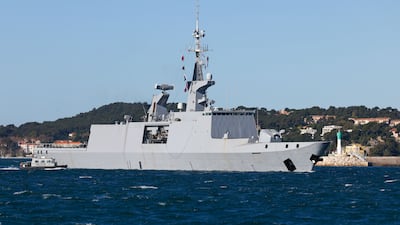

French warships and minehunter drones are at “a very high readiness” for deployment to the Arabian Gulf, a French admiral has told The National.
Rear Admiral Remi Thomas said France already had mine-countermeasure vessels and autonomous systems “ready to go now” for operations in the Middle East.
French sea drones are already aboard the British Royal Fleet Auxiliary Lyme Bay, which has been converted into a mother ship for unmanned minehunting systems.

“We have two minehunters ready to not only be deployed but ready to operate in the Middle East, and we have also drones embarked on board Lyme Bay,” said RAdm Thomas, who also acts as the French navy’s chief of staff for plans and programmes.
RAdm Thomas was speaking before the Euronaval exhibition taking place in Paris next month and as the Iran war has shown few signs of ending.

France has also positioned frigates in the Middle East and is prepared to maintain a permanent naval presence when the US and Iran have found a workable peace agreement, he said.
Iran is said to have laid dozens of mines during the conflict, while merchant shipping remains vulnerable to missiles, drones and fast-boat attacks.
It will also be announced in the coming days that the French navy has launched a tender to charter two vessels to serve as mother ships for its growing number of surface and submarine drones.

Brig Gen Francois Watteau, who is in charge of international naval projects at the defence procurement agency, said France would order an additional 12 unmanned surface vessels to help with mine-clearing operations.
“What we are currently facing is a need in very quick time for a solution for mine warfare,” he said. The officer described the system as a mine countermeasure “toolbox” developed with Britain and similar to the Lyme Bay system, which will be operational for up to 10 years with deployments to the Middle East.

The security situation around the Strait of Hormuz remains volatile. Despite the return of commercial traffic in recent months, there have been seven attacks on commercial vessels in the past week.
The minesweeping force could be used to help clear any mines planted in the Red Sea with the rebel Houthis said to have the potential to lay the devices.
The fleet will also operate in the Arabian Sea off Oman on the approach to the Strait of Hormuz that is currently heavily used by oil tankers.
Britain and France have also formed a “coalition of the willing” to build a multinational mission to support freedom of navigation and clear mines. In May, 38 countries gave political backing to the proposed operation.
RFA Lyme Bay has already been sent to the Middle East with more than 270 sailors, including more than 100 Royal Navy mine-warfare and explosive-ordnance specialists. The Type-45 destroyer HMS Dragon is also in the Indian Ocean to assist with air defences and reassure commercial traffic when the Strait of Hormuz fully reopens.
Working together, the Anglo-French Maritime Mine Counter Measures programme has developed a system where unmanned surface vessels tow high-resolution sonar systems to search for mines. Once discovered, they deploy remotely operated vehicles to identify and destroy them.
At least 10 European Nato countries will contribute to the mission, including Germany, the Netherlands and Belgium. Each has traditional mine-sweeping ships that will be deployed when there is a “permissive environment” in the waters.