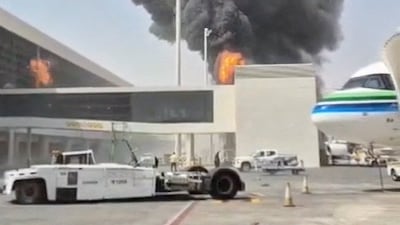

Airports are being forced to rethink how they protect passengers and keep flights running as missile and drone attacks pose an increasingly serious threat to civilian aviation, industry experts have warned.
Repeated attacks by Houthi rebels in Saudi Arabia, alongside months of disruption caused by the war in Iran, have exposed the vulnerability of airports to modern warfare and the difficulty of maintaining operations during prolonged security crises.
Industry leaders gathered at the Dubai Airport Show on Monday said airports were investing in new technology and contingency planning to withstand threats from military strikes to cyber attacks, while acknowledging that no facility could ever be completely secure.

Tim Walder, chairman of the British Aviation Group, said the changing nature of global conflicts had created unprecedented challenges for airport operators.
“What we’re seeing today is a completely different set of challenges being faced geopolitically,” he said. “Resilience isn’t something that’s 100 per cent, it’s always going to fail on occasions, but we learn faster.
“The key thing is the airport can be a leader in terms of understanding where the threats can come from, such as cybersecurity and climate change.”
Crisis support
Mr Walder, whose company offers expertise on meeting the challenges of the global aviation industry, said supporting passengers during a crisis was critical to retaining confidence.
“If something goes down, you lose passenger confidence and you can lose that for a long time,” he said. “Cyber-attacks are obviously high up there when talking about risk and we are seeing different levels of that.
“A few months ago in the UK and Europe, hackers attacked the software that supports the check-in process and that impacted a number of airports in Europe, including London and Brussels.
“These attacks aren't going to be just necessarily hitting an individual airport or airline, they're going to hit a network. The question is how do we make the network more resilient as well.”
Critical Gulf transit hubs and other major infrastructure are increasingly connecting site security with dedicated anti-drone and air defence measures to improve protection at airports.
International gateways to the region have increased perimeter screening and police patrols near airports, while others have implemented terminal entry checkpoints in response to raised threat levels in the Middle East.
Exhibitors at Dubai World Trade Centre displayed the latest countermeasures and showed how drone technology was rapidly advancing to help secure airspace.
Udi Lowy, sales director for the Gulf Co-operation Council and India at D-Fend Solutions, said his company’s EnforceAir Plus system was capable of hijacking unidentified drones and bringing them under control.

“Drones are quite a new threat in the world, so most of the technologies just adopt [existing] air-defence mechanisms for drones,” he said. “We are using cyber systems that detect the communication of the drone and we have the ability to retract the relevant information from the drone itself.”
Take control
Rather than jamming a drone’s signal to bring it down, potentially causing damage or injuries on the ground, the EnforceAir Plus system takes over its controls and lands it safely nearby. It can then verify from where the drone was deployed and by whom.
The system can even be programmed to deal with a swarm attacking airspace simultaneously, Mr Lowy said.
“Sometimes, a kid can fly a drone and create mayhem. Rather than jamming all signals, we cherry-pick the signal we want to interfere with and actually take the drone itself. “We don't interfere with any other signal, so there is no interference with airplanes.”
The Ministry of Defence has reported a total of 2,265 drone attacks on the country since February 28, when the Iran war broke out, with Dubai International Airport handling 111 aerial threat alerts.
Future airport developments, including the expansion of Al Maktoum International Airport, will feature blast-proof designs and hardened concrete shells to bolster defences against aerial attacks.

Speaking on a panel at Dubai Airport Show on operational resilience under pressure, Binu Gopal, chief operating officer at Ras Al Khaimah International Airport, said the priority in a crisis was to maintain operations as safely and efficiently as possible.
“We prepare for multiple kinds of disruption which may occur at the airport,” he said. “Resilience is the ability to continue our operations even when we face some kind of disruption, maintain critical activities and respond to the disturbance, and get back to normal safely and efficiently.
“This cuts across the entire ecosystem, be it set operations, terminal operations, airlines, ground-handling operations, customs and immigration. However, during a crisis, it becomes more and more interdependent. For us it is not about having a contingency plan, it's about how well we are able to respond as a team.”