
Even as global oil demand continues to grow, albeit gradually, it is broadly understood that technological developments could eventually drive that demand to zero by the end of the 21st century. However, the latest economic research shows that such a fall in oil demand won’t necessarily mean a fall in oil production – in fact, in the short run, we may paradoxically see higher levels of oil consumption. This has important implications for Gulf countries.
For the time being, setting aside the disruptions associated with the near closure of the Strait of Hormuz, oil demand is buoyant and growing at a steady pace. But there are strong forces in the background that are making analysts predict a terminal decline in the demand for oil starting in the middle of this century. These include sustainability commitments, the emergence of alternative technologies such as electric cars and solar power, and the desire by oil-consuming countries to achieve higher levels of energy security.
If these forecasts are borne out, it is natural to imagine that falling demand for oil will lead to falling production. Yet this reasonable assumption may turn out to be misleading, as evidenced from recent research by University of Chicago professor Ryan Kellogg. Using simulations to predict what will happen to oil, Prof Kellogg identifies two forces that are pulling in opposite directions, making it unclear whether failing oil demand will indeed bring about a contraction in oil supply, or if it will motivate oil-rich countries to increase their production.
Starting with the more intuitive scenario, Prof Kellogg notes that the production cycle for oil is both long and requires a lot of up-front capital expenditure.
For example, when a new well is discovered, the process of mobilising the extraction equipment and initiating operations typically takes about five years with a large proportion of the spending occurring during that initial phase. In light of this, if producers forecast an impending significant contraction in oil demand, it makes sense for them to hold off on investing in new wells. After all, the market for their output might be gone (or at least severely curtailed) by the time operations start to run smoothly, while the bill for the setup will still need to be paid.
Accordingly, under these conditions, oil production will simply follow its natural lifecycle of gently tapering off as existing operational fields dry up, resulting in global oil supply mirroring the decline in oil demand. Under such a scenario – which Prof Kellogg terms the “disinvestment” case – we would expect oil prices to be relatively stable.
The more unusual scenario is what Prof Kellogg labels the “green paradox”, whereby policies that are ostensibly friendly to the environment cause a decrease in oil demand, but cause a sharp increase in oil supply that results in more oil being consumed during a transition period. This happens if oil-rich countries decide they want to avoid having their reserves turn into “stranded assets”, meaning that they try to get as much oil out into the market as possible today before the currently valuable resource becomes commercially non-viable in the future.
This is somewhat analogous to stock markets: if you own stocks and you are suddenly informed that their price will fall next month, you will rush to call your broker and sell your stocks now before you suffer a capital loss. Notably, under the green paradox scenario – and unlike the disinvestment scenario – global oil prices will fall sharply as a supply glut collides with falling demand.
Prof Kellogg also noted how the behaviour of the oil-producing group Opec can reinforce the green paradox. The bloc has for decades co-ordinated oil suppliers through production quotas to prevent oversupply, thereby implying a lower total volume in the market compared to a scenario where production decisions are decentralised and not co-ordinated. If an anticipated decline in oil demand leads to lower quota adherence by the group, the green paradox will be accentuated as a laxer output configuration becomes the norm.
In practice, the world will not neatly fit into either the disinvestment or the green paradox scenario. The forces associated with each will materialise to some degree, meaning that either they cancel each other out, or whichever is stronger prevails. Given the strategic significance of oil, predicting what actually happens has important implications for carbon emissions, supply chain logistics, resource-related conflicts, and even economic planning, as in the case of the Gulf states’ visions.
With this in mind, Prog Kellogg analyses the past behaviour of oil-producing countries to build a sophisticated model of the effect of an anticipated contraction in long-term oil demand on production and prices. His simulation suggests that the most likely outcome is for the disinvestment effect to be stronger than the green paradox effect, meaning that falling oil demand is broadly mirrored by falling oil supply, and oil prices will be relatively stable.
-
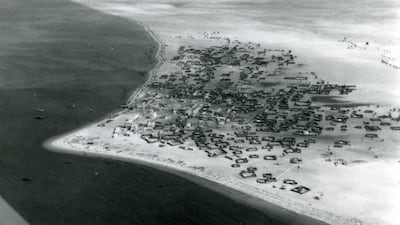
Abu Dhabi, then part of the Trucial States, pictured from above in the late 1950s / early 1960s. The emirate's coastline and palm dwellings can be seen. Photo: BP Archive -
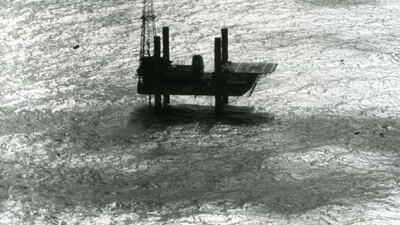
The oil rig Adman Enterprise off Das Island in 1958. Oil was struck on March 28, 1958. Photo: BP Archives -
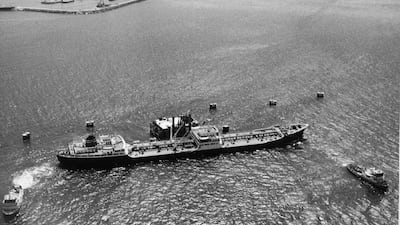
The tanker 'British Signal' moves away from the Das Island after loading with crude oil on July 4, 1962. Photo: BP Archive -
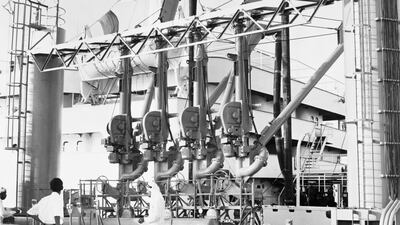
A loading berth off Das Island with BO Tanker Company's 35,000-tonne 'British Signal' loading crude in July 1962. -
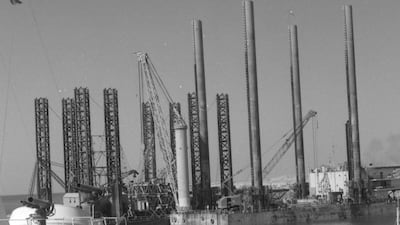
The harbour at Das Island from the deck of the ADMA tug 'Arzanah' showing the work barge 'ADMA Constructor' and the drilling barge 'Offshore 55' at berth in 1962. Photo: BP Archive -
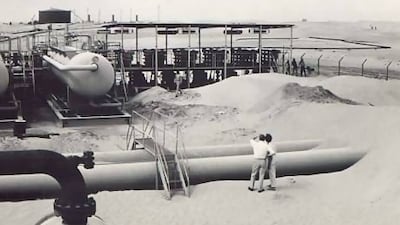
Abu Dhabi Petroleum Company production at Bu Hasa, an Empty Quarter oilfield for which a concession was granted in 1939. Photo: Total -
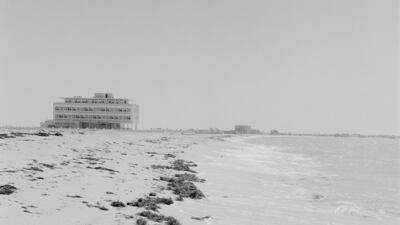
The Beach Hotel along Abu Dhabi's coast, pictured in 1962 - the year the emirate exported its first shipment of oil. Photo: BP Archive. -

Crossing from the mainland to Abu Dhabi island in the 1950s beside the Maqta Tower, now overshadowed by the Maqta and Sheikh Zayed bridges. Photo: BP Archive -
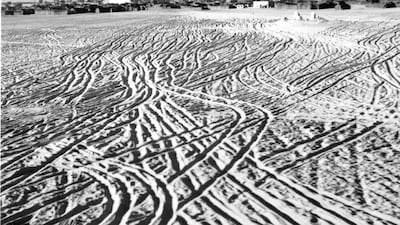
Abu Dhabi in the late 1950s or early 1960s, the view of the town from the home of a British family working in the oil industry. Photo: BP Archive -
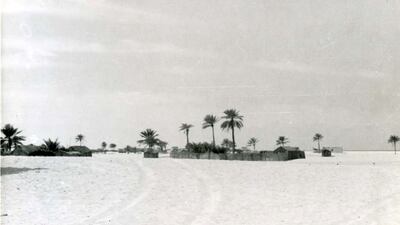
The town of Abu Dhabi in 1953. Photo: BP Archives -
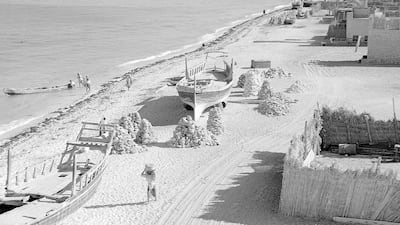
Stacks of coral dry on the beach in Abu Dhabi in the mid-20th century. Coral stone was used in the construction of many of the country's historic buildings, including Qasr Al Hosn. Photo: BP Archive -

Jacques Cousteau on board 'Calypso' in the Gulf in 1954. Photo: BP Archive -
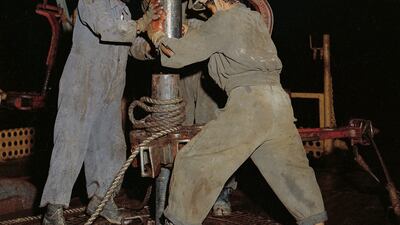
Three local workers prepare the drilling bit for an exploration well at Shuweihat on the Abu Dhabi coast in 1956. Despite reaching a depth of more than 4,000 meters, the well was dry, prompting a return to the Murban Bab field, where commercial quantities of oil were discovered four years later. Photo: Adnoc -
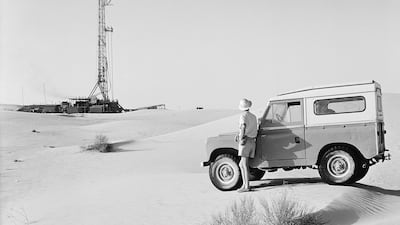
Deep in the desert, a worker with his Land Rover watches a drilling rig at the Murban Bab oil field in 1964. Photo: Adnoc -
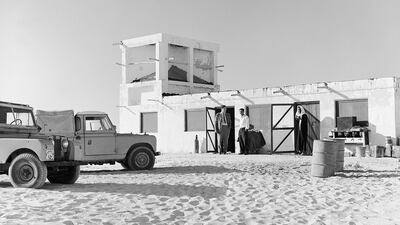
The oil company guest house in Abu Dhabi informally known as Henderson's Folly, after the UK's political officer Edward Henderson who had it built, in 1961. The building was later handed over to residents for social use to start The Club. Photo: Adnoc -
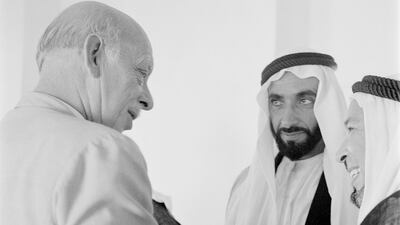
Sheikh Zayed meets with a senior official from BP in late 1957, as the concession prepares to begin drilling for oil. Photo: BP Archives -
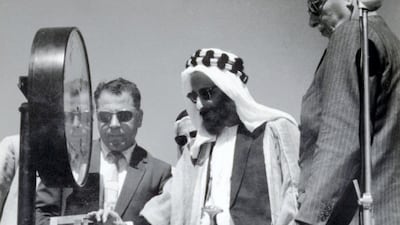
Sheikh Shakhbut, Ruler of Abu Dhabi, at the inauguration of Abu Dhabi Marine Areas Ltd's Umm Shaif oilfield October 1962. Photo: Abu Dhabi Department of Culture and Tourism -
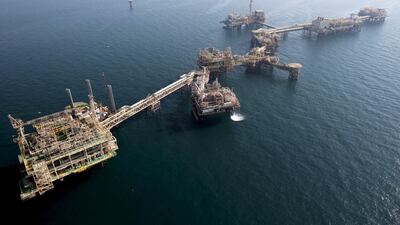
The supercomplex at Umm Shaif field in modern times. Located 150km offshore of Abu Dhabi, the oilfield is operated by Adnoc's Adma-Opco unit. Photo: Adnoc


A key reason for the model’s prediction is that – historically speaking – oil producers have demonstrated a significant preference for the present over the future, and with it an aversion to the large up-front investments needed for the green paradox effect to dominate.
Environmentalists will surely be happy if this prediction plays out as it means that they need not worry that green policies – which check oil demand – result in a temporary boost to oil consumption. For most oil producers in the Arab world, such a path would also be preferable to oil markets devolving into a Hobbesian state of nature, as prices would remain higher for a longer time. Their status as low-cost producers would afford them a “last hurrah” as the global economy permanently shifts away from oil as it once did from coal.
It is important to note that for producers, low production costs provide time, not immunity. They make the region’s oil likely to be among the last barrels produced, but they cannot guarantee either high prices or stable revenues. Economic diversification – and, more specifically, diversification of government revenue and exports – therefore remains indispensable. Its purpose is not to predict the precise date of peak oil demand, but to ensure that the region’s prosperity no longer depends on getting that prediction right. Policymakers in the region understand this well.