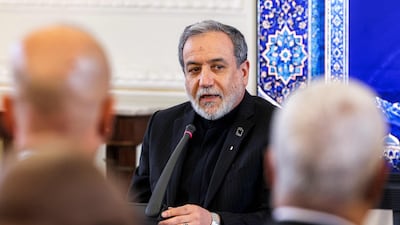
Iran's Foreign Minister Abbas Arachghi on Wednesday defended his efforts to end the war with the US amid criticism from within political circles.
Mr Araghchi fielded three hours of questions from members of Iran's parliament, the Islamic Consultative Assembly, which could in theory hear a motion on his impeachment after it was filed by a critical MP.
The case relates to claims that Mr Araghchi overstepped by holding a meeting with US officials in New York without the permission of Iran's supreme leader Ayatollah Mojtaba Khamenei.
MPs also informed Mr Araghchi of "public concern" about Iran's unity and cohesion, state media said. It is the latest hint of division within Iran's political circles, which have been reshaped by the war and the killing of senior figures such as Ayatollah Ali Khamenei.
Mr Araghchi said the delegation he led at the UN General Assembly in New York had "explained Iran's positions in the most eloquent and authoritative manner possible". He said his team had followed the instructions of "competent authorities" in Iran.
"Iran showed in New York that it is tough in defending itself and serious in using diplomacy to ensure national security," state media quoted Mr Araghchi as saying.
Mr Araghchi is proposing a "seven-day plan" that would count down to reopening the Strait of Hormuz in a week if the US accepts Iran's conditions. US President Donald Trump has rejected Iran's offer.
US Secretary of State Marco Rubio said on Wednesday that Iran had “lost complete control” of the strait, saying oil flows through the waterway had returned to near prewar levels.
The seven-day moving average for crude exports from the Gulf was 18.3 million barrels per day on September 30, compared to the average 18 million bpd that passed through the region in the 12 months before the Iran war began, according to ship-tracking firm Kpler. The figures include shipments through the Strait of Hormuz, the Red Sea and by other methods.
Mr Rubio said Iran was facing “crippling sanctions” and that its economy was in “total and complete free fall”. He predicted its economy “is about to reach a point that few countries in the world have experienced in terms of how bad it is going to get”.