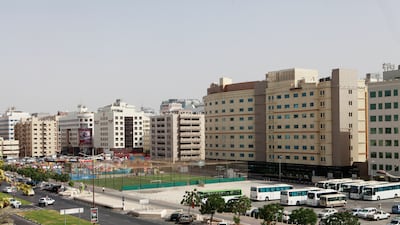

Dubai has earmarked more than 44 areas in which unrelated men and women can live in shared accommodation, and landlords have one year to regularise buildings used for shared housing.
The move came as the city cracks down on overcrowding and the illegal subletting of multi-occupancy apartments.
Dubai is grappling with a major population rise; more than 200,000 people moved to the emirate this year, despite the impact of the war in Iran.

Most approved shared housing areas are located outside major tourist hubs, such as Al Souq Al Kabeer, Al Ras, Al Warqa 1, Al Barsha 1, Al Muraqqabat, and Al Rigga. Additional areas may be approved in the future.
The Dubai Municipality's shared housing guide sets standards for building design, occupancy, health and safety, shared facilities, and approved locations. These regulations address unregulated residential practices and protect the privacy, safety, and rights of owners and occupants.
Ahmed Elnaggar, founder of Elnaggar & Partners, a legal firm, said the law identifies six types of property that may be approved for shared accommodation: residential apartments, stand-alone houses, residential complexes, mixed-use buildings, adjoining houses and multi-storey buildings.
Mr Khan noted that unauthorised partitioning occurs throughout Dubai, not in a single area. He expects enforcement to focus on specific buildings rather than neighbourhoods, emphasising “the asset, not the location.”
Requirements for shared housing
Each building must be designated as either individual or family accommodation. Bedrooms must provide at least five square metres per person. Family units require a separate bedroom with an en suite bathroom.
The guide specifies requirements for shared facilities and services based on accommodation type and occupancy. Buildings must include kitchens, sanitary facilities, and designated areas for dining, recreation, laundry, and clothes drying, as appropriate.
The law excludes labour accommodation, which is governed by separate legislation.
One-year period
Property owners have one year from the law’s effective date, September 8, 2026, to bring shared housing buildings into compliance.
Owners, property managers, and leasing companies should use this period to assess properties and make the changes needed to meet the new standards.
Taimur Khan, head of research for the Middle East and Africa at JLL, anticipates the property market will respond before the September 2027 deadline, given the significant penalties for non-compliance. Although there is time to comply, Dubai Municipality has already begun inspections in identified problem areas.
Violations may result in fines from Dh500 to Dh500,000. Repeat offences within a year can double the penalty, up to a maximum of Dh1 million.
Permits and safety approval
Buildings and villas may be designated for shared housing only after obtaining the required permit. Permit applications and renewals are available through the Build in Dubai platform.
Maryam Al Muhairi, chief of the Building Regulation and Permits Agency at Dubai Municipality, said the guide provides a clear reference for property owners and management and leasing companies.
“It sets out planning, building, technical, health and public safety requirements, as well as the areas where buildings may be allocated for shared housing,” she said. “This will contribute to providing a safe, healthy and well-regulated residential environment for different segments of the community, while translating the provisions of the Shared Housing Law related to protecting rights and enhancing public health and safety.”
She stated that the objective is to raise awareness, strengthen oversight, and help owners standardise their buildings, while preserving Dubai’s urban and aesthetic character.