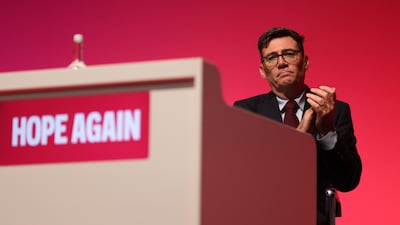

UK Prime Minister Andy Burnham has ruled out a general election until 2029. Globally, that is a good thing.
Political instability drives some of the worst aggravations on the international scene, and the rise of Mr Burnham might already be seen as lurching from one leadership option to another. After more than two months in power, the current incumbent has given the country an inkling of how he approaches power and what his sense of purpose is.
The governing Labour party is certainly happy to have swapped Keir Starmer for Mr Burnham. Justin Madders, a junior minister, observed on Monday that there were “North Korean-type” levels of approval for the new leader in the rank and file. He was reacting to a new YouGov poll that shows that Mr Burnham is the most popular of the big names in the party, with 94 per cent approval from its grassroots.
With this solidity and a consensual style of politics, the UK now has a chance to take the leap with a man who has a set out some core issues – all domestic policy choices that have not been resolved for decades – and demonstrates a new empathetic style. In any case, it is unclear what the advantage of going into a general election would be in a country where more parties are competitive in different regions.
Mr Burham readily concedes that his government is constrained by his party’s manifesto, released during the 2024 general election campaign and which includes a promise not to raise the three main taxes. These revenue-raisers are out of bounds as long as Mr Burnham adheres to this manifesto.
With the UK caught up in a debt crisis that is gripping most of the world’s large economies, Labour’s pledge is contributing to a sense that politics has been caught in a trap.
-

Andy Burnham celebrates after his swearing-in as MP at the Houses of Parliament in June 2026. All photos: Getty Images -

Mr Burnham speaks as he celebrates his victory in the Makerfield by-election -

Mr Burnham is declared winner in the by-election in June -

Mr Burnham speaks to a resident in Ashton-in-Makerfield as he goes door-to-door canvassing in May -

Britain's Prime Minister Keir Starmer, MP and former deputy prime minister, Angela Rayner and Manchester mayor Mr Burnham in Ashton-under-Lyne, Greater Manchester, in April -

Mr Burnham speaks to the media as he visits Heaton Park Hebrew Congregation Synagogue, after a stabbing and car attack took place on Yom Kippur in October 2025 -

Mr Burnham speaks at an event promoting British democracy, at ACC Liverpool in September 2025 -

Mr Burnham poses outside the Salford Lads Club made famous by The Smiths and their album The Queen Is Dead, after launching his mayoral re-election campaign in April 2024 -

Mr Burnham and Prince William visit the Hideaway Youth Project during a visit to Moss Side, Manchester, in November 2023 -

Mr Burnham poses for pictures at the start of the 40th Great North Run in September 2021 in Newcastle-Upon-Tyne -

Mr Burnham sanitises his hands before a memorial service for victims of Covid at Manchester Cathedral in 2020 -

Labour leader Jeremy Corbyn is greeted by Mr Burnham as he arrives at Manchester Victoria Station in 2018 -

Mr Burnham celebrates winning the Greater Manchester mayoral election in 2017 -

Mr Burnham takes part in a hustings in Glasgow in 2015, when he was campaigning to be Labour leader -

Then secretary of state for culture, media and sport, Mr Burnham attends a cabinet meeting in Downing Street, London, in 2008


Mr Burnham is choosing a second – and trickier – path of seeing off the current parliamentary term. In doing so, he would give voters the opportunity to see through the coming months, when an economic crisis is bound to top the agenda. Proving his credentials in those circumstances would allow for the charismatic leader to take a proven track record to the country later down the track.
The benefits of pursuing this strategy will be won only by making hard decisions, most of which could be forced by international circumstances and the shrinking resources available to the UK government.
Mr Burnham’s first virtue is that he refuses to echo the chorus of “doom” that he hears from elite commentators and analysts. In his political project, there is no room for worries around future deficits and moments of truth in the welfare-heavy budget.
There is a path to transcending these issues in his head.
When a letter written by the pensions industry reaches his desk, he may well see it as a vindication. The letter points to how in recent years people have been withdrawing funds in the run-up to budget presentations in Parliament on speculation of new tax measures. These often don’t come to fruition, but the uncertainty has destabilised the system. It is a niche example of how playing the game of speculation and allowing momentum to build out of it do real damage within the UK.
The government’s Middle East policy has a part to play in stabilising the political landscape.
In Liverpool, where Mr Burnham is leading the ongoing Labour party conference, the mood is dramatically different from a year ago. The sense of a party divided against itself is gone.
It is hard to imagine the walkout I witnessed when former chancellor of the exchequer Rachel Reeves addressed the Gaza war and the party’s policies last year.
Mr Burnham’s senior colleagues are now benefitting from a change of tone. Indeed, the party has embraced his new policies, especially around sanctions on West Bank settlements. This has also starved the Green party of much-needed fuel, at a time when it had been threatening to win over Labour’s urban strongholds.
Yet by continuing the policy of allowing US defensive operations in the Strait of Hormuz out of bases like RAF Fairford, Mr Burnham has signalled operational continuity. He has changed the politics surrounding the issue itself.
A similar approach can be seen in how Mr Burnham will announce on Tuesday that he will bring a major dementia policy to the country when he fights the next election. This is a progressive holy grail that has been tried by successive governments.
In taking a long-term approach, Mr Burnham is giving himself a platform to work with the centrist Liberal Democrats, who currently hold more than 10 per cent of parliamentary seats.
The YouGov polling presented on the conference fringes on Monday showed that Labour members by far preferred the option of governing with the “LibDems” when presented with potential partners. The figures show that 73 per cent of the party would back a coalition with the LibDems if the next election resulted in a hung parliament.
So on both wings of his political position, the Prime Minister has already built solid achievements that shore up Labour’s grip on power. The large majority in Parliament inherited from his predecessor, Mr Starmer, affords Mr Burnham the opportunity to get the laws he wants passed without negotiating with other parties. That is a precious asset in a political situation that is otherwise in flux.
The country is not prepared to go back to choosing a new government just two years after the previous general election. With the air clear, Mr Burnham should get on the task of proving that his leadership can master the challenges facing the country. Then he can ask for more time.

