The political impact of the UK’s decision to take sanctions measures against Israeli interests linked to illegal settlements in the West Bank is playing out even before the details of the package are known.
It is fair to say that there is an underlying tone to the commentary that is both potent and personal. Personal because the figurehead for the announcement is UK Foreign Secretary Ed Miliband, who is Jewish. It is not only his critics who have made this association; even the governing Labour party’s briefings have alluded to Mr Miliband’s biography.
The Foreign Secretary’s profile is important to how the announcement will play out. So, too, is the UK’s history in the Middle East and its continuing role as one of the five permanent members of the UN Security Council.
The UK may have left the EU as a result of Brexit, but its impact as a European power taking this step is – perhaps – one of the most important considerations following the announcement. Last week, Mr Miliband travelled to Ireland, where the Irish presidency of the EU was holding informal consultations on issues including sanctions on Israel over developments in the Palestinian homeland.
The UK is already knitted into a European process on the issues involved through a caucus of countries that comprises itself, France, Germany and Italy. This E4 caucus tends to issue statements as one. But it has begun to split on the need for action against Israel, with Germany, Italy and – to a lesser degree – France not ready to take direct targeted measures.
By shifting to a more robust foreign policy on Palestine-Israel, the UK is joining Spain, Ireland, Belgium and the Netherlands with a pipeline of similar bans on both direct imports and exports, as well as support through financing or other ties to the economic activities taking place in the settlements. As the Chatham House scholar Julie Norman pointed out in her latest analysis, the current government is in a position to do so because it can align its values with British interests.
Government deliberations on a sanctions package have been waged behind closed doors for months, even under the leadership of former prime minister Keir Starmer who was very clear in his support for Israel’s military-led response to the October 7, 2023 attacks from Gaza.
-
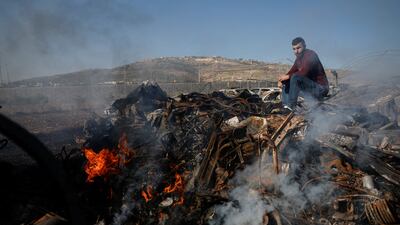
Palestinian Yahya Dalal, 32, sits near cars burnt in an attack by Israeli settlers, in Huwara, in the occupied West Bank. Reuters -

Ahmad Adawi inspects a burnt-out vehicle after a settler attack in the village of Al Jaba, near Bethlehem. AP Photo -

A Palestinian reads the Quran in a mosque that was set on fire in the village of Deir Istiya, near Salfit. Reuters -
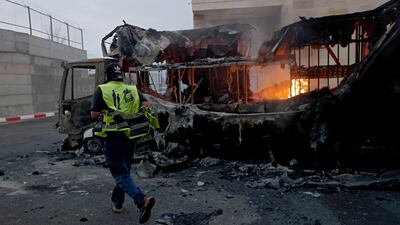
A fire burns behind a gutted lorry in Al Ladain, near Beit Lid, west of Nablus city. The Palestinian health ministry said three Palestinians were wounded during the attack by Israeli settlers. EPA -

A cat sits near a car torched by Israeli settlers in the village of Atara, near Ramallah, in October. Reuters -
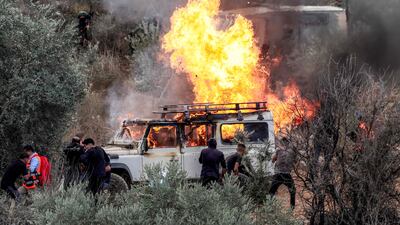
Palestinian men and first responders try to extinguish a burning vehicle set ablaze during an attack by Israeli settlers in Beita, south of Nablus, during the olive harvest. AFP -
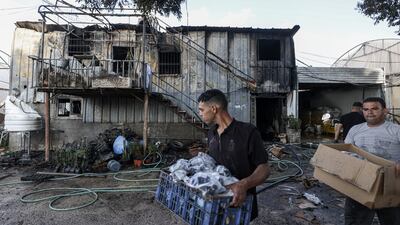
Men retrieve items from an attack on a plant nursery in the village of Deir Sharaf, west of Nablus, in September. AFP -

A man stands in the burnt wreckage of a building in Abu Falah, near Ramallah, in August. Reuters -
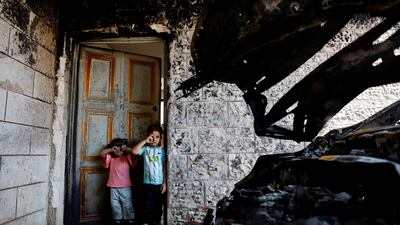
Palestinian children stand next to a burnt car after an attack by Israeli settlers in Silwad, near Ramallah, in July. Reuters -

A man walks past charred vehicles, a day after an attack on Dayr Dibwan, east of Ramallah, in June. AFP


After winning the leadership, new Prime Minister Andy Burnham used one of his first video messages to say that Labour’s policy approach since 2024 had been “wrong”. “The response has too often not been good enough,” he said. “We need to do better.” That was a clear values-based judgment for the new government, and the scheduled announcement on Tuesday is a manifestation of those words.
One of the strongest proponents of the package within government has been Ed Llewellyn, the Foreign Office’s political director. Mr Llewellyn had a formative experience more than 20 years ago in Sarajevo in the Balkans, where he worked for the UN’s high representative to address the region’s recovery from civil war atrocities. The principles that the UN-led international community adhered to, then, should be borne in mind when seeking an effective role for the UK in Palestine and Israel.
In 2024, the International Court of Justice issued a ruling that obliged member states to “take steps to prevent trade or investment relations” that help sustain illegal settlements in the West Bank. This is a broad advisory, but it effectively provides guidance for enforcement of the Security Council’s Resolution 2334, adopted in 2016, that found that the settlements have no legal validity.
It is the dire situation in Gaza that led Mr Miliband to issue an urgent plea for change late last week. It caused an outbreak of Israeli hasbara against the Foreign Secretary. It also prompted Mike Huckabee, the US ambassador to Israel, to claim that the UK government was filled with “Jew hate”. Such language is a foretaste of what is to come this week.
Israel’s move to develop the E1 corridor, which would create a land bridge blocking transit between Bethlehem, Ramallah and East Jerusalem, is designed as a blow to a two-state solution. For the UK, which under Mr Starmer took the historic decision to recognise Palestinian statehood, that is a move that cannot be ignored.
This week’s package, then, needs to make an impact at several levels to justify the political interests at stake.
It should bolster the Palestinian claim to statehood. It should reverse UK-based involvement in the settlements. It should demonstrate that there are real consequences internationally for violations based on expanding so-called facts on the ground. Lastly, it should increase pressure on Israeli politics for a change in direction.
Israel is moving into the final stages of a general election, but it would be narrowly wrong to see this step as interference in that country’s domestic politics.
It is, instead, right to see this as an important step in the European policy process. For that reason, expect the UK’s statement to lead to wider – and more far-reaching – efforts by the Europeans to make a difference.