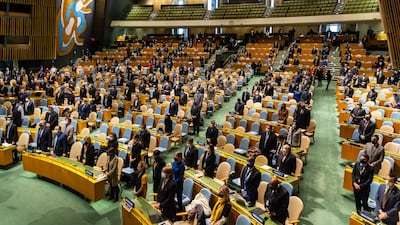

The world's biggest diplomatic gathering – the general debates of the 81st UN General Assembly – begins on Tuesday. Traffic comes to a halt across Midtown Manhattan New York for a week as foreign ministers, presidents, chief executives and activists swarm New York, each convinced their meeting matters more than the one down the hall. It's impossible to get a table at a restaurant on the East Side anywhere between 40th and 62nd Street. Hotels are booked solid, and room rates shoot up.
This year is also embattled Antonio Guterres's final UNGA – the Secretary General’s swan song, so to speak. The 77-year-old Portuguese politician was elected in 2016, and faced a world that already included a vicious war in Syria and the shock of Brexit. Compared with what awaits his successor, that old world looks almost tame. Mr Guterres faced enormous frustrations – calling for the protection of civilians in Gaza during some of Israel's worst bombardment, and a world where US President Donald Trump's second term mutilated multilateralism.
Mr Guterres came into office at a time when UN envoys still had some respect and weight. Ten years on, he will make his final speech as a globalist in a world where the UN has increasingly little leverage. The Secretary General’s critics will say he did not push hard enough for peace in Ukraine or the Middle East. He would likely push back by saying he did what he could, attempting lukewarm diplomacy and the supply of humanitarian aid.
This year's official UNGA focus is standard fare: the Sustainable Development Goals – the 17 targets on poverty, hunger, gender equality and other issues that member states adopted the year before Mr Guterres was elected. However, this assembly will convene in a deeply uncertain moment, and its theme – Restoring Trust, Managing Transformation – is almost ironic given how stalled the SDGs actually are. Only a third of the 17 goals are on track.
As with many annual global summits, the real business at UNGA happens off the main stage — the roundtables and bilaterals tucked into UN missions and hotel suites across Midtown. Many delegates' attention will focus on the wars that are still burning. The US has entered another forever war in Iran, one with shifting goals and an early declared "victory" from Mr Trump that doesn't look much like one. Gaza and Palestine will be central, with France using its Security Council presidency to push, once again, for a two-state solution a year after the New York Declaration on the issue. Ukraine will get its usual hearing, though after nearly five years the appetite for fresh pledges is thinning. Sudan – the war nobody wants to deal with and where the humanitarian outcome is horrific – will likely get a fraction of the floor time its casualty numbers deserve.
Having just returned from a high-level security forum in Kyiv — where the train just before the one carrying foreign dignitaries such as Boris Johnson, David Petraeus and Carl Bildt was attacked by a Russian drone — I can say that nearly five years of war have exhausted the Ukrainians. They still see themselves as the last frontline between Europe and President Vladimir Putin's imperial Russia, and they are right. But they are increasingly alone. Mr Putin is wanted by The Hague and won’t be at UNGA. Europe has done what it can, and Mr Trump has given his royal decree on Ukraine: he’s not interested. In Kyiv, our conversations were largely focused on AI warfare – the future of autonomous kill drones when humans are not in control. This is terrifying, sci-fi stuff that will also be addressed in New York this week.
-
Likened to diplomatic 'speed dating', UN General Assembly gives the world's top diplomats a chance to meet in person. The assembly has played host to a number of famous moments over the years. AP -
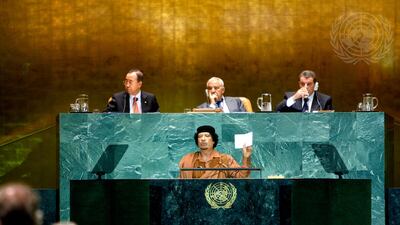
Libyan leader Muammar Qaddafi famously addressed the UNGA for more than 90 minutes in 2009. Photo: UN -
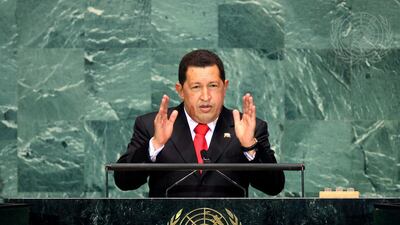
Venezuelan president Hugo Chavez said in 2006 that he could smell sulphur in the UN chamber after George W Bush spoke, likening the US leader to the 'Devil'. Photo: UN -
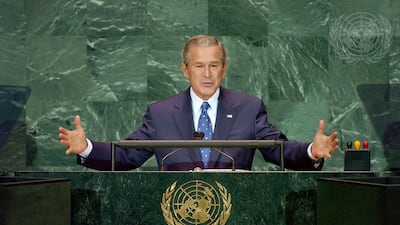
Mr Bush at UNGA in 2005. Photo: UN -
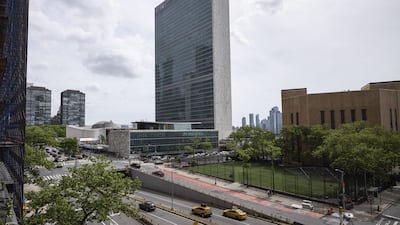
The UN Headquarters in New York. Residents of the Big Apple brace themselves for two weeks of traffic chaos as UNGA takes place. EPA -
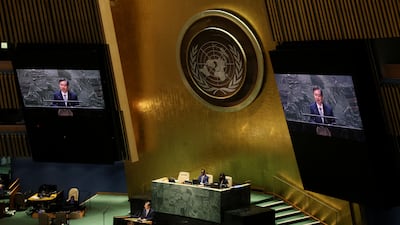
South Korean ambassador to the UN Cho Hyun speaking in the chamber. Reuters -
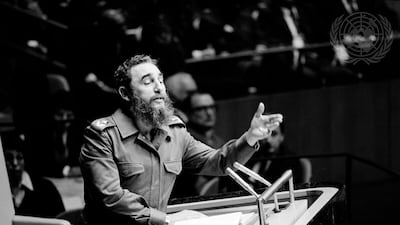
Cuban leader Fidel Castro addressing the General Assembly. Photo: UN -
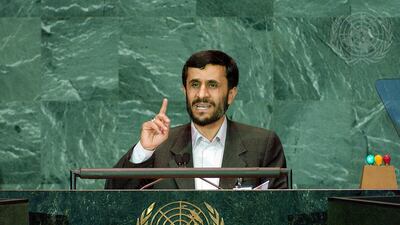
Former Iranian president Mahmoud Ahmadinejad in 2005. Photo: UN -
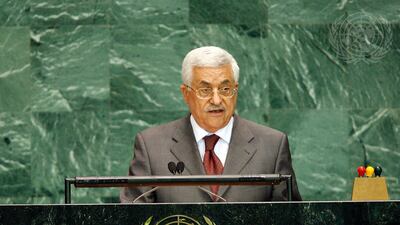
Mahmoud Abbas, President of the Palestinian National Authority, addresses UNGA. Photo: UN


Another leader wanted by The Hague, Benjamin Netanyahu, will be in New York. The Israeli Prime Minister will face down the protesters who gather every year calling for his removal. Despite his unpopularity abroad and at home, Israel’s deal with Washington for more one-tonne bombs arrives at the exact moment public opinion is turning against his government and even armies allied with Israel are pressing it toward more ethical conduct.
He will return home to his own headaches: a traumatised, isolated country and an election just weeks away – one he is racing to survive by unifying the right. Current polling shows him winning no more than 51 seats, many fewer than his coalition holds now. Few global leaders feel they can trust Mr Netanyahu, but everyone fears that whoever might replace him could be even worse.
Climate change will be addressed. This year's gathering follows a summer that made global warming impossible to ignore: devastating floods in Nepal; fires raging through France and California; and a Europe unprepared for the heat (the EU now calls the situation in central and southern Europe "desertification"). The headline session is sea-level rise, timed for delegations from the Pacific and Caribbean island states whose territory is shrinking by the year. But let's be honest. Who is going to advocate for the Marshall Islands or Tuvalu when the Strait of Hormuz is closed? The delegations from these countries pound the pavement seeking meetings and trying to get the ear of the Secretary General or foreign ministers, often to no avail.
Mr Guterres has already signalled which threats he considers gravest – Gaza and Ukraine at the centre, alongside the US-Iran war that has closed the Strait of Hormuz and pushed oil past $100 a barrel. But it's runaway AI that will likely dominate the private conversations happening throughout Manhattan.
Who governs these machines, and how? What policies and safeguards can be laid out? OpenAI this week disclosed six new incidents of "concerning" behaviour, and not just the Hugging Face incident, where swarms of agents invaded and took control. Mr Guterres wants multilateral oversight, but the US and EU would rather leave it to the private sector. This is a dangerous divide that Mr Guterres has warned risks becoming "a race to the bottom" on safety. Meanwhile Mr Trump – whose frenemy Elon Musk is leading the charge on AI development – has shown little interest in building policy or controls to match the technology's speed. Expert after expert has appeared on TV describing doomsday scenarios if AI agents are not called to heel.
It's a lot on the plate of a Secretary General about to leave office. Which is, in the end, the real question hanging over this UNGA. Mr Guterres leaves office having spent nine years insisting the UN can still deliver, right as the evidence for that claim gets harder to find. The UN seems woefully small in regard to the greater forces out there hammering it down.
There is a Security Council that cannot act on Gaza or Ukraine, development aid that is falling at its steepest rate on record, and a new Secretary General race is already underway in the corridors while ministers speak from the podium. UN reform has been promised for years. As far as I can see, nothing has happened.
Restoring trust was always going to be this session's slogan. Whether anyone stuck in that Midtown traffic, or waiting in line to get into a roundtable session, or going through a massive security checkpoint to get to the best party actually believes it is the story worth watching.

