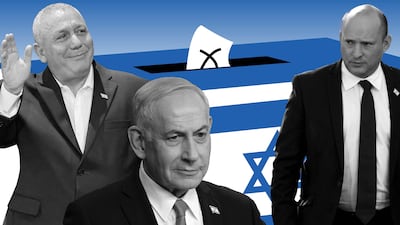

When I was the British ambassador in Israel, my number-one rule for Israeli politics was this – never bet against Bibi.
Israeli Prime Minister Benjamin Netanyahu is a brilliant and ruthless political operator, with an extraordinary ability to snatch victory from the jaws of apparently inevitable defeat. In the past 17 years, he has been the country’s Prime Minister for all but 18 months. For much of the world, he is Israel, not just its leader but the personification of the country.
On October 27, Israelis will vote in a general election for the 120-seat Knesset. Polling has been volatile all summer; the opposition parties led for most of it, but that lead has now gone. The latest polls put both blocs in the low to mid 50s, with Mr Netanyahu’s bloc ahead in several, and the remaining dozen or so seats going to two largely Arab parties. On most readings, no bloc reaches the 61 seats needed for a majority.
The politics will not stop with the vote but move into coalition-building. Mr Netanyahu will try to peel off opposition parties, promising ministerial jobs and the jettisoning of the far right in his current coalition. His opponents will look for the least difficult route to 61 seats, probably through defections or a coalition with the Islamist Ra'am party.
One way or another, Israel may well end up being led by a different government, and quite possibly a different prime minister. But how much difference will this actually make? A different prime minister will change some things and present a more palatable face to the world, but the core dilemmas facing Israel will remain unchanged.
The frontrunner to replace Mr Netanyahu is currently Gadi Eisenkot, the former chief of staff of the Israeli army, whose Yashar party has spent the summer running level with, or just ahead of, Mr Netanyahu’s Likud. Mr Eisenkot is in many respects the opposite of Mr Netanyahu: a working-class son of Moroccan immigrants, sober where Mr Netanyahu is dramatic, and widely respected, not least because he lost his son Gal in Gaza, during an operation to recover the bodies of Israeli hostages in December 2023. Also in contention would be Naftali Bennett, who is a popular choice for prime minister despite his party trailing Mr Eisenkot’s in the polls.
It would be a mistake to assume that not being Mr Netanyahu makes either of his rivals peaceniks. Mr Eisenkot is widely recognised as the author of the Dahiya doctrine – the use of disproportionate force against civilian infrastructure in areas held by terrorist groups. He would come into office holding strong national security credentials and a clear set of positions on the key issues that provide a guide to where he would take Israeli policy. Across the range of those issues, he has disagreed with Mr Netanyahu about tactics and implementation but not about the core direction.
On Gaza, Mr Eisenkot has called for the elimination of Hamas and its replacement by an upgraded Palestinian Authority. Israel has haemorrhaged international support over the war, but the country remains traumatised by the attack on October 7, 2023, and there would be little support for any policy that looked soft on Hamas. Mr Eisenkot might avoid some of the more extreme statements and actions of the Netanyahu government, but the underlying dilemma remains – although most Israelis don’t want to permanently occupy the Gaza Strip, they have learnt that neither can they simply leave and hope for the best, and that there are few good options in between.
The same dilemma holds on Lebanon, where Israelis have bad memories of the “Lebanese mud” in which Israelis felt stuck during the 18-year occupation that ended in 2000. Many feel, however, that without such an occupation the Israeli state cannot guarantee the safety of its citizens living in the north.
Iran was always top of Mr Netanyahu’s agenda. He has warned about Tehran’s nuclear ambitions for more than three decades, and helped push US President Donald Trump to act. Yet despite the issue being personal for the Prime Minister, and deep disappointment among the Israeli public regarding the outcome of the conflict so far, there is little daylight between the leading contenders for prime minister – all call for continued pressure on Iran but disagree on the “how”. As army chief, Mr Eisenkot called for greater intelligence-sharing with Saudi Arabia. Mr Bennett has gone even further, calling for automatic retaliation against Iran in the case of any attack by Tehran’s proxy in Lebanon, Hezbollah.
Israel’s centre has historically been more forward on Palestinian statehood than the right, but even that distinction barely holds up in this election. Mr Eisenkot’s stance reflects the widespread loss of faith among the Israeli public in the prospects for peace. “I have never said two states for two peoples,” he stated in June, adding that “anyone who talks about 'peace now' and two states doesn’t understand the conflict”.
Mr Bennett has said he will not allow a Palestinian state to be established, and on settlements he is potentially no more restrained than Mr Netanyahu – he has said that Area C of the West Bank, a zone that covers about 60 per cent of the territory and is under full Israeli security and administrative control, should ultimately become part of Israel. Mr Bennett once ran the settler movement’s umbrella body, the Yesha Council.
If there is a change, it is more likely to be at home and in tone rather than on the big security issues. Both Mr Eisenkot and Mr Bennett have called for an independent inquiry into the failures that allowed the October 7 attack to happen, one of the key issues of the campaign so far, on which feelings have been sharpened by the reporting of warnings received before the attack. Both have also called for the preservation of judicial independence. Both have backed drafting ultra-Orthodox men into the army. Mr Bennett has called for repairing frayed relations with the Democratic Party in the US, with European governments and with Jewish communities around the world.

For the Arab world, a new Israeli leader would represent an opportunity, but perhaps not for profound change. Mr Eisenkot has spoken of closer intelligence ties with Saudi Arabia; Mr Bennett wants to expand the Abraham Accords and pursue Saudi ties. Both might be easier for Arab governments to deal with than Mr Netanyahu, whose reputation and coalition partners have become a liability. However, Riyadh has made normalisation conditional on a credible path to Palestinian statehood – and neither Mr Eisenkot nor Mr Bennett is offering one. A change of prime minister would not remove that obstacle.
All of this means even if my number-one rule no longer holds, and Mr Netanyahu is finally forced out of the Prime Minister’s residence, what follows may be less different than many believe.

