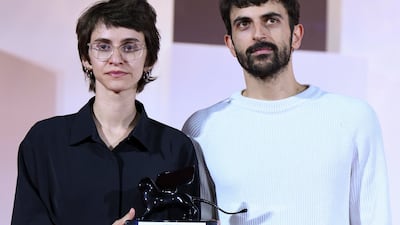
Israeli Prime Minister Benjamin Netanyahu has attacked the makers of Gaza documentary Naza, accusing the award-winning film of contributing to “global anti-Semitic incitement”.
His comments add to a growing backlash against Israeli directors Yuval Abraham and Rachel Szor, after two government ministers called for them to be stripped of their citizenship over the film, which won the Special Jury Prize at the Venice Film Festival on Saturday.
“It’s shocking. We are fighting global anti-Semitic incitement and when it comes from within us it is intolerable,” Netanyahu said in a video posted on Telegram on Monday. “And now two Israeli directors portraying the [Israeli military] as war criminals receive applause at the Venice festival.”

Naza examines Israel's targeting practices in Gaza and alleges that mass civilian deaths were routinely factored into decisions over military strikes.
Netanyahu's reaction comes after Israeli Culture Minister Miki Zohar called for Abraham and Szor to be stripped of their Israeli citizenship, accusing them of “treason against the state”.
“I will act immediately to revoke the Israeli citizenship of these despicable creators for treason against the state,” Zohar wrote on X.
National Security Minister Itamar Ben-Gvir described the pair as a “disgrace and an embarrassment” and told them to leave the country.
“I am certain that your friends, that is to say our enemies Hamas in Gaza, will welcome you with open arms," he wrote on X.
The 80-minute documentary examines how Israel selects targets in Gaza, including its use of artificial intelligence. The film draws on clandestine interviews conducted over three years with 24 Israeli military intelligence officers and soldiers.

The participants, whose identities are concealed, were filmed at night on rooftops in Tel Aviv, with their faces and voices digitally altered. They describe military operations in which strikes were carried out despite Israel being aware that civilians were present in those areas.
The film takes its title from an Israeli military term referring to the number of civilians expected to be killed in an air strike. One of those interviewed claims that approval was given for an attack on a single Hamas member, despite the possibility that as many as 500 civilians could be killed.
Israeli military chief Eyal Zamir said he had ordered a legal investigation to identify the sources featured in the film.
Naza was one of the most talked-about films at this year's Venice festival. Audience members held Palestinian flags during a record-breaking standing ovation lasting about 24 and a half minutes that followed its premiere on Thursday.
Tunisian filmmaker Kaouther Ben Hania, who was part of the festival jury, praised Abraham and Szor's approach to documenting the war after presenting them with the Special Jury Prize.
“Those two brilliant directors found a way with the constraints of filming testimonies anonymously,” she said at the post-awards news conference. “And it's not about their feelings. They are cogs in a bigger machine. I found this just brilliant, necessary and very important in a time when we are talking a lot about denial.”
Ben Hania, whose Gaza drama The Voice of Hind Rajab won the Silver Lion Grand Jury Prize at Venice last year, said the filmmakers documented events as they unfolded. “They are filming fresh history. The genocide is still ongoing. This is brave,” she added.
Naza was produced by The Guardian and James Wilson, with The Zone of Interest director Jonathan Glazer serving as an executive producer. When accepting the award, Abraham said it was important for the documentary to be seen in Israel.
“We believe that the denial of a crime is what helps it persist, and that’s why it’s important for us that the Israelis see this film,” he said.
He also credited Palestinian journalists with documenting events in Gaza before the filmmakers began their work. “I want to be very clear. This truth has been documented and is known from the first day thanks to Palestinian journalists,” he said. "More than 200 of them have been killed by Israel in Gaza. Their voices were silenced and denied."

Abraham and Szor were previously among the four directors of No Other Land, which won the Academy Award for best documentary feature in 2025. The film, made with Palestinian filmmakers Basel Adra and Hamdan Ballal, documented Palestinian communities facing displacement and settler violence in the occupied West Bank.
Its Oscar win also drew criticism from Zohar, who at the time accused the filmmakers of damaging Israel's international image.
As culture minister, Zohar does not have the authority to revoke Israeli citizenship. While Israeli law allows citizenship to be revoked in limited circumstances involving what it defines as a breach of loyalty to the state, including treason and espionage, stripping the filmmakers of their citizenship would require further government and legal action.

