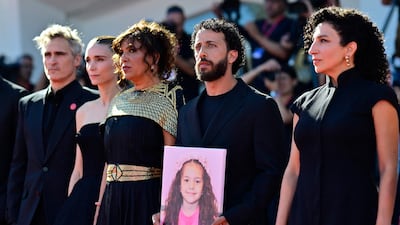

Palestinian actor Motaz Malhees has criticised Israel’s decision to investigate the killing of Hind Rajab through its own military justice system, after the army acknowledged for the first time that its troops fired on the car carrying the five-year-old and her family.
Malhees, who portrayed Palestine Red Crescent Society worker Omar Alqam in the Oscar-nominated film The Voice of Hind Rajab, questions whether the investigation will lead to anyone being held responsible. The film revisits the final hours of the five-year-old Palestinian girl killed in Gaza in January 2024.
“It has been more than two and a half years since Hind Rajab was killed, and for all that time, the Israeli army lied, denied and deflected,” he tells The National. “Now they are finally admitting it and launching an investigation into themselves. The irony of a criminal investigating its own crimes is not lost on me.

“Hind is one of thousands of children killed by this army,” Malhees adds. “Are they going to admit to every single one?
“More importantly, what happens next? Will the soldiers responsible actually be brought to justice, or will this be another soft landing that protects them? Until there is real accountability, these admissions and news cycles mean nothing.”
Kaouther Ben Hania, the Tunisian filmmaker who wrote and directed The Voice of Hind Rajab, described the military’s announcement as “a smokescreen” in a statement posted on Instagram.

“For more than two years, the evidence has been there: independent investigations, satellite imagery, ballistic analysis,” she wrote. “And there was the most devastating evidence of all: Hind’s own voice, describing the Israeli tanks circling around her. What more did we need?”
Her film uses real audio recordings of Hind’s phone call to the Palestine Red Crescent Society alongside dramatised scenes inside the operations centre.
Ben Hania said the cases the Israeli military was choosing to address were “precisely the ones that international public opinion has made impossible to ignore”.
“And what about all the others?” she asked. “Those whose names we will never know because their deaths never broke through the wall of international indifference?”
The Israeli military announced on Wednesday that its Military Police Criminal Investigation Division would examine the deaths of Hind, six members of her family and two paramedics sent to rescue her on January 29, 2024.
Its fact-finding mechanism concluded that Israeli troops fired on the family’s car as it approached them while travelling “contrary to an advance notice” issued to residents of the area.
Hind’s mother, Wissam Hamada, also criticised the decision in a statement posted on Instagram.
“Opening an investigation is not justice,” she wrote. “I do not want a closed military investigation. I want an independent, transparent investigation and genuine accountability for everyone responsible.”
“Hind is not just a news story or a case reopened because of international pressure. Hind is my daughter, and I will continue to demand the truth and justice for her, my family, and the paramedics who tried to save her.”
“Opening an investigation is a long-overdue step,” she concluded. “Justice has not yet begun.”
Five passengers were killed in the initial attack, while Hind and her 15-year-old cousin Layan Hamada survived. Layan was subsequently killed as Hind spoke to the Red Crescent Society, with dozens of shots audible during the call.
Hind answered when emergency workers called back and remained on the phone for hours, pleading for someone to rescue her.
The military acknowledged that the movement of an ambulance sent to reach Hind had been co-ordinated. Its statement said that, “according to the allegations raised”, a shell was fired towards the vehicle when it arrived, killing paramedics Youssef Al Zeino and Ahmed Al Madhoun.
It said the criminal investigation had been ordered because of “alleged failures” in that co-ordination. The statement did not explain how Hind or Layan died.
Their bodies were found 12 days later, after Israeli forces withdrew from the area. Hind was still inside the family’s car, while the remains of the paramedics were discovered in their destroyed ambulance nearby.
The admission reverses the military’s preliminary finding in 2024 that its forces were “not present near the vehicle or within the firing range” of the family’s car.
A Washington Post investigation subsequently found that Israeli armoured vehicles had been operating nearby, and that the gunfire and damage to the ambulance were consistent with Israeli weapons.
Forensic Architecture mapped 335 bullet holes across the car. Working with audio investigation group Earshot, it estimated that the gunfire heard as Layan was killed came from between 13 and 23 metres away. Researchers concluded that, at that distance, the shooter would have been able to see that civilians, including children, were inside.

Rana Faqih, the Red Crescent responder who tried to reassure Hind during her final hours, told The National that opening an Israeli investigation was nowhere near enough.
“From the outset, the society has demanded, and continues to demand, an independent investigation by a neutral and transparent committee,” she said.
Hind’s grandmother, who is also named Hind Rajab, told the Associated Press: “An international investigation is required to uncover the truth and hold all those responsible accountable,” she said. “We call for justice, not only for Hind, but for all Gaza children.”
Dyab Abou Jahjah, director general of the Belgium-based Hind Rajab Foundation, said its distrust was based on Israel’s previous record of investigating its own forces.
“We do not trust the Israeli justice system, not out of an ideological position, but because of the track record,” he told Al Jazeera. “And in this particular case, the Israeli justice system as a whole has always been complicit in Israeli crimes.”
The Hind Rajab case was one of two incidents referred for criminal investigation after the military reviewed 150 cases from the Gaza war. The second involved the killing of 15 Palestinian medics and rescue workers in Rafah in March 2025.
The military declined to open criminal investigations into three other attacks, including the April 2024 strikes that killed seven World Central Kitchen workers and two incidents involving staff from Doctors Without Borders.
Israel denies deliberately targeting civilians and rejects wider allegations of genocide and war crimes in Gaza.
The Voice of Hind Rajab received a record 24-minute standing ovation at its 2025 Venice Film Festival premiere and won the Silver Lion Grand Jury Prize. It was later nominated for Best International Feature Film at the Academy Awards.

