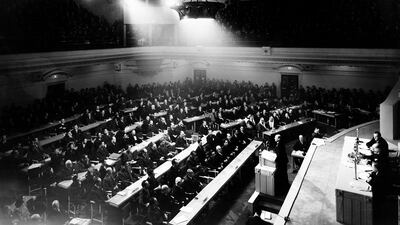

With the 81st UN General Assembly’s high-level week opening on Tuesday, it is a fitting moment to ask whether the institution has outlived its purpose – especially given how profoundly the world has changed since its inception in 1945.
The UN operates in an increasingly fragmented and insular world today, with the wars in Gaza, Ukraine and Sudan having exposed the limits of the international system. The Security Council, the primary forum responsible for maintaining international peace and security, has been paralysed by divisions.
In the absence of an enforcement mechanism, international law and resolutions have often been rendered toothless by member states choosing to disregard them. The organisation has lacked speed and agility in trying to address the more lasting challenges posed by climate change and the rise of artificial intelligence.

But judging the UN only by its inadequacies would be to overlook its basic structure. The organisation was never designed to be a world government. It has no army capable of enforcing its will, and it relies on member states for a majority of its funds, as well as political support.
What the UN does provide is a permanent forum in which countries large and small have a seat, and in which adversaries can communicate when bilateral relations have broken down. It has at its disposal standards and institutions developed over decades that are vital to deal with cross-border problems – such as climate change and pandemics – and that individual countries would be constrained to solve by themselves.
Its myriad agencies deliver much-needed humanitarian assistance, disaster relief, public health and social development. These agencies remain the primary source of support for vulnerable communities around the world.
Over the past decade – a period marked by much disruption and instability – the world has made tangible progress in its aim to achieve the UN’s 17 Sustainable Development Goals. More than 100 million additional children and youth have been brought into schools. There’s been a 10 per cent rise in the number of people being covered in social safety nets. Women’s global parliamentary representation has increased from 22 per cent to 27 per cent. Global internet connectivity and access to electricity have improved.
Progress has also been made on climate action, through landmark agreements such as the UAE Consensus. Conservation efforts have doubled protection of key ecosystems. During the Covid-19 pandemic, the UN mobilised international logistics, scientific co-operation and equitable vaccine distribution.
None of these achievements would have been possible without collective action and co-ordinated frameworks. It is this spirit of international co-operation that one hopes will prevail when the General Assembly convenes this week to discuss globally critical issues such as the runaway development of AI.
The UN should not be immune to criticism. It urgently needs reform, greater efficiency and stronger accountability – beginning with the Security Council. But the limitations that come with countries tackling global issues alone present the strongest argument for making the organisation work better – not for abandoning it.
That will be the task of the next Secretary General of the UN – set to start his or her term next year. This UNGA high-level week will be a reminder of what is at stake to choose the right candidate with the right vision for the UN.
While it cannot – and was not meant to – resolve every crisis, the ability to solve problems collectively remains the most persuasive reason for sustaining the UN. It may be imperfect, but it remains just as indispensable.

