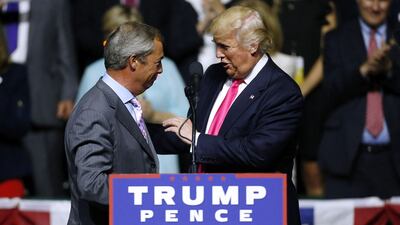

What happens to populist politicians when they are not so popular? Perhaps we are about to find out on both sides of the Atlantic.
Politics in the US and the UK often seem to rhyme. In the 1980s, it was that famous “special relationship” between US president Ronald Reagan and Margaret Thatcher, the Conservative British prime minister he called “Maggie”. In the 1990s, Bill Clinton created the “New Democrats”, suggesting to Americans that whatever they did not like about the “Old Democrats”, was a thing of the past. He found an echo in Britain’s Tony Blair who rebranded his party “New Labour” for the same reason.
Right now, there is another synchronicity involving two political mould-breakers: US President Donald Trump and the leader of Reform UK, Nigel Farage. Both are expert communicators on the political right, both have immigration as a key, vote-winning issue. Both are also – in different ways – in a degree of political difficulty, even though Mr Trump and Mr Farage are the communications geniuses of the information age.
They are never out of the news. They cut through the blizzard of information in modern politics. Mr Trump’s social media posts lead news bulletins and make headlines around the world. Mr Farage’s ability to dominate political storytelling is extraordinary for someone who has never held any position in any British government, and – love him or loathe him – he is probably the best known and most recognisable face in British politics in the 2020s. That’s why his current political difficulties are big news across the UK.
For the past two years, Mr Farage’s Reform party has scored significant successes in local council and other elections. Reform emerged as the most popular party in opinion polls. Mr Farage himself – without the advantages of Mr Trump enjoys by dint of being in power – still often manages to dominate Britain’s national political conversation. However, as the ancient Greek philosopher Heraclitus noted more than 2,000 years ago, character is destiny.
Mr Farage’s character has a less-attractive side. As a result, his destiny may be to become less successful than he hoped. Despite winning re-election in his Clacton constituency last week, Mr Farage’s self-inflicted troubles are just beginning. He won Clacton with 63 per cent of the vote on a turnout of 44 per cent, but now a parliamentary investigation into a £5 million ($6.75 million) gift he received from a foreign-based crypto millionaire has been reopened.
Mr Farage claims the money was to pay for his own security. He does indeed face threats of violence from people who dislike him and his politics. But even some prominent Farage supporters have begun to question his judgment and character in not declaring the gift, and his somewhat petulant reaction to being investigated for the receipt of an enormous amount of money. Tim Montgomerie was a well-known Conservative writer and activist who defected to Reform two years ago. He was impressed by Mr Farage’s leadership. Now Mr Montgomerie has publicly expressed doubts, telling the BBC: "When he [Mr Farage] goes down this angry route, he doesn’t help himself. It’s very frustrating how he’s behaved today. He needs to get a grip of this problem.”
If character truly is destiny and anger is in his character, can Mr Farage really “get a grip?” Perhaps. But Reform is slipping. Under UK Prime Minister Andy Burnham, Labour has edged slightly ahead in the opinion polls. The Conservatives, led by Kemi Badenoch, have gone through difficult times but now appear more settled and ready to take on Reform for votes on the right of the political spectrum. Journalists, including from newspapers that have in the past been sympathetic to Reform, are investigating the sometimes-unusual ways in which the party has received large donations of money. If the parliamentary inquiry finds against Mr Farage, it could lead to a recall petition, meaning he could face another by-election. This time the Conservatives and others would undoubtedly try to unseat him.
We may also wonder if character is destiny for Mr Trump. He has perfected a communications technique that constantly keeps him in the news, sometimes with bizarre arguments about green algae in Washington’s reflecting pool, and sometimes about world-shattering events, such as those in Iran or Gaza. Mr Trump is the world’s most indefatigable news source, but at the price of sowing confusion and distrust among America’s friends and allies.
The on-off Iran conflict has shaken the world economy, the American public and the Republican Party. Republicans face considerable problems before November’s mid-term elections. Mr Trump and Mr Farage therefore have something else in common beyond their skills as storytellers. They have been enormously successful at changing the political conversation on both sides of the Atlantic. But what we are now about to find out is whether Mr Trump and Mr Farage can solve the big problems facing the American and British peoples. Perhaps their gifts as brilliant storytellers do not mean they really solve problems. They certainly appear, however, to be able to create them.

