

British summer tradition usually demands that politics and politicians go quiet. The break is what newspapers used to call the August “silly season” where news is limited. It begins this week at Westminster with “adjournment” debates winding up business. MPs then head off to their constituencies or the beach or a foreign holiday.
But just like many other British political traditions – stable government, prime ministers in office for years, a two-party system – this quiet and relaxed summer tradition is being severely tested this year.
First, the country is to have its seventh prime minister in a decade. Next week, Parliament’s newest MP, Andy Burnham, is expected to become the newest leader of the Labour party and therefore prime minister. Barring some unforeseen challenge, he will move into Downing Street and Keir Starmer will move out next Tuesday.
Then Mr Burnham is expected to hit the ground running, avoiding a summer holiday. Instead, he plans on touring the UK and in some way to lead and transform the summer “silly season” into a very serious political road-trip.
Mr Burnham is committed to devolving powers and functions of government out of London to his home city, Manchester, where he has been mayor for years. The public can then expect statements – or at least clues – about his policies on the economy, extra spending on defence, national security, and the wars in Ukraine and the Middle East.
All this is serious, but it runs alongside a very British comic farce.
The leader of the Reform UK party, Nigel Farage, is in considerable difficulty. He has built his career for more than 30 years and aims to be prime minister. In pursuit of that ambition, he has then gone through a number of incarnations in different parties ranging from the Conservatives decades ago through the UK Independence Party to the Brexit Party and now his most successful incarnation, Reform.
What is obvious, however, is that Mr Farage can change party names, but he cannot change his character. That involves headline-grabbing stunts, right-wing (some would say far-right) policies, a love of attention and – the bit where his current troubles appear to lie – a supposed love of money.
Enormous donations and gifts of cash either to Mr Farage personally or to his party are now being examined, including a £5 million ($6.7 million) gift from a very rich donor based in Thailand. To widespread scepticism, Mr Farage says this was for his “personal security”. Then there is reportedly a £1 million donation from the mother of a convicted fraudster, George Cottrell.
All this may be both legal and within the parliamentary rules, but the public shall soon find out. Some very serious investigations are in progress, and if donation rules are broken, Mr Farage is in deep trouble.
To pre-empt that, he has resigned his parliamentary seat in Clacton, Essex, forcing a by-election. This move has been treated with ridicule as an unwelcome stunt, and forcing an unnecessary election has done something astonishing in the highly divided world of British politics: it has united every other mainstream party – Labour, Conservatives, Liberal Democrats and Greens. They have all declared almost immediately that they will not fight against Mr Farage, suggesting this is merely a despicable money-wasting and time-wasting political stunt to divert attention from the huge donations of money.
-

Reform UK leader Nigel Farage poses with winning councillors outside Havering Town Hall following the 2026 local election results in May. All photos: Getty Images -

Mr Farage is interviewed by GB News near where two men were attacked in the Golders Green area of north London in April 2026 -

Mr Farage embraces former Conservative home secretary Suella Braverman, who had defected to Reform, in London, in January 2026 -

Mr Farage poses with a named shirt on day one of the Reform UK conference in Birmingham in November 2025 -
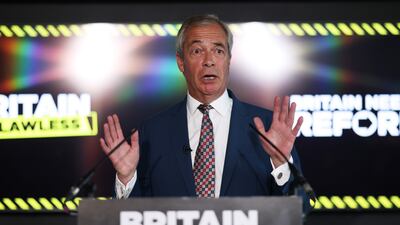
Mr Farage attends a press conference on law and order in London in August 2025 -
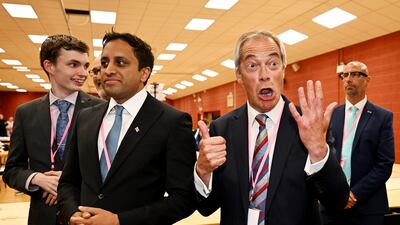
Mr Farage celebrates as Reform candidate Sarah Pochin is declared the winner of the Runcorn and Helsby by-election in May 2025 -
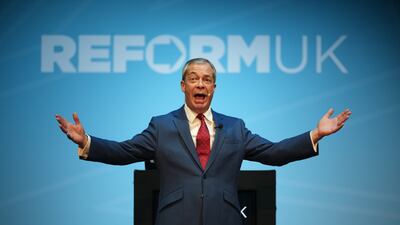
Mr Farage speaks on stage during the Reform UK East Midlands Conference in Leicester in January 2025 -
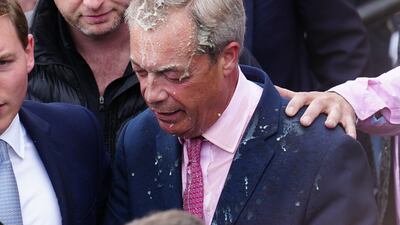
Mr Farage after a woman threw a drink over him at the launch of his general election candidacy at Clacton Pier in 2024 -

Mr Farage shares a joke with boxer Derek Chisora during a visit to a gym in Clacton-on-Sea in 2024 -
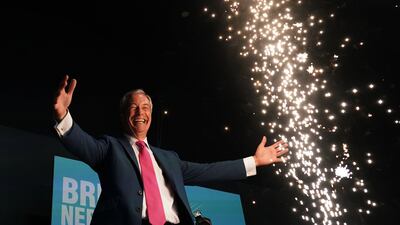
Mr Farage at a campaign event in Sunderland in 2024 -
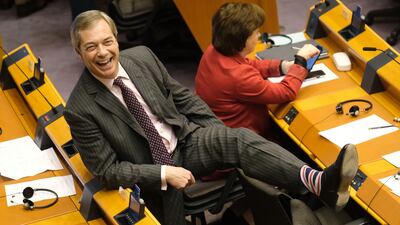
Mr Farage, then Brexit Party leader and member of the European Parliament, before the Brussels parliament was to approve the Brexit deal, in January 2020 -
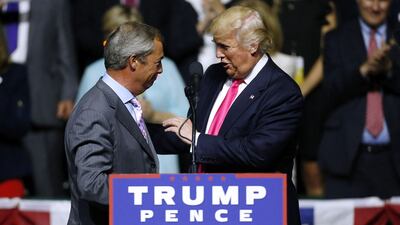
Republican presidential nominee Donald Trump greets Mr Farage at a 2016 campaign rally in Jackson, Mississippi -
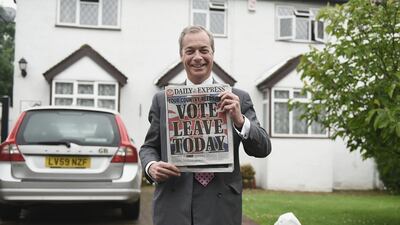
Mr Farage, as leader of Ukip and a prominent Vote Leave campaigner, holds up the Daily Express as he returns home after buying newspapers in Westerham in 2016 -
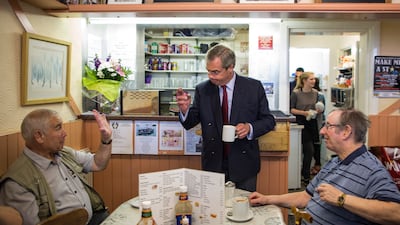
Mr Farage speaks to members of the public at a cafe in Ramsgate in 2016 -
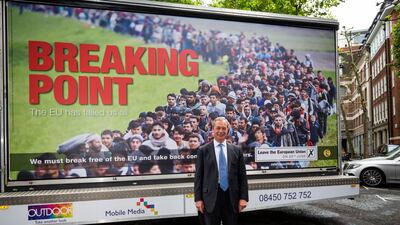
Mr Farage poses with the Ukip's EU referendum poster in Westminster in 2016 -
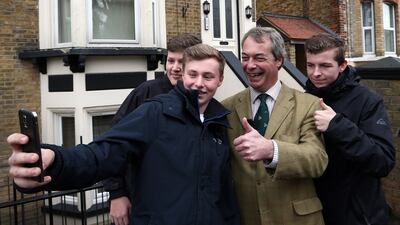
Mr Farage has a selfie taken as he canvasses in the Thanet South constituency in Broadstairs in 2015 -

Mr Farage is interviewed after being announced as Ukip leader again in 2010 -
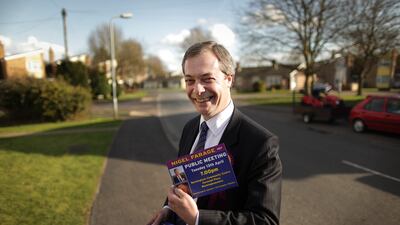
Mr Farage on the campaign trail in Winslow in 2010 -
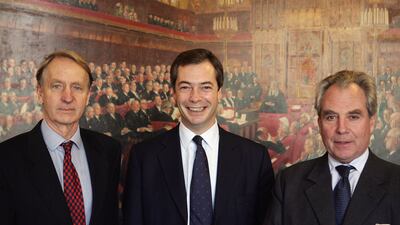
Mr Farage with Lord Willoughby de Broke, left, and Lord Pearson in London in 2007. The Conservative peers had defected to Ukip


But one well-known political candidate says he will stand in the race. He is a comedian who dresses as if he is a large dustbin, calls himself “Count Binface” and says he is an alien from outer space.
This seems a very British comedy-farce, but I have talked to Count Binface and he should not be underestimated. He is well-informed, witty, politically savvy and entertaining if – obviously – a bit eccentric.
But the comedy of this contest masks something potentially very significant. In Britain, a politician can be loathed, but if he or she is laughed at, that can be terminal. Mr Farage has possibly made a catastrophic error in forcing an unnecessary election while facing serious investigations of his sources of money.
The election will come in peak holiday season, in mid-August. Pollsters and pundits suggest voters could show their annoyance and vote Binface. Either way, the “campaign” may prove to be one of the strange yet significant political moments in recent British history.
Could Count Binface actually win? Given the increasingly peculiar nature of British politics, and the fact that voters dislike politicians who force unnecessary elections, Mr Farage may now begin to feel uneasy. And even if he wins, if the subsequent parliamentary investigation finds any wrongdoing on his part, he may be forced to resign again after a recall motion, and fight yet another by election.
Yes – British voters have a sense of humour, but they do not like being taken for fools. Mr Farage knows he is in big trouble. Count Binface – the bin-wearing challenger who calls himself an “intergalactic space warrior” – could end the career of a man who for three decades has longed to become prime minister.
If this were offered as a movie script, you would think it too far-fetched.

