A majority of children around the world will have gone to school this morning. Perhaps their parents watched them leave or reminded them to pack something. Or perhaps they did not think about it at all, because they did not need to.
There is a quiet promise that is so routine they may have forgotten it is a promise: that the place where their children learn will still be there tomorrow, that they will be safe there and that the system their societies built to carry knowledge from one generation to the next will be allowed to stand.
It is a promise most parents might take for granted. Yet it exists because, over the past century, the international community sought to formalise it. The protection of schools during war appears in the Geneva Conventions, in cultural protection treaties and in global education commitments endorsed by nearly every government. In recent years, 123 states have also endorsed the Safe Schools Declaration, pledging to protect students, teachers and educational facilities during armed conflict.
Yet that promise, it turns out, was never universal. And today, it is eroding for too many children. This is happening at a time of such major geopolitical developments that most of the world has not fully registered that it happened.
What some scholars describe as scholasticide – the systematic destruction of an education system during conflict – risks becoming normalised in Gaza. Even at the beginning of the conflict, hundreds of schools had already been damaged. Universities had suspended operations. The concern was not only the scale, but the trajectory: that the dismantling of an education system would gradually be absorbed into the landscape of the conflict, documented and debated, but ultimately accepted as one more feature of a war the world had decided to watch.
We have reached a point, however, where the evidence no longer requires interpretation. According to UN agencies, more than 90 per cent of Gaza’s school buildings have been damaged and destroyed during the war, requiring either full reconstruction or major rehabilitation before they could function again. Universities have ceased functioning as full institutions, despite improvised efforts to sustain some teaching under extreme conditions.
Approximately 660,000 school-age children have been deprived of regular education for more than two academic years. Thousands of students and hundreds of educators have been killed. Libraries, archives and research collections have been destroyed.
These figures have been documented by the UN, confirmed by satellite imagery and catalogued by institution. In July last year, the presidents of Gaza’s universities published an open letter describing the devastation: campuses razed, higher education across the territory shattered, institutions attempting to sustain intellectual life in ruins.
International mechanisms exist to document attacks on education, but they rarely translate into meaningful accountability. The destruction of education systems during war, whether through targeting, collateral damage or prolonged siege conditions, is one of the oldest strategies of conquest.
When Rome destroyed Carthage in 146 BC, the scrolls burned with the city. When the Mongols sacked Baghdad in 1258, they destroyed the House of Wisdom and drowned centuries of Islamic Golden Age scholarship in the Tigris River. The target was the intellectual continuity of a civilisation: the capacity of a people to carry themselves forward, to think, remember and reconstitute.
Across later centuries, the pattern continued. Colonial systems often restricted access to education as a mechanism of control. By 1900, many indigenous children in Canada had been placed in residential schools designed to sever the transmission of language, history and identity. During the Second World War, Nazi authorities closed every Polish university and arrested more than a hundred professors in a single operation in an effort to decapitate intellectual life. Cambodia’s Khmer Rouge shut every school, executed educators as a class enemy and produced a knowledge crisis that lasted decades.
-
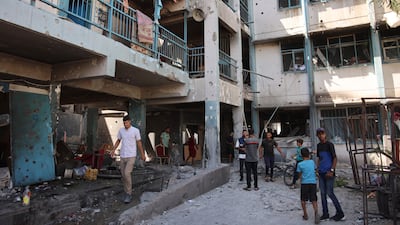
Palestinians inspect the damage at the site of an Israeli strike on a school in Gaza city's Al Zeitoun neighbourhood on Saturday. AFP -
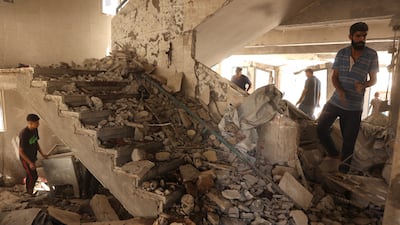
Palestinians inspect the damage at the site of an Israeli strike on a school in Gaza city's Al Zeitoun neighbourhood on Saturday. AFP -
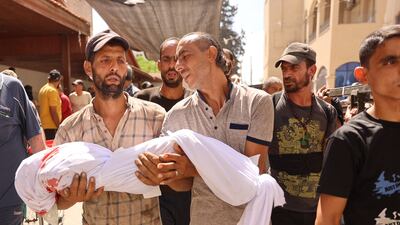
Palestinians carry the body of a child during a funeral after an Israeli strike on a school in Gaza city's Al Zeitoun neighbourhood on Saturday. AFP -
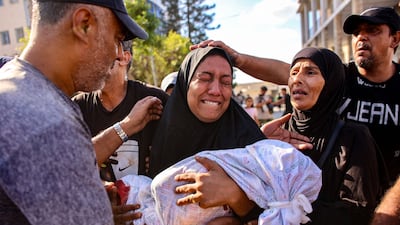
A woman mourns as she holds the shrouded body of a child killed during the strike on Saturday. AFP -
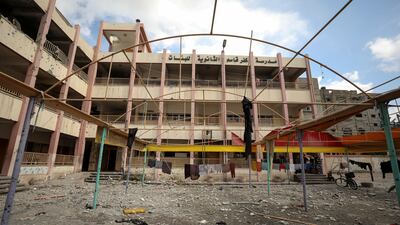
Damage to a school building hit by an Israeli air strike on the Beach refugee camp in Gaza city on Sunday. Reuters -
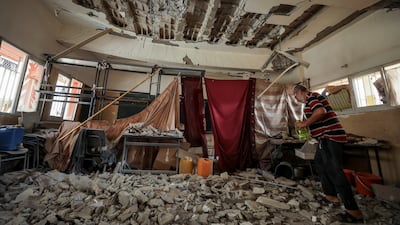
A Palestinian man inspects the damage to a school in the Beach refugee camp after a strike on Sunday. Reuters -
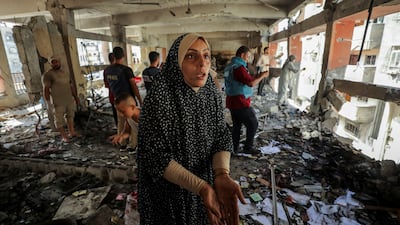
Palestinians inspect the damage to a school hit by an Israeli strike in the Beach refugee camp on Sunday. Reuters -
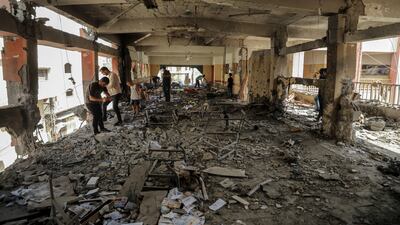
Palestinians inspect the damage to a school in the Beach refugee camp after it was struck on Sunday. Reuters


In more recent conflicts, universities and schools have repeatedly been damaged or destroyed, from Bosnia in the 1990s to Iraq after 2003.
In each of these cases, however belatedly, however imperfectly, the international community eventually responded. Bosnia generated the International Criminal Tribunal for the former Yugoslavia. Cambodia produced the Extraordinary Chambers. Iraq’s shattered education sector became central to international reconstruction. Even the colonial cases, generations later, produced truth commissions and reparative frameworks.
By and large, they were slow, incomplete and often too late for those who suffered most. But the responses existed. The destruction of education was recognised as something that required an answer. Gaza has not yet produced any such answer.
Satellite verification, institutional records, named victims and evidence captured in real time have produced one of the most comprehensively documented cases of education system collapse in modern history.
The combination of greater destruction, better evidence and fewer consequences is not a paradox. That is what desensitisation looks like, and it should concern us all.
Once the destruction of an education system produces no meaningful enforcement of the protections designed to prevent it, those protections have not just failed, they begin to lose credibility everywhere. Every armed actor in every current and future conflict now has an operational precedent: education infrastructure is a permissible target when the political environment accommodates it.
In recent years, schools have been struck in several theatres beyond Gaza. A missile attack on a girls’ school in Iran killed nearly 160 people. Hostilities in southern Lebanon forced repeated school closures and damaged education infrastructure. None of these cases are identical. But they share a trajectory: education systems are increasingly exposed to the direct consequences of modern warfare, and the global institutional response grows quieter each time.
The framework that failed to protect someone’s children is the same framework that is supposed to protect everyone else’s.
In the Arab world, including North Africa, nearly half of the population is under the age of 25. In several countries, more than 60 per cent of citizens is under 30. The stakes are not theoretical. Unctad, the UN body that analyses trade, development and the economic effects of crisis, reported that Gaza’s economy has effectively collapsed: output has fallen by more than 80 per cent, unemployment has reached about 80 per cent and virtually the entire population of 2.3 million people now lives below the poverty line.
The destruction of an education system does not merely interrupt schooling. It compounds the collapse of everything else. A generation that loses access to learning does not disappear. It becomes the unemployment crisis, the economic fragility and the political instability that will emerge years later and be discussed as though they were unexpected.
They are not a mystery. They are the predictable consequence of choices being made now, with full knowledge of their consequences, in full view of the world.