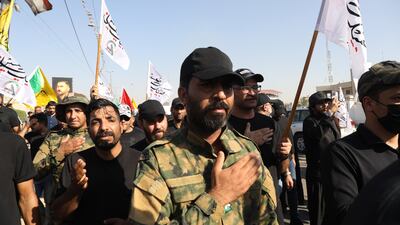

A new government is set to be inaugurated in Baghdad at a moment of acute national and regional volatility. It will assume office at a critical crossroads and face a defining test: either pursue and implement far-reaching structural reforms, including the credible resolution of armed non-state actors from state institutions, or risk a slide into intensified confrontation between the US and entrenched militia networks, with potentially violent consequences for the state itself.
Iraq occupies a precarious position amid ongoing US-Iran tensions. It is neither a direct party to the confrontation nor an insulated bystander, but rather has become a contested arena where regional and international rivalries converge. Its dependence on US security support, combined with deep Iranian political, economic and militia-linked influence, creates a structurally complex environment and represents one of the most pressing challenges confronting the new government.
In recent weeks, US bases in Iraq were subjected to hundreds of drone and rocket attacks, directed or enabled by Iran and carried out largely by aligned militias operating under the “Islamic resistance in Iraq”. These operations caused damage to critical military and diplomatic infrastructure and underscored the growing operational capacity of non-state actors within Iraq.
The Kurdistan Region of Iraq, widely perceived as a permissive environment for US military presence, was also heavily targeted, facing about 500 aerial attacks during the same period. More than 60 per cent originated from Iran-aligned factions within the Popular Mobilisation Forces, with the remainder launched from Iranian territory. These strikes inflicted significant damage on energy infrastructure, Peshmerga installations and civilian areas. At least 24 fatalities were recorded, including civilians, Peshmerga personnel and members of Iranian-Kurdish opposition groups.
As a non-sovereign entity, Kurdistan lacks the capacity to independently secure its air space or use advanced air defence systems. Effective aerial protection remains largely confined to Erbil, where US military and diplomatic facilities are located. Beyond this limited zone, critical infrastructure across the region remains highly vulnerable to repeated attacks.
For Iran and its aligned militias, Kurdistan represents both a soft and symbolically significant target within Iraq’s fragmented security landscape. These attacks serve multiple objectives: deterring hostile operations near Iran’s borders, signalling strategic resolve, pressuring Baghdad and Erbil to limit US engagement, and reinforcing militia relevance without crossing the threshold into full-scale war.
Meanwhile, the Iraqi government and key Shiite actors within the Co-ordination Framework, an umbrella organisation of Iran-aligned factions, have neither decisively condemned these attacks nor taken meaningful action to prevent them. This inaction continues to fuel internal tensions and is likely to generate greater political and security repercussions in the near term.
Baghdad’s limited capacity to control Iran-aligned armed groups reflects a deeper structural reality. These actors are embedded within the state itself, particularly through the PMF, yet retain autonomous command structures and external loyalties. Their influence extends across Iraq’s political system, including the legislative, executive and judicial branches. This has produced a condition of hybrid sovereignty, where authority is fragmented and governance is shaped through negotiation rather than centralised control.
These dynamics profoundly affect state-militia relations, Baghdad-Erbil ties and Iraq’s international partnerships. The presence of armed groups operating beyond effective state control undermines confidence in Baghdad’s authority and complicates its ability to uphold constitutional responsibilities or implement agreements. The result is a cycle of recurring political, security and economic crises.
The impact on the Kurdistan region has been severe. Persistent insecurity has disrupted civilian life and eroded public trust. Economically, attacks on energy infrastructure have constrained production, delayed exports and deterred investment. Fiscal pressures have intensified, complicating governance and service delivery. These challenges are compounded by internal fragmentation within Kurdistan’s political and security structures.
At the national level, the consequences are even more profound. The continued operation of armed groups outside full state control erodes institutional legitimacy and entrenches a fragmented security order, increasing the likelihood of Iraq becoming a sustained arena for proxy confrontation. For US-Iraq relations, ongoing attacks strain security co-operation and risk narrowing the relationship to short-term security concerns at the expense of broader engagement.
-

Iraqi election workers count ballots in Baghdad after an early voting day for security forces and displaced people in the country's national parliamentary election. EPA -

The early voting day on Sunday took took place two days before polls open to the public across the country on Tuesday. AFP -

Members of the security forces stand guard outside a polling station in Mosul. Reuters -

A policeman checks comrades arriving to vote at a polling station in Baghdad. EPA -

Displaced Iraqis prepare to cast their vote at a polling station in the Debaga camp east of Makhmur, in northern Iraq. AFP -

A policeman flashes the V sign while standing in the queue to vote in Baghdad. EPA


More seriously, the risk of direct confrontation between the US and Iraqi militias is growing. While US responses have so far remained calibrated, the potential for escalation into a broader campaign, targeting militia leadership, infrastructure and drone capabilities, remains significant, irrespective of the trajectory of the US-Iran negotiations. Given the blurred boundaries between state and non-state military facilities, state security infrastructure could also be struck. Furthermore, Washington might resort to applying harsh fiscal and economic pressure on the country, too.
Washington is also likely to view the next Iraqi government as a continuation of the current political order, given that the incoming prime minister will emerge from the same Co-ordination Framework dominated by pro-Iranian and PMF-linked factions. Consequently, the new government may find itself similarly constrained, unable to prevent external strikes, yet expected to absorb their political and financial consequences. This dynamic underscores persistent governance fragility and adds to Iraq’s already strained public finances through reconstruction and compensation demands.
Regionally, the implications are equally consequential. Drone attacks conducted by PMF-aligned groups against neighbouring states, particularly the Gulf countries, Jordan and Syria, have extended the impact of Iraq’s internal fragmentation beyond its borders, reshaping how Iraq is perceived across the Arab world.
As long as armed actors retain the ability to use Iraqi territory for coercion, retaliation or signalling, Baghdad will struggle to present itself as a sovereign and reliable partner. Failure to address this challenge risks deepening tensions with the immediate neighbours too, leading to diminished political support, eroding trust and a gradual form of Arab disengagement. Restoring confidence will therefore require more than domestic stabilisation; it will necessitate a credible commitment to preventing the use of Iraqi territory in ways that undermine regional security.
Looking ahead, Iraq faces a convergence of risks: escalation, institutional erosion and economic stagnation. Progress will depend on gradual de-escalation and incremental institutional reform, particularly in clarifying command-and-control structures. However, given the entrenched position of non-state actors with transnational ties, meaningful reform will be complex and protracted, if at all.
Iraq’s federal government must pursue a dual-track approach, incrementally consolidating control over armed actors through political agreements while retaining credible coercive leverage. International partners, though increasingly frustrated, retain influence through conditional engagement and targeted support. Absent meaningful reform, Iraq’s political and security dynamics risk tipping towards large-scale confrontation and systemic instability.

