


Live updates: Follow the latest news on US-Iran war
The ramifications and unintended consequences of the war on Iran are not confined to the Middle East. Take the continent and oceans to the east, the vast area known as the Asia Pacific, more recently re-termed the “Indo-Pacific” by the US and some of its allies.
The latest National Security Strategy document, published by the administration of US President Donald Trump just last November, states: “The Indo-Pacific is already the source of almost half the world’s GDP based on purchasing power parity, and one third based on nominal GDP. That share is certain to grow over the 21st century. Which means that the Indo-Pacific is already and will continue to be among the next century’s key economic and geopolitical battlegrounds. To thrive at home, we must successfully compete there.”

How is that going for the US at the moment? Well, the energy crisis caused by the war is having a huge and immediate impact across Asia – the destination for more than 80 per cent of the crude oil and liquefied natural gas that passes through the Strait of Hormuz.
In Bangladesh, universities have been closed and fuel rationing introduced to reduce electricity and fuel consumption. Vietnam has urged businesses to allow employees to work from home, again, to conserve fuel. In the Philippines, President Ferdinand Marcos Jr has ordered some government departments to switch to a four-day week. In Malaysia, the government’s fuel subsidy bill – to keep petrol and diesel affordable – is expected to rise by 400 per cent to more than $800 million a month.
In Indonesia, the chairman of the country’s Logistics Association said that container shipping rates had gone up 25 per cent in the first 10 days of the war, while another industry body warned that international logistics costs could rise up to 40 per cent because of the disruption to shipping. And it’s not just oil and gas.
About one third of the world’s fertiliser supplies also pass through the Strait of Hormuz. Prices of one nitrogen-based fertiliser are reportedly already 40 per cent higher in South-East Asia than before the war. Food exports from Asian countries cannot get through to the Gulf, while higher fertiliser costs will inevitably lead to prices of locally produced food going up.
As if that wasn’t bad enough in terms of perceptions of American reliability, there is the security aspect.
Last year, US Secretary of Defence Pete Hegseth told an audience in Singapore: “No one should doubt America’s commitment to our Indo-Pacific allies and partners.” When the US installed its Terminal High Altitude Area Defence missile system in South Korea in 2017, it caused a diplomatic crisis with China. The Thaad system was supposed to counter threats from North Korea, but Beijing argued it compromised its own security, and the move was the subject of endless discussions at conferences in the whole region (as I can testify, since I was with Malaysia’s national think tank at the time).
But now, the US is moving its Patriot missiles and Thaad interceptors out of the country to support its actions in the Gulf. South Korean President Lee Jae Myung opposes their removal, but he told his cabinet last week that “it is an undeniable reality that we cannot fully have our way on this matter”. Ely Ratner, assistant secretary of defence in the administration of former US president Joe Biden, put it more strongly. He said this “sends a terrible signal at a time when there are already huge concerns in Seoul about the Trump administration’s shaky commitment to Asia”.
The 2,500-strong US Marines unit that are being sent to the Middle East are also coming from East Asia. They are usually based in Okinawa, Japan, and their departure means that there will now be “no quick response force to aid operations in the Pacific theatre”, a senior former US defence official told The New York Times. If these men and materiel were so crucial to the US’s presence in the region, how can they be shifted out at a moment’s notice?
I discussed all of this with two friends who have spent decades advising governments from Australia to China, as well as several countries in South-East Asia. Our conclusions about regional perceptions were that the current experience of the Gulf shows that US bases do not protect their hosts – they make them a target, and Washington’s struggle to force the Iranian leadership to capitulate makes them appear militarily weaker than expected. Mr Trump’s capricious and frequently insulting behaviour towards US allies in Nato serves as a warning to treaty allies in the Asia Pacific.
The US and Israel acting outside of international law, and with a habit of launching attacks on the people they are supposedly negotiating with, leads to “weakened institutions, and the erosion of trust”, as Malaysian Prime Minister Anwar Ibrahim put it in a speech earlier this week. Mr Trump also loses face twice in the region: once for delaying his meeting with Chinese President Xi Jinping, and twice for having to ask Beijing to send warships to the Strait of Hormuz, a request that was turned down in any case.
-
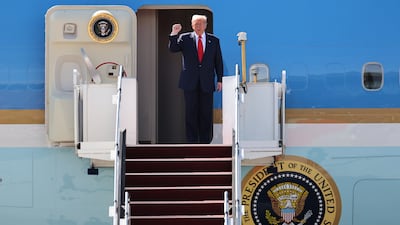
US President Donald Trump disembarks from his Air Force One flight on arrival at Kuala Lumpur International Airport to attend the 47th Association of Southeast Asian Nations (Asean) summit in the Malaysian capital. AP -
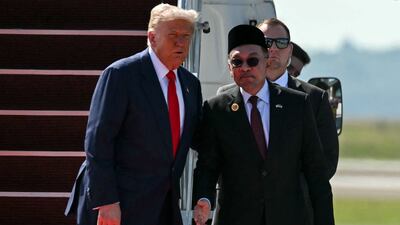
US President Donald Trump with Malaysia's Prime Minister Anwar Ibrahim at Kuala Lumpur International Airport. The US President arrived in Malaysia on October 26 on the first leg of an Asian tour that will include trade talks with Chinese President Xi Jinping. AFP -
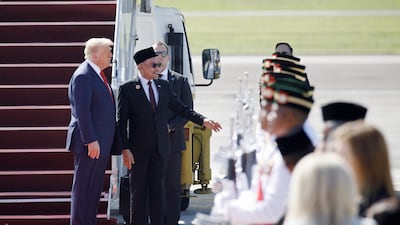
US President Donald Trump with Anwar Ibrahim, Malaysia's Prime Minister, after arriving at Kuala Lumpur International Airport in Malaysia. Bloomberg -
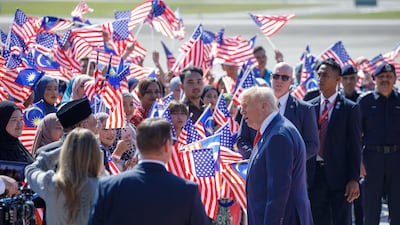
A flag-waving reception for US President Donald Trump at Kuala Lumpur International Airport in Malaysia. Bloomberg -
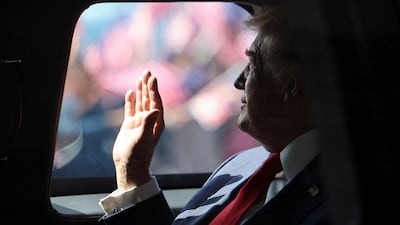
US President Donald Trump waves from his official vehicle as he heads to attend the 47th Asean summit in Kuala Lumpur, Malaysia. Reuters -
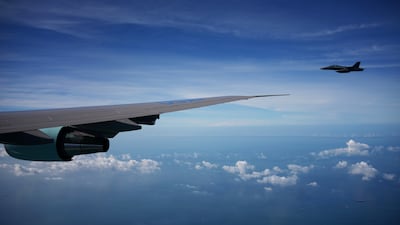
A Royal Malaysian Air Force F-18 Hornet fighter jet escorts Air Force One with US President Donald Trump aboard en route to Kuala Lumpur International Airport in Malaysia. Getty Images


Anti-American sentiment in the region – home to about 250 million Muslims – had already been stoked by outrage at the carte blanche both the Biden and Trump administrations appeared to give Israeli Prime Minister Benjamin Netanyahu to act as he willed in Gaza. Mr Trump’s wilful imposition of tariffs, some punitive, didn’t help – even if the US Supreme Court has since ruled that most of them were illegal. Now the war on Iran has led Indonesia to suspend participation in Mr Trump’s Board of Peace, while the country’s influential Ulema Council has called for a full exit.
“This is a Suez moment for America,” one of my analyst friends said during our discussion – referring to the failed joint attack by Britain, France and Israel on Egypt in 1956, which is regarded as the instance of imperial overreach that marked the end of the UK’s status as a great power.
The parallels aren’t exact, and I might not go so far. But for America’s reputation in the Asia Pacific, it is undoubtedly catastrophic.
The US National Security Strategy also contains the following sentence: “President Trump is building alliances and strengthening partnerships in the Indo-Pacific that will be the bedrock of security and prosperity long into the future.” The words now sound more like a forlorn aspiration – or even a bad joke – than a statement of fact. For who can trust and rely on a country willing to carelessly inflict so much economic damage on its supposed friends, while the security guarantee it promises may bring war instead of peace?
I’m reminded of a former colleague at Malaysia’s national think tank who told me years ago, “the Americans always leave in the end”. That may be overly pessimistic, and many in the Asia Pacific don’t want the US to depart. In the chancelleries of the region, they will still be recalibrating their friendships and alliances, however. And one big neighbour may increasingly look like a more dependable partner. I’m sure there are plenty ready to answer the phone in Beijing.

