
Pope Leo XIV visited Lebanon this week, the third visit by a supreme pontiff to the country since John Paul II in 1997 and Benedict in 2012 (Pope Paul VI stopped very briefly in 1964, on his way to India). The fact that Lebanon is the site of the Pope’s first foreign visit (with Turkey) is significant. The country holds the highest percentage of Christians in the Arab world.
It is reasonable that Pope Leo saw a need to provide support for a Lebanese-Christian community whose numbers are dwindling. In recent years, the country’s economic collapse and the horrific explosion at Beirut port in August 2020, which devastated mainly Christian neighbourhoods, helped cause an exodus from the country, hitting Christians particularly hard because of their smaller numbers.
This came on top of the sharp decline in the Christian populations of other Arab countries in the past two decades, notably Iraq and Syria, mainly because of the US invasion of Iraq and its aftermath and the Arab uprisings. In light of this, Lebanon has added importance for the Catholic Church as a place to staunch the Christian exodus.
Yet beyond how the Pope sees Lebanon, how do Lebanon’s Christians view their own future in their country? What mood might the pontiff have caught while on his visit? If he got a sense of this, it cannot have been reassuring.
Lebanon’s Maronite-Christian community played a central role in the establishment of a Lebanese state in the period immediately following the First World War, and no less important a part in the emergence of an independent Lebanon in 1943. However, today, Christians are far less confident about their country, in large part because their minority status has become more evident in comparison to Lebanon’s two largest communities – the Sunnis and Shiites.
That is not to say that Christians are being marginalised, or are even willing to roll over and accept irrelevance. They still hold 50 per cent of the positions in government, Parliament and other state bodies, at least on paper, but their major problem is that many seem to have lost conviction in the realisation of any Lebanese national project, and their contribution to it.
-
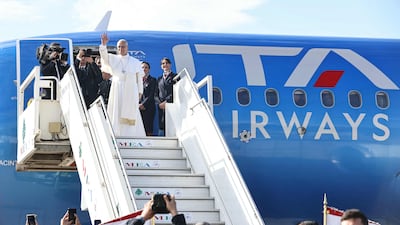
Pope Leo XIV waves as he leaves Beirut International Airport. AFP -
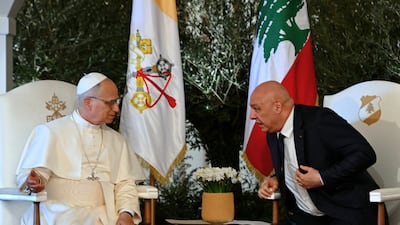
Pope Leo speaks to Lebanese President Joseph Aoun during a farewell ceremony at the airport. AP -
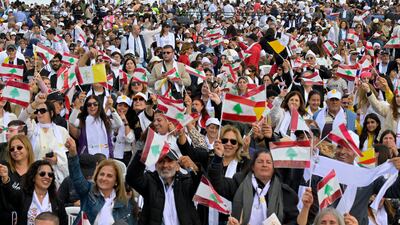
People wave Lebanese flags at a mass led by Pope Leo at the Beirut waterfront. EPA -
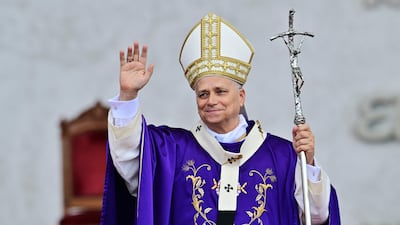
The Pope waves at the end of the mass. AFP -
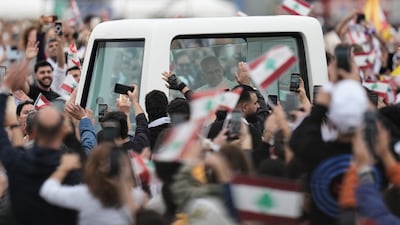
Pope Leo arrives at Beirut waterfront. AP -
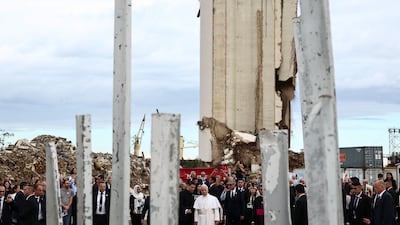
The pontiff holds a silent prayer at the site of the 2020 Beirut port blast. AFP -
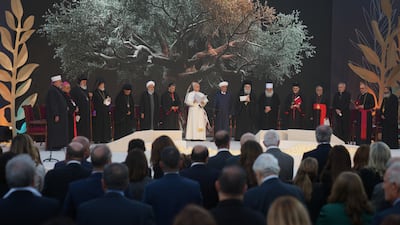
Pope Leo attends an ecumenical and interreligious meeting near the Mohammad Al Amin Mosque, in the Martyrs' Square in Beirut. AP -
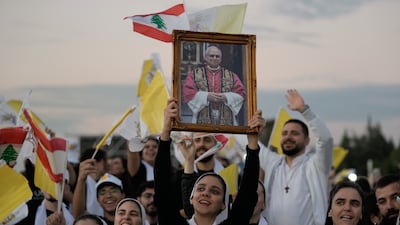
People hold aloft a portrait of Pope Leo as an expectant crowd awaits his arrival in Bkerki. AP -
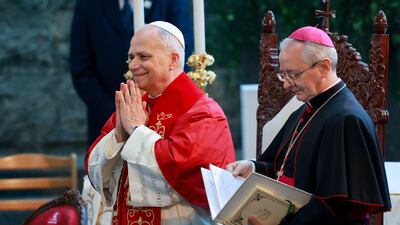
The Pope arrives to meet bishops, priests, consecrated people and pastoral workers at the Shrine of Our Lady of Lebanon in Harissa. Reuters -
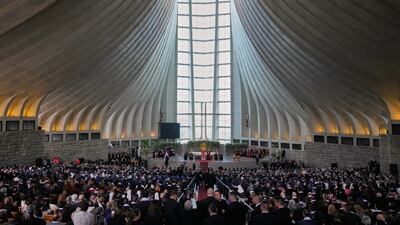
A crowd attends the gathering at the Catholic Basilica of Harissa. AP -
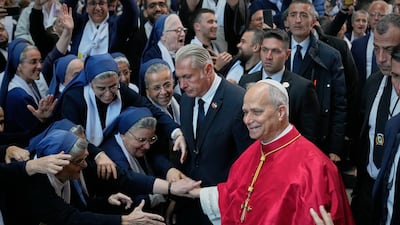
Nuns reach out to Pope Leo as he arrives at the Catholic Basilica of Harissa. AP -
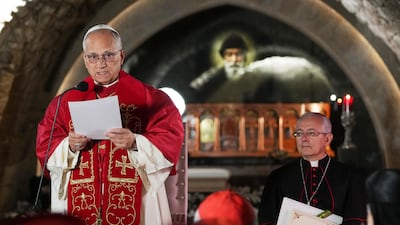
Pope Leo delivers a speech in front of the tomb of St Charbel Makhlouf at the Monastery of St Maroun, in Annaya. EPA -

Pope Leo visits the Monastery of the Carmelite Sisters of the Theotokos in Harissa. EPA / Vatican Media -
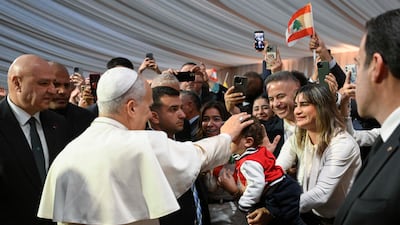
Pope Leo blesses a child during a warm welcome as he arrives in the country at Beirut International Airport. EPA -
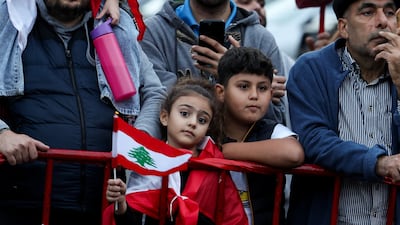
A child holds a Lebanese flag on the day Pope Leo arrives in Lebanon. Rueters -
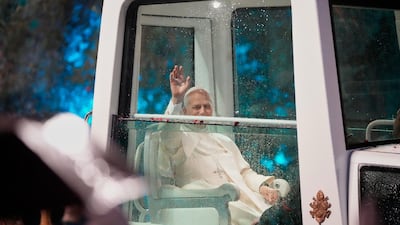
Pope Leo arrives for a welcoming ceremony at the Presidential Palace in Baabda, east of Beirut. AP -
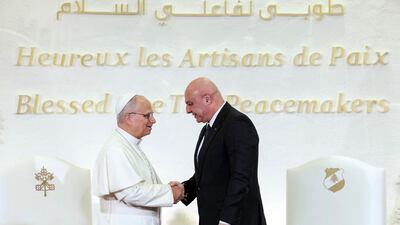
Pope Leo meets Lebanese President Joseph Aoun at the Presidential Palace. AFP -
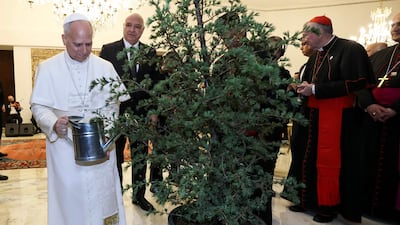
The pontiff, watering a tree next to President Aoun, was making his first foreign trip on a six-day visit to Turkey and Lebanon. AFP -
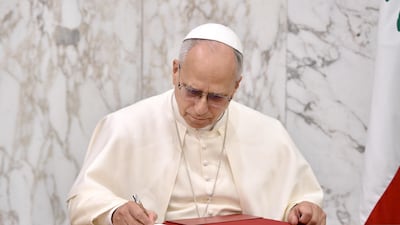
He wrote a dedication in the guest book at the end of his courtesy visit. EPA -
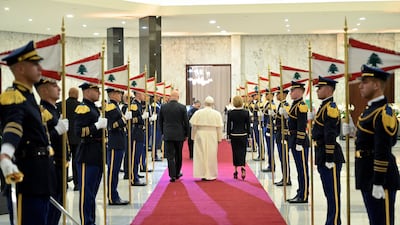
Pope Leo, President Aoun and his wife Neamat, the first Lady of Lebanon, review a guard of honour. EPA -
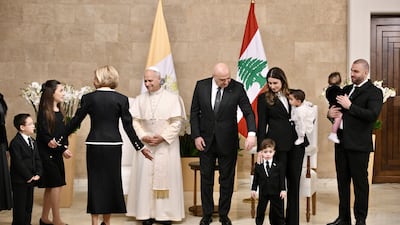
Pope Leo meets President Aoun's family. AFP -

Pope Leo receives a gift at the Presidential Palace. Reuters -
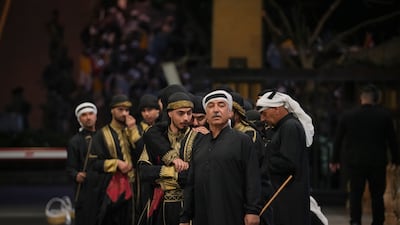
Members of different groups perform during Pope Leo's visit to the Presidential Palace. Getty Images -
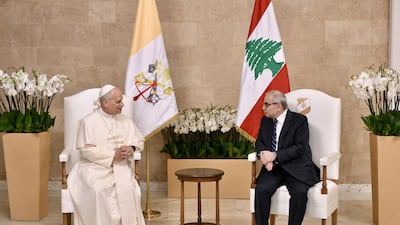
Pope Leo meets Lebanese Prime Minister Nawaf Salam. AFP


Instead, they are increasingly drawn to what are effectively projects of separation, albeit to different degrees. Perhaps such a mood is understandable, as no one in Lebanon feels that a national agenda is possible in a country so fragmented. Since 2011, when the door was closed on the interregnum of hope following the Syrian withdrawal of 2005, and Hezbollah effectively took over running the country, many Christians saw Lebanon going in a direction with which they could not identify.
Much has changed since then, not least Hezbollah’s weakening in the conflict with Israel last year. But this hasn’t changed Christian attitudes towards various models of separation – federalism, partition, or broad administrative decentralisation – which have very different implications, and may not match Christian expectations.
Federalism, for example, would not really resolve what has disturbed many Christians in recent years, namely the domestic and foreign policy directions imposed by Hezbollah. Under most federal systems, foreign policy and defence are governed by the central government, not federal cantons, so the problem would remain the same.
Partition, in turn, is not sensible in so small a country as Lebanon. Economically, the smaller entities would not survive. Moreover, many Christians live in Muslim-majority areas. What happens to them? The blithe nature of the discussion on partition is also ahistorical. Throughout the 20th century – in Palestine, Cyprus, Ireland, Vietnam and India – partition led to terrible bloodshed, while leaving conflicts mostly unresolved.
Broad administrative decentralisation is a far more realistic option. It would be justified by the Taif Agreement’s clauses on administrative decentralisation, but expanded to also include financial decentralisation. This would give Christian areas greater latitude to run their financial affairs and address the beef that their areas pay relatively more in taxes than those in which the state’s presence is less pronounced.
A discussion of such political issues was not on the Pope’s public agenda, but politics cannot be far from any consideration by the church of the Christian presence in Lebanon. One potential challenge for the community is that, increasingly, there is talk of implementing Taif in its entirety, as part of a quid pro quo for Hezbollah’s disarmament. This would involve abolishing sectarian quotas, thereby giving relatively more representation to the Muslim communities, which in turn would encourage Shiite groups, Hezbollah in particular, to surrender their weapons.
The real question, however, is not just the number of parliamentary or cabinet seats Christians retain, or fail to retain, but whether they can again feel they are a part of a collective cross-sectarian effort that gives their citizenship meaning. Therefore, at the heart of the Christian presence is Lebanon’s deep dysfunctionality as a state. Unless and until the state becomes functional, the Lebanese will continue to send their children abroad, with most never returning, and by extension Christian numbers will decline.
In 1997, Pope John Paul stated that Lebanon was “more than a country: it is a message of freedom and an example of pluralism for East and West”. The phrase has been quoted ad nauseam, but still contains an essential truth: only a truly pluralistic entity that is capable of managing Lebanese society’s myriad differences, but that also preserves each community’s freedoms, will revive Lebanon with its enthralling possibilities.
But for that to happen, the Lebanese state has to serve its citizens and above all its youth. Many of them are, legitimately, asking today not what they can do for their country, but what their country can do for them.

