
As Lebanon continues to disintegrate, its political system is unequivocally broken. What had been an interesting consociational model until its civil war in 1975, was replaced at the war's end in 1990 with a pluralistic system of national pie-sharing that included the wartime leaders and a new class of businessmen.
That system began to collapse in late 2019, as Lebanon's debt and declining capital inflows brought the country to its knees financially. From a political perspective, this killed the cash cow the political cartel in power had relentlessly plundered. Yet these leaders have refused to surrender any power, while an armed militia, Hezbollah, whose loyalty is to Iran, has continued to impose its preferences, preventing the country from exiting its dire situation.
Lebanon's war ended in 1990, a year after parliament's approval of the Taif Agreement, a political reform plan negotiated in Taif, Saudi Arabia, in September-October 1989. The constitution was amended, transforming a presidential system into one in which the main executive body became the council of ministers. While the changes redistributed power among the religious communities, what Taif also created was a perfect structure for a carving up of the state among sectarian leaders, many of whom had previously led militias.
Whereas sectarian power-sharing had been a feature of the pre-war state, the war and Syrian hegemony after 1990 thoroughly undermined national institutions. The sectarian leaders and their Syrian patrons were able to hijack the state after the war ended and turn ministries and state bodies into profitable fiefdoms. Consequently, Lebanon’s financial system in the 1990s was geared towards financing what had become the facade of a state, one ruled by politicians for whom all issues were resolved through manufactured crises that hastened mutually-profitable resolutions. Lebanon’s reconstruction generated massive corruption and theft, which became an inherent part of the political order.

Since the Syrian withdrawal in 2005, after the killing of Rafik Hariri, the post-Taif constitution has been transformed into an instrument of blockage. By effectively imposing a system of sectarian unanimity for all major decisions, the document has prevented progress when there is no consensus among the ruling cartel. The political system has staggered from one impasse to the next, as the politicians and parties have held the state hostage in order to force through their political priorities.
The impaired nature of political decision-making has heightened a feeling that a united Lebanon is no longer worth preserving. That is why the country's sectarian reflexes are pushing many to think of mechanisms of separation that would allow Lebanon to function better, albeit within the hollowed out shell of a single state.
A major factor encouraging such thinking is the presence of Hezbollah. Because the party is too strong to be brought to heel by the state and is closely integrated with one of Lebanon’s major religious communities, there are those who believe the best option is to move towards a soft divorce. In that way, many areas of Lebanon might be able to isolate themselves from Hezbollah’s efforts to use the central government to impose its will, or wage war with Israel on Iran’s behalf.
-

An anti-government protester shouts slogans as other demonstrators burn tyres to block the road during a rally against the power cuts, the high cost of living and the low purchasing power of the Lebanese pound, in front of Lebanese Central Bank at Hamra street in Beirut, Lebanon. EPA -

Riot police stands guard in front of Lebanese Central Bank during a rally against the power cuts, the high cost of living and the low purchasing power of the Lebanese pound, at Hamra street in Beirut. EPA -
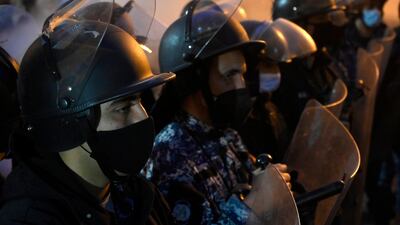
Riot police stands guard in front of Lebanese Central Bank during a rally against the power cuts, the high cost of living and the low purchasing power of the Lebanese pound, at Hamra street in Beirut. EPA -
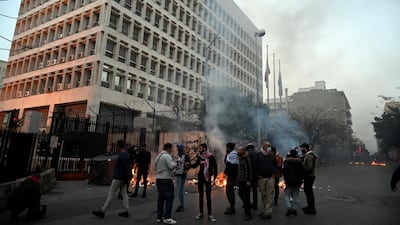
Anti-government protesters burn tyres and rubbish bins to block the road during a rally against the power cuts, the high cost of living and the low purchasing power of the Lebanese pound, in front of Lebanese Central Bank at Hamra street in Beirut. EPA -
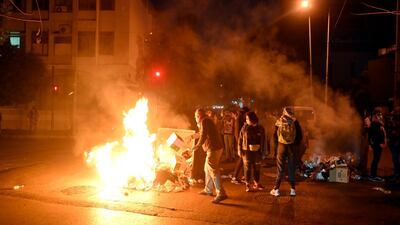
Anti-government protesters burn tyres and rubbish bins to block the main road leading to Hamra street during a rally against the power cuts the high cost of living and the low purchasing power of the Lebanese pound, in Beirut. EPA -
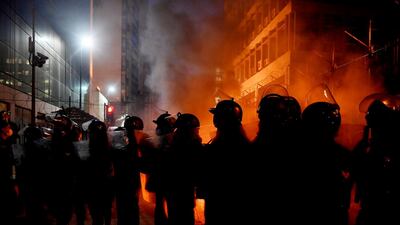
Riot police stands guard in front of Lebanese Central Bank during a rally against the power cuts, the high cost of living and the low purchasing power of the Lebanese pound, at Hamra street in Beirut. EPA -
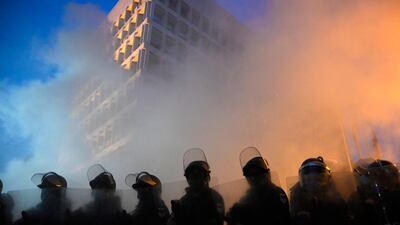
Riot police stands guard in front of Lebanese Central Bank during a rally against the power cuts, the high cost of living and the low purchasing power of the Lebanese pound, at Hamra street in Beirut. EPA


Partition cannot work in so small an entity as Lebanon, while federalism has problems of its own, not least how to reach arrangements over religiously mixed districts. But Taif did offer a partial path out by laying the groundwork for a process of administrative decentralisation.
According to Taif, this would involve broadening the authority of the heads of the muhafazaat, or governorates, and qadas, or small administrative districts. Councils would be put in place for each qada, offering some freedom, and Taif mentions redrawing Lebanon’s administrative map to boost local development.

The Taif proposals can be expanded if the aim is to accentuate decentralisation. While governors and heads of qadas in Lebanon are appointed by the central government, filling these positions through local elections instead could be a way of limiting the potential impact of political obstruction at the centre.
The purpose would be to allow each governorate and qada to function in a relatively autonomous way from the rest of the country. In the mind of supporters, this would mean that sectarian demographics at the national level would matter less, because minorities, particularly the Christians and Druze, would manage their own affairs in their respective areas. More important, this could potentially represent an initial step towards federalism.
Doubtless, there are problems with this idea. For one, Hezbollah could oppose giving up on a Lebanese state that protects its weapons, and it would be more vulnerable to attack in a country where it is mainly limited to Shia majority areas. But a decentralised system would also relieve it of having to constantly control a country whose myriad sects increasingly reject the party’s agenda.
Such a system would also reinforce sectarian leaders and parties in areas where they dominate, to the detriment of those opposing them. In other words, the sectarian stranglehold of the political cartel could be transferred to the local level. Yet an upside is that Lebanon also tends to retain strong pluralistic impulses locally, where personal and family ties tend to dominate.
But as the masonry keeps falling, now seems to be the time to think about reimagining Lebanon, whether this involves decentralisation or some other system that gives the Lebanese more of a role in deciding their fate. The post-war system morphed into a criminal enterprise run by leaders who robbed the population. Lebanon's social contract is dead and has to be replaced.
Michael Young is a senior editor at the Carnegie Middle East Centre in Beirut and a Lebanon columnist for The National