


US President Donald Trump’s leadership style has drawn plenty of praise, criticism and consternation from various quarters around the world.
One cannot discount his success in halting the war in Gaza, which is an astonishing achievement and one that underscores his exceptional abilities beyond his performative theatrics. Yet, keeping the peace in the enclave and using it as a foundation upon which to build a lasting settlement between Palestinians and Israelis demands diligent follow-up and a measure of solemnity.
Whether Mr Trump is up to the task remains to be seen.
By adopting the principle of “peace through strength”, the US President is said to be trying to restore security around the world. But it is important that he has the vision not only for how he can succeed but also for the consequences of failure, or, at the very least, an understanding of the nature of the possible obstacles. This is especially salient in the context of the Palestine-Israel conflict.
With Mr Trump given to restlessness, there are risks to the trajectory of his administration’s Middle East policy as well as to US interests more broadly, particularly given Washington’s reputation for abandoning friends and allies, and breaking promises.
Indeed, the US President’s own inconsistency regarding some global conflicts undermines the trust necessary for American leadership. For example, his wavering stand on the war in Ukraine has added to the uncertainty around the future of that conflict as well as that of Europe’s security.
This has fundamentally affected US-Europe relations. Some continental leaders are concerned by what they perceive to be Mr Trump’s capricious nature, superficial decision-making and a lack of attention to Europe’s complexities.
Some of these predispositions were on display in the Egyptian city of Sharm El Sheikh last week, when he led a ceremony to sign the Gaza ceasefire deal with leaders and diplomats representing a number of the world’s countries.
At the summit, Mr Trump avoided public mention of the two-state solution or the Palestinians’ right to self-determination. Even if he may have privately assured leaders of the Arab and Islamic nations during a meeting in New York that he remained committed to Palestinian statehood, the US President came off as evasive in Sharm El Sheikh. But this was a moment that demanded clarity and leadership from him.
True, the first phase of the ceasefire deal was focused on the joint Egyptian-Qatari-Turkish efforts to rein in Hamas in Gaza. This could justify Mr Trump’s omission of the Palestinian statehood issue, since the next phase to be led by Saudi Arabia will tackle exactly that. Still, the US President should have shown more deference to his Arab and Muslim partners by acknowledging the key end goal of the entire process.
It would also have been wiser for Mr Trump’s team to emphasise his seriousness about Middle East peace when he previously said he would not allow Israel to annex the West Bank or reoccupy Gaza. This declaration will continue to be received with scepticism unless the US President makes a binding commitment.
Of course, the US President deserves credit for forcing Mr Netanyahu to publicly apologise to the Qatari leadership, just days earlier, for violating that country’s sovereignty in pursuit of Hamas’s leaders based in Doha. His insistence that the Israeli Prime Minister agree to end the Gaza war reinforced the notion that the US President is intent on starting a new chapter in how he deals with Israel.
-

Red Cross vehicles carry hostages from Gaza city under the ceasefire agreement between Israel and Hamas. Reuters -

US President Donald Trump arrives at Ben Gurion Airport near Tel Aviv, before delivering a speech to Israel's Knesset. AFP -
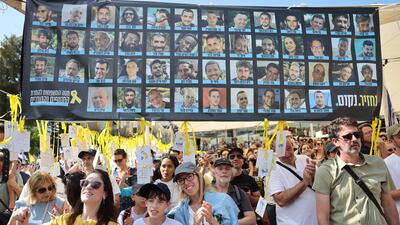
Israelis gather in Tel Aviv to celebrate the release of hostages from Gaza. EPA -

Palestinians board a bus after being released from the Ofer military prison between Ramallah and Beitunia, in the occupied West Bank. AFP -

US President Donald Trump signs the guest book at the Knesset, with Israeli Prime Minister Bejamin Netanyahu, second left, and Knesset Speaker Amir Ohana, second right -
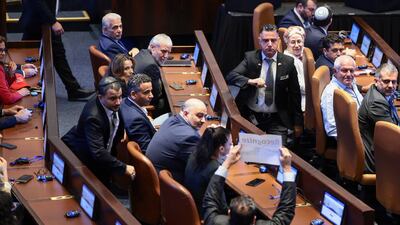
Knesset member Aymen Odeh holds up a sign bearing the message 'Recognise Palestine' during Mr Trump's speech to Israeli politicians. Reuters -
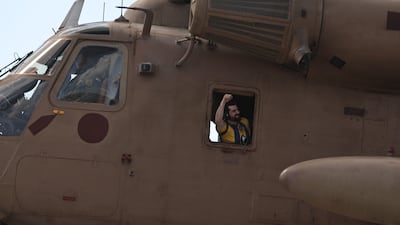
Released Israeli hostage Ziv Berman waves from a military helicopter as he arrives at Sheba Hospital, near Tel Aviv. EPA -

Released Israeli hostage Matan Zangauker, left, is greeted by his mother. AFP -

Palestinians released from Israeli jails. More than 150 have crossed the border into Egypt to live in exile. AFP -
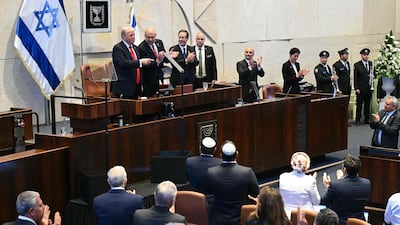
Mr Trump receives a standing ovation from Israeli politicians in the Knesset. AFP -
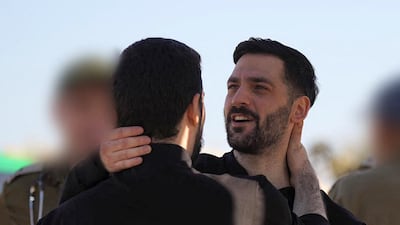
Gaza hostage Gali Berman is released as part of an exchange deal between Israel and Hamas. AFP -
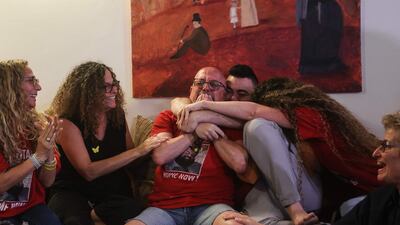
Family and friends of an Israeli hostage celebrate news that Hamas has released captives from Gaza. AFP -
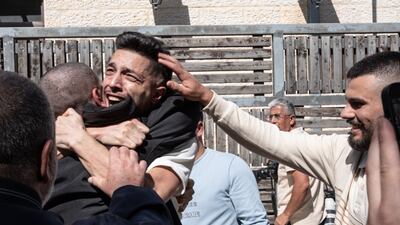
Palestinians welcome relatives released from Israeli jails. Thomas Helm / The National -
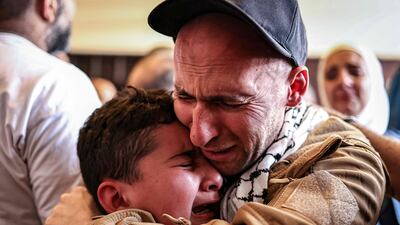
A freed Palestinian detainee arrives at Ramallah Culture Centre, in the occupied West Bank, after leaving Ofer military prison. AFP -
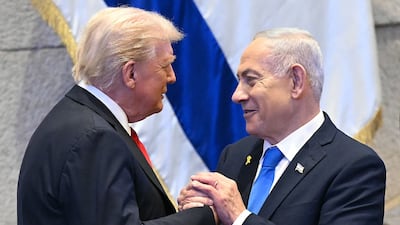
Mr Trump and Mr Netanyahu at the Knesset, where the US President was praised for his support of Israel. AFP -
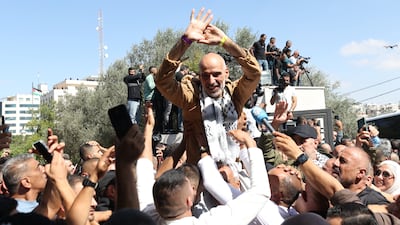
A freed Palestinian is greeted by a cheering crowd in Ramallah, in the occupied West Bank, as Israel releases hundreds of detainees from jail. EPA -
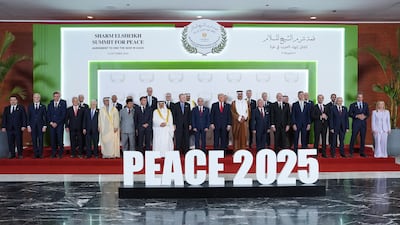
Mr Trump and other world leaders pose for a photo during a summit in Sharm El Sheikh, Egypt. Getty Images -
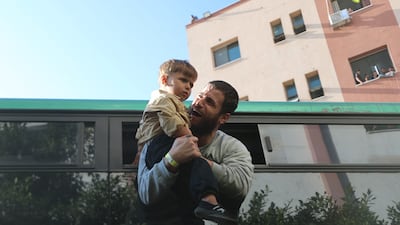
A Palestinian released from Israeli prison is reunited with family after arriving on a bus outside Nasser Hospital in Khan Younis, Gaza. AFP -
Freed hostage Avinatan Or gestures to the crowd outside Beilinson Hospital in Petah Tikva, Israel. Getty Images -
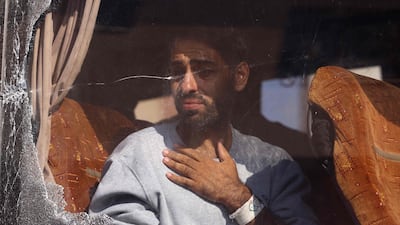
A released Palestinian arrives on a bus in Khan Younis. AFP -
Released Israeli hostage, Eitan Abraham Mor, embraces his loved ones in Petah Tikva. Reuters


This is part of the evolving US-Israeli relationship, not a rupture in their fundamental alliance. But it’s not symbolic either. It marks a significant shift in America’s relations with Middle Eastern countries. Mr Trump has outlined strategic partnerships with the most influential Gulf and Middle Eastern countries, while still maintaining Washington’s special relationship with Israel.
That is foundational to the emerging Trump Doctrine.
What transpired in Sharm El Sheikh was essentially the sealing of a pact between the US and the guarantor states of Mr Trump’s Gaza plan – Egypt, Qatar and Turkey. This means the US President is the guarantor of Israel’s commitment to keep the peace, while Egypt, Qatar and Turkey are the guarantors of Hamas’s compliance.
However, much ambiguity remains around Hamas’s long-term future. There remains a very real risk that the group shifts to Lebanon, where another Iranian proxy, Hezbollah, is waiting to revive the very thing Mr Trump’s plan has sought to dismantle – armed resistance. The US President needs to understand the short and long-term consequences of such a development.
While it was wise for him to invite Iran to join the peace train and integrate itself into the new Middle East, he must understand that his doctrine will be tested not just by some states but also by groups that those states – particularly Iran – will use to try to destroy it.
The Islamic Republic will not alter its nuclear, missile or regional expansion doctrine. It will, instead, battle the Trump Doctrine and the “peace through strength” principle at its core. After all, for Iran but also for Israel, surrendering to the “power of peace” is incompatible with their founding logic.
So what will Mr Trump do next? One can only hope he keeps his eye on the ball, and that he builds on his recent successes by weaving together a serious doctrine grounded in gravity and balance.

