The positive, can-do relationship between Donald Trump and Narendra Modi isn't enough to keep the US-India equation on the rails. Reuters


India needs to find its own ‘Trump whisperers’ to deal with the US tariff threat


  • English
  • Arabic

August 19, 2025

The threat of up to 50 per cent US tariffs on goods from India, which emerged from the White House over the past month, struck many as a bolt seemingly out of the blue. Indian Prime Minister Narendra Modi had had a good visit to Washington in February, and a detailed trade deal between Washington and New Delhi seemed all set for approval at the end of this month.

While India will probably avoid the worst-case outcome, the level of surprise indicates that New Delhi lacks high-level advocates in Washington with the inside track. As a result, it is still struggling to grasp how US President Donald Trump makes decisions, or how he views both trade and the Indo-US equation. Until those inter-linked problems are sorted out, bilateral relations will continue to bounce between the highs of periodic direct contact by the two national leaders, and regular lows in between.

India’s diplomatic and business communities continue to wonder how things went so wrong between the two governments in recent months. The answer to this question lies in New Delhi’s struggle to adapt to Mr Trump’s commercial (rather than diplomatic) approach to dealmaking.

The tariff threats to India come from two directions: the Russia-Ukraine war and the emergence of competition – as opposed to co-operation – between major trading powers facing the threat of tariffs from Washington.

The war in Ukraine is the more volatile of the two factors, with the Trump administration’s policy veering from Moscow’s point of view, then to that of Kyiv and Brussels, and now back to Moscow’s following the US-Russia summit in Alaska last Friday. This latest swing is good news for New Delhi, as the threat of secondary sanctions for buying Russian oil is likely to recede at least temporarily. But even if (or more likely when) the pendulum swings again, it is unlikely that the US will be maximalist in its demands. Any rapid and major change in Indian oil purchases would put strains on global oil supply and send prices shooting up for American voters, something that no administration wants to see.

The battle between the EU and UK on the one hand, and Russia on the other, to influence Mr Trump on the war in Ukraine also provides an essential window into the challenges of diplomacy with the administration. Much has been made in commentary about the importance of top-level chemistry, and the natural advantage of strong leaders such as Russian President Vladimir Putin winning Mr Trump’s respect and agreement. However, Russia’s example goes to show why this just isn’t enough.

Mr Putin’s ability to effectively communicate Russia’s perspective is extremely powerful. But the lack of any other interlocutors who can engage with Mr Trump as persuasively means that Moscow struggles to build momentum. In contrast, the EU and UK have found a range of “Trump whisperers”, people below the head-of-state level who understand the US President. It is these contacts who have managed to stay appraised of Mr Trump’s ever-shifting priorities and perspectives and convince him of the relevance of their positions to those priorities. Until India can find its own Trump whisperers, the positive, can-do Trump-Modi personal equation will not be enough to keep the bilateral relationship on the rails.

The other half of the tariff threat is closely tied to this problem. Mr Modi’s productive meeting with Mr Trump in February gave India’s notoriously tough negotiators a sense of what it would take to craft an agreement that would satisfy both sides. But one of the Trump administration’s greatest successes is that it has created competition rather than co-operation between countries facing the threat of US tariffs.

Over the course of the summer, the larger trade partners of the US – led by the EU and UK – showed a new willingness to cross their own previous red lines to make deals with Washington. Mr Trump seems to regard it as axiomatic that these developments shifted the baseline of expectations for all others who followed. In this view, it would be up to India (currently only the US’s 10th-largest trade partner) to try to improve its offer and match the depth of concessions granted by the larger US trade partners.

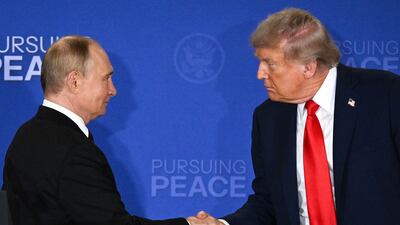
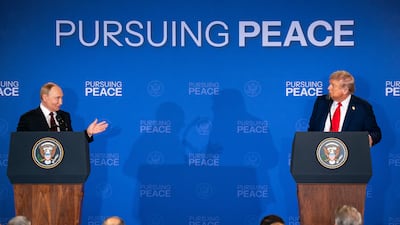
  • US President Donald Trump, right, and Russian President Vladimir Putin shake hands at the end of a joint press conference after participating in a US-Russia summit on Ukraine at Joint Base Elmendorf-Richardson in Anchorage, Alaska, on August 15. AFP
    US President Donald Trump, right, and Russian President Vladimir Putin shake hands at the end of a joint press conference after participating in a US-Russia summit on Ukraine at Joint Base Elmendorf-Richardson in Anchorage, Alaska, on August 15. AFP
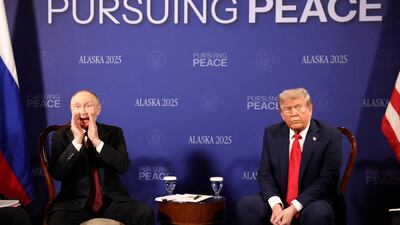
  • US President Donald Trump meets Russian President Vladimir Putin in Anchorage, Alaska. Reuters
    US President Donald Trump meets Russian President Vladimir Putin in Anchorage, Alaska. Reuters
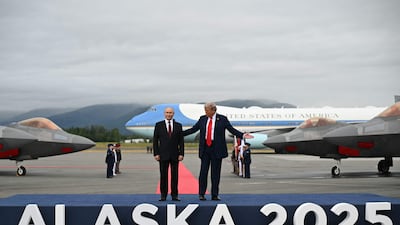
  • Mr Trump and Mr Putin pose on a podium on the tarmac after they arrived at Joint Base Elmendorf-Richardson in Anchorage. AFP
    Mr Trump and Mr Putin pose on a podium on the tarmac after they arrived at Joint Base Elmendorf-Richardson in Anchorage. AFP
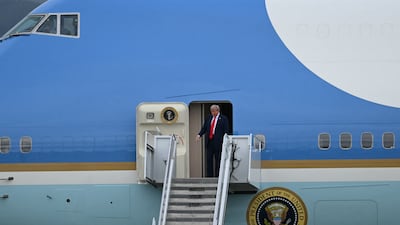
  • Mr Trump steps off of Air Force One on arrival at Joint Base Elmendorf-Richardson in Anchorage. AFP
    Mr Trump steps off of Air Force One on arrival at Joint Base Elmendorf-Richardson in Anchorage. AFP
  • Mr Putin arrives at Joint Base Elmendorf-Richardson. Reuters
    Mr Putin arrives at Joint Base Elmendorf-Richardson. Reuters
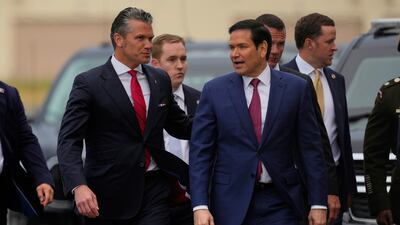
  • US Defence Secretary Pete Hegseth and Secretary of State Marco Rubio arrive in Anchorage. AP
    US Defence Secretary Pete Hegseth and Secretary of State Marco Rubio arrive in Anchorage. AP
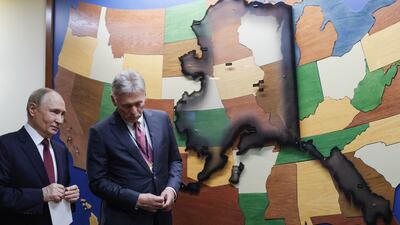
  • Russian President Vladimir Putin is accompanied by Kremlin spokesman Dmitry Peskov, following a meeting with US President Donald Trump at Joint Base Elmendorf-Richardson in Anchorage, Alaska. EPA
    Russian President Vladimir Putin is accompanied by Kremlin spokesman Dmitry Peskov, following a meeting with US President Donald Trump at Joint Base Elmendorf-Richardson in Anchorage, Alaska. EPA
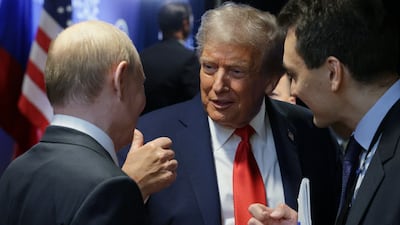
  • US President Donald Trump and Russian President Vladimir Putin (L) speak before a joint news conference following their meeting at Joint Base Elmendorf-Richardson in Anchorage, Alaska. EPA
    US President Donald Trump and Russian President Vladimir Putin (L) speak before a joint news conference following their meeting at Joint Base Elmendorf-Richardson in Anchorage, Alaska. EPA
  • Discussions between President Donald Trump and Russian counterpart Vladimir Putin concluded after more than two-and-a-half hours at their summit in Alaska, marking their longest in-person meeting and offering a sign that by the US leader's own judgement the talks have gone well. Bloomberg
    Discussions between President Donald Trump and Russian counterpart Vladimir Putin concluded after more than two-and-a-half hours at their summit in Alaska, marking their longest in-person meeting and offering a sign that by the US leader's own judgement the talks have gone well. Bloomberg
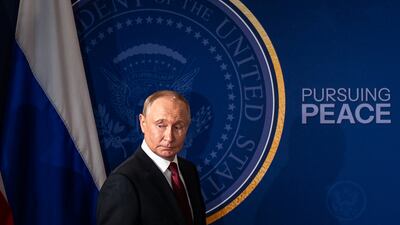
  • Russian President Vladimir Putin arrives for a joint news conference with US President Donald Trump after talks in Anchorage, Alaska. Bloomberg
    Russian President Vladimir Putin arrives for a joint news conference with US President Donald Trump after talks in Anchorage, Alaska. Bloomberg
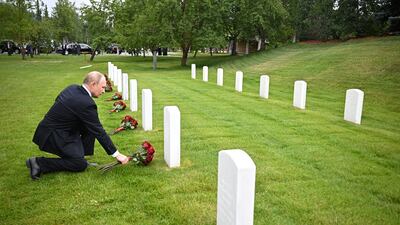
  • Russian President Vladimir Putin places flowers at the graves of Soviet soldiers at Fort Richardson National Cemetery in Anchorage, Alaska. Reuters
    Russian President Vladimir Putin places flowers at the graves of Soviet soldiers at Fort Richardson National Cemetery in Anchorage, Alaska. Reuters
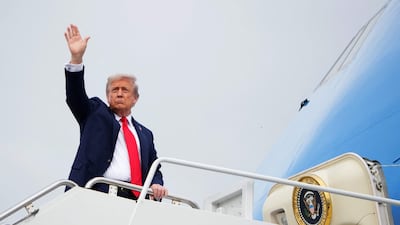
  • US President Donald Trump boards Air Force One as he leaves Joint Base Elmendorf-Richardson in Anchorage, Alaska. AFP
    US President Donald Trump boards Air Force One as he leaves Joint Base Elmendorf-Richardson in Anchorage, Alaska. AFP
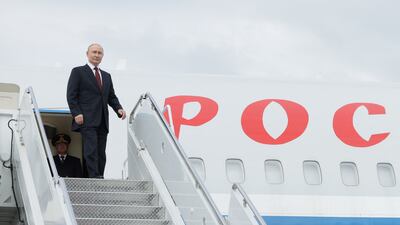
  • Russian President Vladimir Putin boards a plane upon departure in Anchorage, Alaska. Reuters
    Russian President Vladimir Putin boards a plane upon departure in Anchorage, Alaska. Reuters

Despite all this, India and the EU find themselves in a similar boat. The Trump administration does not view either entity to be dominant security actors in their regions (unlike say China, Russia or Israel). This magnifies his annoyance when they offer a narrative that contradicts his own – for example, the EU’s constant reminders that Russia is the aggressor in the Ukraine war, or New Delhi’s rejection of Mr Trump’s claim that he mediated the end of the recent hostilities between itself and Pakistan earlier this year.

Similarly, the US President’s anger with European and Indian trade surpluses with Washington is complemented by a lack of fear over their economic advantage. Mexico, China and Canada's trade offers have greater political leverage than the EU or India for reasons that go beyond sheer volume.

These exporters supply daily goods from food to energy and mid-to-low-range cars and phones that have a critical direct impact on the everyday lives of average American voters. Any trade war brings serious political costs for the Trump administration. Indian exports, on the other hand, range from engineering goods to gems and jewellery that do not carry the same risks. Neither do luxury European goods, whether cheese, wine or limousines. The one exception is India’s supply of generic medications, which have become a cornerstone of American health care; a canny Mr Trump may extend a temporary waiver to generate pressure while avoiding backlash.

In short, the strength of India’s hand in dealing with the Trump administration is fundamentally different than it looked at the start of the US President’s second term, when the new rules of the power game were just beginning to emerge. But on the other hand, the European experience suggests that even a so-so hand can be played to great advantage once those new power rules have been understood and applied.


Superliminal%20
%3Cp%3EDeveloper%3A%20Pillow%20Castle%20Games%0D%3Cbr%3EPublisher%3A%20Pillow%20Castle%20Games%0D%3Cbr%3EConsole%3A%20PlayStation%204%26amp%3B5%2C%20Xbox%20Series%20One%20%26amp%3B%20X%2FS%2C%20Nintendo%20Switch%2C%20PC%20and%20Mac%0D%3Cbr%3ERating%3A%204%2F5%3C%2Fp%3E%0A
Avatar: Fire and Ash

Director: James Cameron

Starring: Sam Worthington, Sigourney Weaver, Zoe Saldana

Rating: 4.5/5

MATCH INFO

Burnley 1 (Brady 89')

Manchester City 4 (Jesus 24', 50', Rodri 68', Mahrez 87')

Global state-owned investor ranking by size

1.

United States

2.

China

3.

UAE

4.

Japan

5

Norway

6.

Canada

7.

Singapore

8.

Australia

9.

Saudi Arabia

10.

South Korea

Company Profile

Name: Thndr
Started: 2019
Co-founders: Ahmad Hammouda and Seif Amr
Sector: FinTech
Headquarters: Egypt
UAE base: Hub71, Abu Dhabi
Current number of staff: More than 150
Funds raised: $22 million

Indoor cricket in a nutshell

Indoor Cricket World Cup – Sep 16-20, Insportz, Dubai

16 Indoor cricket matches are 16 overs per side

8 There are eight players per team

There have been nine Indoor Cricket World Cups for men. Australia have won every one.

5 Five runs are deducted from the score when a wickets falls

Batsmen bat in pairs, facing four overs per partnership

Scoring In indoor cricket, runs are scored by way of both physical and bonus runs. Physical runs are scored by both batsmen completing a run from one crease to the other. Bonus runs are scored when the ball hits a net in different zones, but only when at least one physical run is score.

Zones

A Front net, behind the striker and wicketkeeper: 0 runs

B Side nets, between the striker and halfway down the pitch: 1 run

Side nets between halfway and the bowlers end: 2 runs

Back net: 4 runs on the bounce, 6 runs on the full

HIV on the rise in the region

A 2019 United Nations special analysis on Aids reveals 37 per cent of new HIV infections in the Mena region are from people injecting drugs.

New HIV infections have also risen by 29 per cent in western Europe and Asia, and by 7 per cent in Latin America, but declined elsewhere.

Egypt has shown the highest increase in recorded cases of HIV since 2010, up by 196 per cent.

Access to HIV testing, treatment and care in the region is well below the global average.  

Few statistics have been published on the number of cases in the UAE, although a UNAIDS report said 1.5 per cent of the prison population has the virus.

If you go

The flights
There are various ways of getting to the southern Serengeti in Tanzania from the UAE. The exact route and airstrip depends on your overall trip itinerary and which camp you’re staying at. 
Flydubai flies direct from Dubai to Kilimanjaro International Airport from Dh1,350 return, including taxes; this can be followed by a short flight from Kilimanjaro to the Serengeti with Coastal Aviation from about US$700 (Dh2,500) return, including taxes. Kenya Airways, Emirates and Etihad offer flights via Nairobi or Dar es Salaam.   

The five pillars of Islam

1. Fasting 

2. Prayer 

3. Hajj 

4. Shahada 

5. Zakat 

Company%20profile
%3Cp%3E%3Cstrong%3ECompany%3A%20%3C%2Fstrong%3EWafeq%3Cbr%3E%3Cstrong%3EStarted%3A%20%3C%2Fstrong%3EJanuary%202019%3Cbr%3E%3Cstrong%3EFounder%3A%20%3C%2Fstrong%3ENadim%20Alameddine%3Cbr%3E%3Cstrong%3EBased%3A%20%3C%2Fstrong%3EDubai%2C%20UAE%3Cstrong%3E%3Cbr%3EIndustry%3A%20%3C%2Fstrong%3Esoftware%20as%20a%20service%3Cbr%3E%3Cstrong%3EFunds%20raised%3A%20%3C%2Fstrong%3E%243%20million%3Cbr%3E%3Cstrong%3EInvestors%3A%20%3C%2Fstrong%3ERaed%20Ventures%20and%20Wamda%2C%20among%20others%3C%2Fp%3E%0A
The%20specs%20
%3Cp%3E%3Cstrong%3EEngine%3A%20%3C%2Fstrong%3E2.0-litre%204cyl%20turbo%0D%3Cbr%3E%3Cstrong%3EPower%3A%20%3C%2Fstrong%3E261hp%20at%205%2C500rpm%0D%3Cbr%3E%3Cstrong%3ETorque%3A%20%3C%2Fstrong%3E400Nm%20at%201%2C750-4%2C000rpm%0D%3Cbr%3E%3Cstrong%3ETransmission%3A%20%3C%2Fstrong%3E7-speed%20dual-clutch%20auto%0D%3Cbr%3E%3Cstrong%3EFuel%20consumption%3A%20%3C%2Fstrong%3E10.5L%2F100km%0D%3Cbr%3E%3Cstrong%3EOn%20sale%3A%20%3C%2Fstrong%3ENow%0D%3Cbr%3E%3Cstrong%3EPrice%3A%20%3C%2Fstrong%3EFrom%20Dh129%2C999%20(VX%20Luxury)%3B%20from%20Dh149%2C999%20(VX%20Black%20Gold)%3C%2Fp%3E%0A
Muslim Council of Elders condemns terrorism on religious sites

The Muslim Council of Elders has strongly condemned the criminal attacks on religious sites in Britain.

It firmly rejected “acts of terrorism, which constitute a flagrant violation of the sanctity of houses of worship”.

“Attacking places of worship is a form of terrorism and extremism that threatens peace and stability within societies,” it said.

The council also warned against the rise of hate speech, racism, extremism and Islamophobia. It urged the international community to join efforts to promote tolerance and peaceful coexistence.

FIGHT CARD

Fights start from 6pm Friday, January 31

Catchweight 82kg
Piotr Kuberski (POL) v Ahmed Saeb (IRQ)

Women’s bantamweight
Cornelia Holm (SWE) v Corinne Laframboise (CAN)

Welterweight
Omar Hussein (JOR) v Vitalii Stoian (UKR)

Welterweight
Josh Togo (LEB) v Ali Dyusenov (UZB)

Flyweight
Isaac Pimentel (BRA) v Delfin Nawen (PHI)

Catchweight 80kg​​​​​​​
Seb Eubank (GBR) v Mohamed El Mokadem (EGY)

Lightweight
Mohammad Yahya (UAE) v Ramadan Noaman (EGY)

Lightweight
Alan Omer (GER) v Reydon Romero (PHI)

Welterweight
Ahmed Labban (LEB) v Juho Valamaa (FIN)

Featherweight
Elias Boudegzdame (ALG) v Austin Arnett (USA)

Super heavyweight
Roman Wehbe (LEB) v Maciej Sosnowski (POL)

Updated: August 19, 2025, 3:42 PM