

US President Donald Trump lives by the following golden rule: whoever has the gold makes the rules.
He pushes for peace because wars are bad for business. He believes what’s best for America over the long term is a world that is tied to Washington through trade, because the ability to dictate economic prosperity is the ultimate leverage.
His realignment of the global economy is about making sure the deals that are done aren’t solely to the benefit of the rest of the world, as they have been in the past. It buys in to the notion that It isn’t America’s job to prop up other countries to the detriment of its own. He believes, rightly, that decades spent in doing so haven’t made the US safer, haven’t kept its economy immune to external shocks, and more to the point, represent a system Americans can simply no longer afford to sustain.
In short, the President believes the US can best protect itself long term – and continue to project its influence – if the world is tied to Washington not by ideology but because of self-interest.
Since the announcement of his economic overhaul in April, Mr Trump has managed to cut trade deals and impose tariffs that have begun to address this imbalance; initial financial panic has, for now, subsided and the US stock market is booming. And while he has been criticised for failing to reach “90 deals in 90 days”, those complaints seem, even for some of his biggest detractors, churlish; this is a man who has fundamentally remade the global economic order as he promised he would. Those who refuse to recognise the President’s genius in “making them all come running”, in their desperation to cut a deal, also miss the bigger picture.
American soft power in the Trump era challenges the notion that funding social programmes gets better results than propelling entire nations towards economic growth. It calls out attempts to project American values through a left-leaning media as wasteful overreach, another expensive exercise in hubris and hypocrisy.
Now “the world’s greatest dealmaker” is setting his sights on Europe and the Middle East.
In the coming months, the Trump administration’s National Energy Dominance Council will shepherd American business delegations to two of the oil and gas industry’s biggest trade shows, Gastech in Milan and Adipec in Abu Dhabi. Europe’s commitment to buy billions of dollars in American gas per year should turn this year’s event in Milan into a total deal fair, with US companies looking to make long-term agreements to supply energy to Europe. Meanwhile, Adipec promises much the same, with a high-profile guest list looking to increase co-operation with partners across the Middle East. Dominating the AI race is crucial to American security and economic success, and the President’s team is prioritising relationships that achieve this.
The energy dominance council, chaired by Interior Secretary Doug Burgum and co-chaired by Energy Secretary Chris Wright, revolves around the notion that America’s natural resources must be put to work in the national interest. It’s a familiar concept to Gulf governments if somewhat alien to their European counterparts.
Speaking to me recently from his office in Washington, Mr Burgum laid out the President’s plans to unlock America’s resources, including the use of federal land for data centres and tapping previously off-limits areas for energy. And while the setting of our conversation evoked a certain nostalgia for America’s past – its walls lined with the taxidermy of a previous century brought up from the basement at the Interior Secretary’s request – there was no mistaking his boundless optimism in the country’s ability to achieve its ambitions.
-
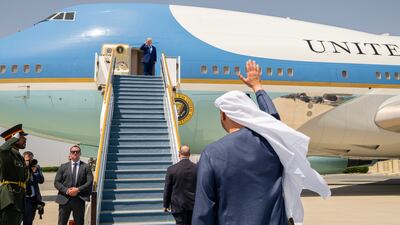
President Sheikh Mohamed bids farewell to US President Donald Trump at the Presidential Airport in Abu Dhabi. Mohamed Al Hammadi / UAE Presidential Court -
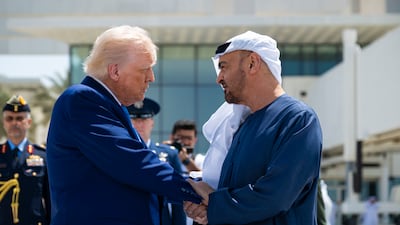
Sheikh Mohamed says goodbye to Mr Trump, as he prepares to leave the UAE and fly back to the US. Abdulla Al Neyadi / UAE Presidential Court -
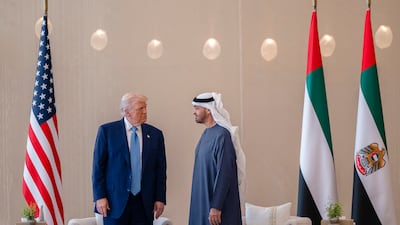
Sheikh Mohamed with Mr Trump, who rounded off his four-day Middle East tour in Abu Dhabi. Mohamed Al Hammadi / UAE Presidential Court -
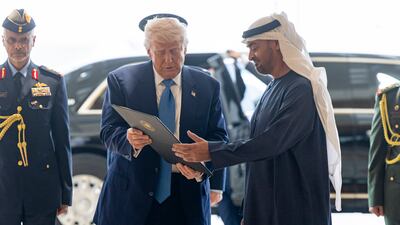
Sheikh Mohamed receives a gift from Mr Trump at the Presidential Airport. Ryan Carter / UAE Presidential Court -
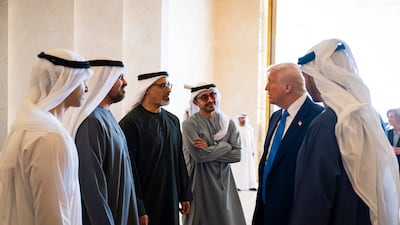
President Sheikh Mohamed; Sheikh Abdullah bin Zayed, Deputy Prime Minister and Minister of Foreign Affairs; Sheikh Khaled bin Mohamed, Crown Prince of Abu Dhabi; Sheikh Theyab bin Mohamed, Chairman of the Office of Development and Martyrs Families Affairs at the Presidential Court; and Sheikh Hamdan bin Mohamed, Deputy Chairman of the Presidential Court for Special Affairs, share some words with Mr Trump before his departure. Abdulla Al Neyadi / UAE Presidential Court -
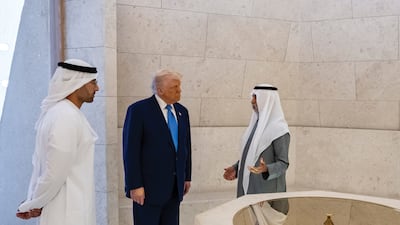
Mr Trump visits the Abrahamic Family House in Abu Dhabi, where he was welcomed on arrival by Sheikh Nahyan bin Mubarak, Minister of Tolerance and Coexistence; Dr Omar Habtoor Al Derei, Chairman of the General Authority of Islamic Affairs, Endowments & Zakat; and Mohamed Khalifa Al Mubarak, Chairman of the Department of Culture and Tourism - Abu Dhabi and President of the Abrahamic Family House, along with senior officials who accompanied him on a guided tour of the interfaith complex. Photo: Abu Dhabi Media Office -
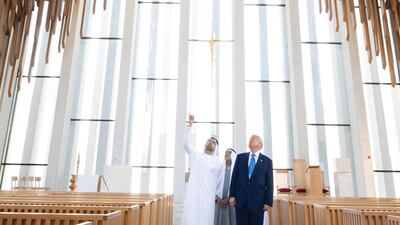
Mr Trump visits the Abrahamic Family House in Abu Dhabi, where he was welcomed on arrival by Sheikh Nahyan bin Mubarak, Minister of Tolerance and Coexistence; Dr Omar Habtoor Al Derei, Chairman of the General Authority of Islamic Affairs, Endowments & Zakat; and Mohamed Khalifa Al Mubarak, Chairman of the Department of Culture and Tourism - Abu Dhabi and President of the Abrahamic Family House, along with senior officials who accompanied him on a guided tour of the interfaith complex. Photo: Abu Dhabi Media Office -
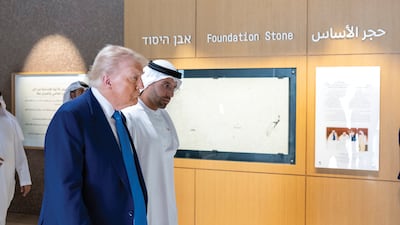
Mr Trump visits the Abrahamic Family House in Abu Dhabi, where he was welcomed on arrival by Sheikh Nahyan bin Mubarak, Minister of Tolerance and Coexistence; Dr Omar Habtoor Al Derei, Chairman of the General Authority of Islamic Affairs, Endowments & Zakat; and Mohamed Khalifa Al Mubarak, Chairman of the Department of Culture and Tourism - Abu Dhabi and President of the Abrahamic Family House, along with senior officials who accompanied him on a guided tour of the interfaith complex. Photo: Abu Dhabi Media Office -
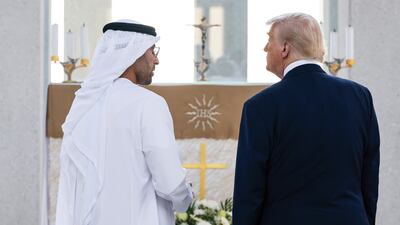
Mr Trump visits the Abrahamic Family House in Abu Dhabi, where he was welcomed on arrival by Sheikh Nahyan bin Mubarak, Minister of Tolerance and Coexistence; Dr Omar Habtoor Al Derei, Chairman of the General Authority of Islamic Affairs, Endowments & Zakat; and Mohamed Khalifa Al Mubarak, Chairman of the Department of Culture and Tourism - Abu Dhabi and President of the Abrahamic Family House, along with senior officials who accompanied him on a guided tour of the interfaith complex. Photo: Abu Dhabi Media Office -
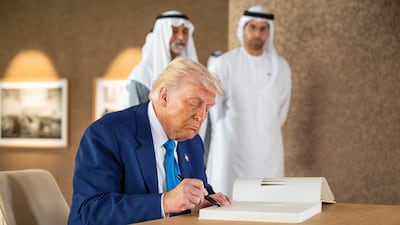
Mr Trump visits the Abrahamic Family House in Abu Dhabi, where he was welcomed on arrival by Sheikh Nahyan bin Mubarak, Minister of Tolerance and Coexistence; Dr Omar Habtoor Al Derei, Chairman of the General Authority of Islamic Affairs, Endowments & Zakat; and Mohamed Khalifa Al Mubarak, Chairman of the Department of Culture and Tourism - Abu Dhabi and President of the Abrahamic Family House, along with senior officials who accompanied him on a guided tour of the interfaith complex. Photo: Abu Dhabi Media Office -
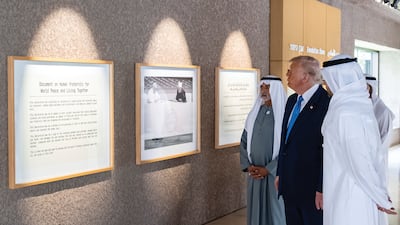
Mr Trump visits the Abrahamic Family House in Abu Dhabi, where he was welcomed on arrival by Sheikh Nahyan bin Mubarak, Minister of Tolerance and Coexistence; Dr Omar Habtoor Al Derei, Chairman of the General Authority of Islamic Affairs, Endowments & Zakat; and Mohamed Khalifa Al Mubarak, Chairman of the Department of Culture and Tourism - Abu Dhabi and President of the Abrahamic Family House, along with senior officials who accompanied him on a guided tour of the interfaith complex. Photo: Abu Dhabi Media Office -
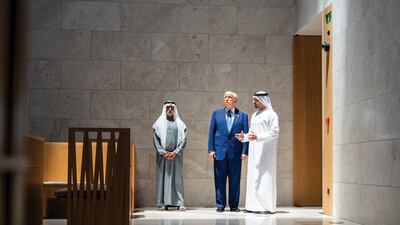
Mr Trump visits the Abrahamic Family House in Abu Dhabi, where he was welcomed on arrival by Sheikh Nahyan bin Mubarak, Minister of Tolerance and Coexistence; Dr Omar Habtoor Al Derei, Chairman of the General Authority of Islamic Affairs, Endowments & Zakat; and Mohamed Khalifa Al Mubarak, Chairman of the Department of Culture and Tourism - Abu Dhabi and President of the Abrahamic Family House, along with senior officials who accompanied him on a guided tour of the interfaith complex. Photo: Abu Dhabi Media Office


Mr Trump’s approach, while often aggressive and usually tactless, resonates with people. This is because, in his refusal to “play by the rules” and make people comfortable, the President taps into an authenticity that most public officials in the West sadly lack.
On the campaign trail, Trump 2.0 was all about finishing the job he started back in 2016; since taking office in January, he has been largely immune to any attempts to undermine his agenda. Singularly focused, he has surrounded himself (mostly) by loyalists, refused to tolerate dissent, and pushed ahead with his ultimate goal: making America great again.
As the President’s reciprocal tariffs took effect overnight, he claimed victory, putting an end to what he believes are the unfair trade policies of the past and predicting billions of dollars in revenue to come. And, so far at least, he isn’t wrong. The government has collected nearly $150 billion in tariff revenue so far. According to CNN, the US treasury recorded $30 billion in the last month alone, a 242 per cent jump compared to the same month a year ago.
As the administration prepares to hawk America’s wares to the world, they will find in the Gulf at least, pragmatic partners. It’s exciting now to see Europe try to catch up.

