


August 4 will mark the fifth anniversary of the Beirut port explosion that killed more than 200 people, one of the largest non-nuclear explosions ever. The families of the victims are still awaiting justice. Earlier this year the magistrate investigating the tragedy, Tariq Bitar, resumed his investigation, which had been suspended after politicians repeatedly intervened to derail it.
The election of Joseph Aoun as Lebanon's president in January, which was followed by the appointment of Nawaf Salam as prime minister, led to much hope that Mr Bitar’s efforts would achieve results. They may yet, not least because the magistrate has shown great persistence and courage in moving ahead in his task, but the obstacles remain immense.
What is in Mr Bitar’s favour is that Mr Salam, a former judge who was president of the International Court of Justice, has committed to pushing forward a plan for the independence of the judiciary. Mr Aoun has also sought to portray himself as a reformer. However, it is almost certain that politics will again complicate matters.
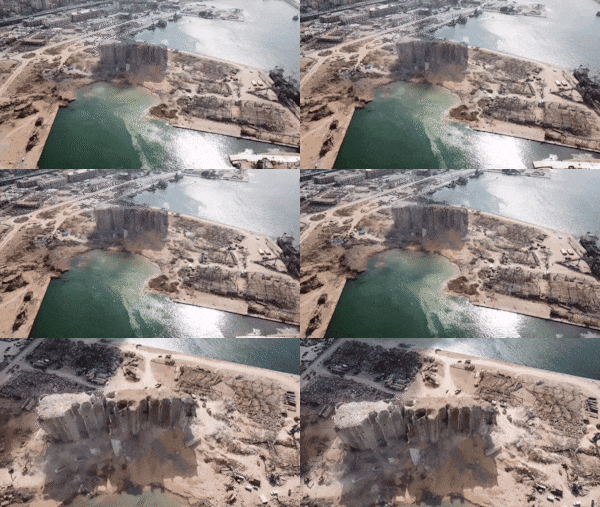
Mr Bitar had cast a wide net on responsibility in his investigation, which rubbed many members of Lebanon’s political class the wrong way. Beirut port was a house of many mansions, in which the country’s different political factions named their people to positions of influence. In summoning politicians and security figures to see who was responsible for allowing the ammonium nitrate that caused the explosion to be stored at the port, the magistrate provoked alarm and pushback across the political spectrum.

In October 2021, Hezbollah and the allied Amal movement took the protests up a notch, in an alarming way. Their partisans organised a demonstration against Mr Bitar before the Palace of Justice, passing by the Christian neighbourhood of Ain Al Remmaneh. On their way, a number of demonstrators entered the neighbourhood, shouting sectarian slogans, provoking a response from young men in the area who killed at least one demonstrator.
The decision to enter Ain Al Remmaneh was not fortuitous. A large majority of the victims of the explosion were Christians. By invading a predominantly Christian area and shouting pro-Shiite slogans, the demonstrators wanted to show that if the Bitar investigation continued, it could lead to sectarian conflict.
After the shooting of the demonstrators, Hezbollah and Amal returned with their weapons, which could have led to an armed sectarian clash. At just the right moment, however, the army intervened and fired on the armed demonstrators, killing several of them and stopping them in their tracks, which restored calm and prevented the worst.
Behind the scenes, the military told those close to it, not unreasonably, that it had averted a new civil war, though it never publicly acknowledged responsibility for firing on the demonstrators. The army commander at the time was Joseph Aoun, the current president.
Therefore, between Mr Aoun, who showed great decisiveness in October 2021, and Mr Salam, who supports an independent judiciary, Mr Bitar may have little to fear. Yet the likelihood is the judge will face the same obstacles he did under the government of former prime minister Najib Mikati if Mr Bitar decides to arrest senior politicians. On top of this, we can’t ignore that the president or prime minister may have political calculations of their own.

For example, while Mr Aoun retains much respect, he has also sought to preserve a good relationship with the parliament speaker, Nabih Berri, and with Hezbollah. This makes sense in practical terms, because both still have the power to block many decisions in the country. The president is also keen, under international pressure, to reach a peaceful agreement with Hezbollah over its weapons, therefore wants to avoid anything that might hinder this.
Mr Aoun, it also seems, would like to bring a contingent of supporters to parliament in the elections next year. Several of his prospective candidates are well known, and were expelled from the Free Patriotic Movement led by Gebran Bassil. Most of them would require Shiite votes to be re-elected in their districts, namely Baabda, Jbeil, and even the Metn, where solid Shiite voting blocs exist.
Would Mr Aoun jeopardise such support if it means backing Mr Bitar’s decision to bring in politicians or security figures close to Mr Berri and Hezbollah for questioning? Given his electoral ambitions, and Mr Berri’s and Hezbollah’s centrality to his other aims, it’s not certain.
It may be too early to make predictions, although there have been reports that Mr Bitar would like to bring out indictments on the five-year anniversary. But even if indictments are issued, how might the political class react? The port explosion is like Agatha Christie’s Murder on the Orient Express, in that the negligence and corruption making it possible stretched across the political landscape, so that everyone was in on the crime.
We can be certain that once an indictment threatens the power of Lebanon’s political leadership, they will circle the wagons and seek to neutralise the investigation. They may not be able to stop Mr Bitar, and it would be foolish at this stage to try, but they might try to find scapegoats and limit indictments to such figures, before closing the file.
The wild card here is Mr Bitar himself. He has shown great integrity in pursuing his work, despite the very real risks he has faced. He’s not likely to agree to sweep things under the rug. However, many of his superiors may do so. The victims’ families would like to see justice, as is their right, but Lebanon is a country where justice has been absent for decades.
Join our Live Q&A with our reporters


