


The India-Pakistan air war this month was short, sharp and utterly confusing for the millions of people in the region and around the world trying to make sense of the news.
Why did events escalate so quickly, only for them to end so abruptly? Why did both countries accept US mediation? How stable is the ceasefire? If we restrict ourselves to the limited number of verifiable facts, it becomes much easier to cut through the noise and usefully assess not only what happened, but what can be expected going forward.
The first point is that there is a long-running but intensifying covert war between India and Pakistan. The Indian Air Force strikes of May 7 – codenamed “Operation Sindoor” – were meant to be a US-style step to bring that conflict into the open by punishing militants, deterring their supporters in the Pakistan Army and reassuring the Indian public of New Delhi’s strength of purpose. However, it is also clear that the decision to refrain from targeting Pakistani military facilities in the initial strikes signalled that the Indian government strongly preferred to avoid any kind of military-to-military clash. The strikes were meant to serve as a political statement.
The mode of attack reinforced that signal. By launching long-range guided weapons from inside Indian air space, the hope was to strike while reducing the opportunity for direct confrontation between the two air forces. This was a lesson learnt from the IAF’s February 2019 retaliatory air strikes on militants in the Pakistani town of Balakot, when Indian and Pakistani jets brawled in Pakistani air space, resulting in the shooting down and capture of an Indian pilot.
But what unfolded during Operation Sindoor has serious implications for air force doctrines and procurement priorities internationally. Mainstream and social media commentators from the two countries have obsessively sparred over how many hits Pakistan scored, but exact numbers are far less important than the fact that Indian aircraft operating in Indian air space were vulnerable to Pakistani planes operating inside their own territory.
To prevent India from potentially matching this capability, Pakistan attempted to strike the Indian Air Force’s new long-range S-400 ground-based air defence system in Adampur. Although the S-400 remained functional, the system seems to have been unable to restrict PAF air operations within Pakistani air space.
This unexpected asymmetry was unacceptable to New Delhi. The objectives for India’s air force and government shifted from responding to terrorism to attempting to restore the balance of air power between the two countries. This was to be achieved by striking Pakistani radars and air bases on May 10 with drones and missiles. Pakistan’s air force responded in kind, targeting Indian air defences and air bases. That is where things stood by the time US-led diplomacy kicked in and ended the air war.
-

A child looks on after taking refuge at a school in Jammu, Indian-administered Kashmir, following an exchange of shelling and small arms fire across the border. Getty Images -
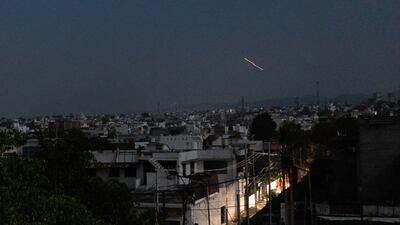
Streaks of light in the skies over the city of Jammu in Indian-administered Kashmir, during a suspected drone attack from the Pakistan side. Getty Images -
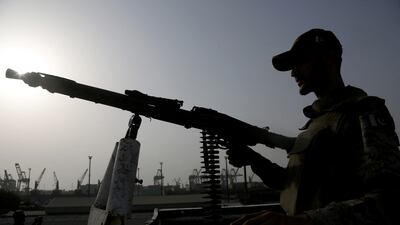
A Pakistani paramilitary trooper keeps guard at Karachi Port. Reuters -
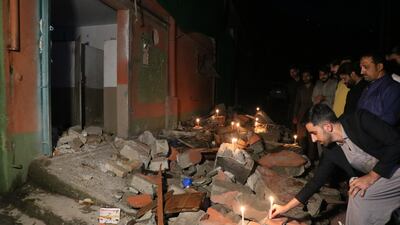
A candlelight vigil for victims of a Indian missile strike on Bilal Mosque in Muzaffarabad, Pakistani-administered Kashmir. EPA -
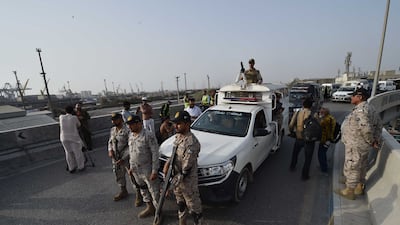
Security personnel at Karachi Port, southern Pakistan. EPA -
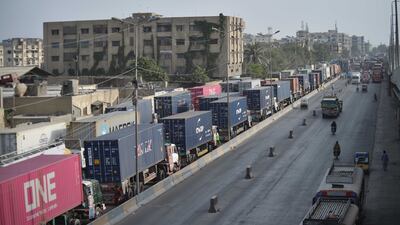
Lorries gridlocked near Pakistan's Karachi Port following the military escalation between New Delhi and Islamabad. EPA -
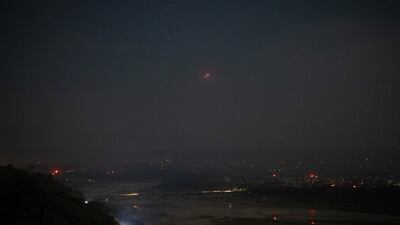
India's air defence system intercepts objects during a blackout following blasts in the city of Jammu, in Indian-administered Kashmir. Reuters -
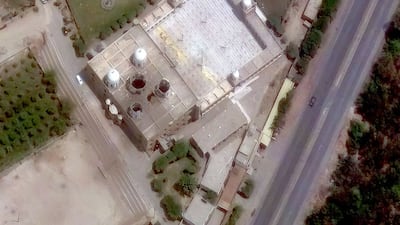
The damaged Jamia Masjid Subhan Allah compound after an Indian strike on the outskirts of Bahawalpur in Pakistan's Punjab province. AFP -

Prime Minister Shehbaz Sharif addressing the special session at the National Assembly in Islamabad. AFP -

Villagers carry their belongings as they move to safer areas after authorities evacuated residents living near the border at Jeora Farm on the outskirts of Jammu. AFP -
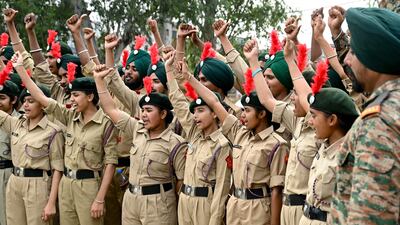
National Cadet Corps cadets shout slogans after conducting an emergency simulation drill as part of the nationwide civil defence mock drills in Amritsar. AFP -
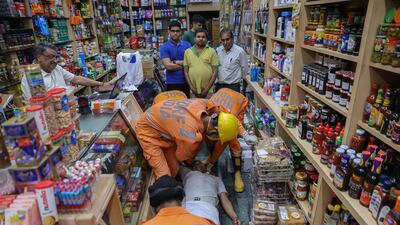
National Disaster Response Force, civil defence and fire personnel conduct an air raid drill at Khan market in New Delhi. EPA -
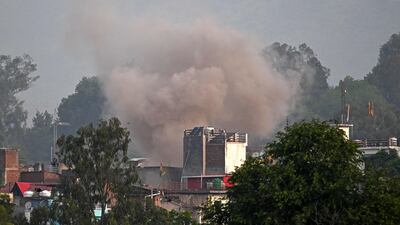
An artillery shell lands in the main town of Poonch district in India's Jammu region on Wednesday as Pakistani troops launch shells from across the Line of Control in retaliation for Indian missile strikes. AFP -
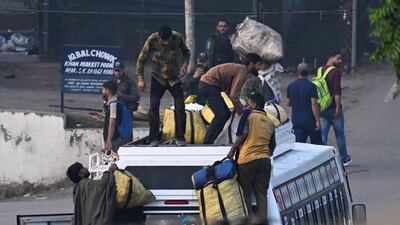
Poonch locals load their belongings on a bus as they flee the shelling. AFP -
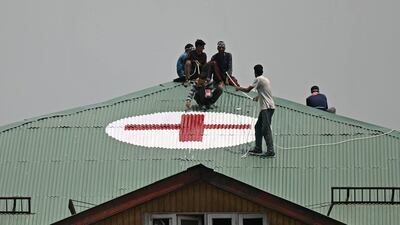
Workers paint a red cross symbol on the roof of a hospital to deter a potential attack in Srinagar, in Indian-administered Jammu and Kashmir. AFP -

Indian school pupils take part in a drill at Rajkiya Sarvodaya Vidyalaya in New Delhi. EPA -
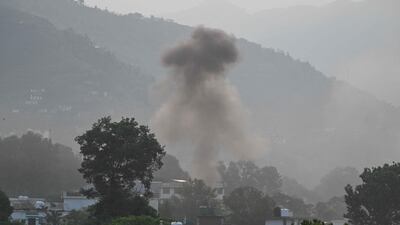
Another Pakistani shell hits Poonch. AFP -
Rescuers search for survivors after India struck a building in a government-run complex in Muridke, Pakistan, about 30km from Lahore. AFP -
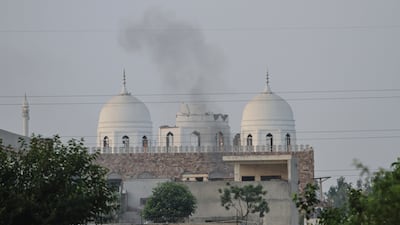
The mosque of an Islamic seminary partially damaged by an Indian missile attack, on the outskirts of Bahawalpur, Pakistan. AP -

Residents are evacuated from an area close to the site of an Indian missile attack, near Muzaffarabad. AP -
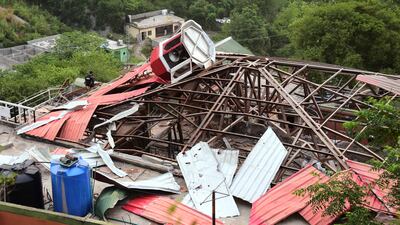
Bilal mosque lies in ruins after being struck by Indian missiles in Muzaffarabad, capital of Pakistan-administered Kashmir. AP -
Volunteers load a body into an ambulance after recovering it from the rubble of a mosque building damaged by a suspected Indian missile attack near Muzaffarabad. AP -
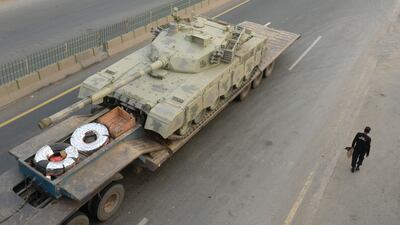
A lorry transports an army tank on a road in Muridke, about 30km from Lahore. AFP -
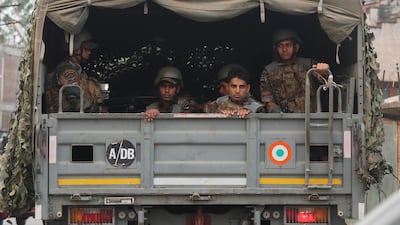
Indian Air Force personnel patrol on the outskirts of Srinagar. EPA -
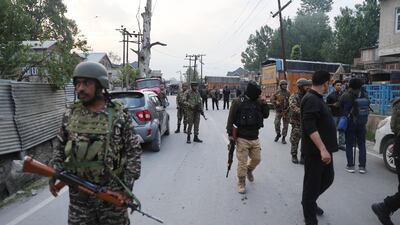
Indian troops patrol a security checkpoint on the outskirts of Srinagar. EPA -
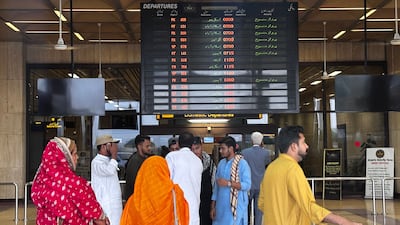
Passengers stranded at Jinnah International airport after all domestic and international flights were cancelled in Karachi. AFP -
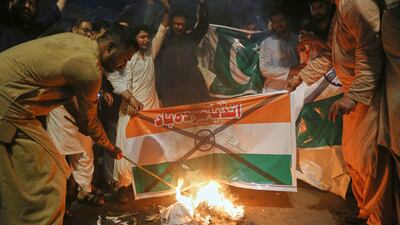
Protesters burn an Indian flag during a demonstration condemning Indian missile strikes in Hyderabad, Pakistan. AP


Given how quickly hostilities escalated, it is fair to ask why they ended so quickly, especially with war fever gripping the region’s media. The simple answer is that for the most part, the governments on both sides prefer to avoid all-out war because of the sheer cost and risk it presents, particularly after the nuclear dimension entered in the 1980s. Since that point, whenever skirmishes and threats of war have become serious, both countries have relied on successive US administrations – backed by the technical reach of American intelligence – to negotiate and verify de-escalation.
Despite US President Donald Trump’s willingness to unilaterally upend much of the existing world order, the peace-making role is one that he has shown intense interest in. It is fair to say that Mr Trump treats high-stakes peace-making as a critical part of his long-term legacy. Moreover, both parties in the subcontinent want to avoid all-out war, despite their mutual antagonism.
Unlike the Russia-Ukraine and Palestine-Israel conflicts, Mr Trump is willing to play a neutral role in South Asia. For one thing, there is nuclear parity, and the US President has always signalled the utmost seriousness with which he takes the risk of nuclear war. In addition, Mr Trump’s primary focus on balance-of-trade issues means that he is less inclined to pursue either India or Pakistan as strategic security partners in the way that Joe Biden, Barack Obama and George W Bush did.
Given the events of 2019 and 2025, key questions remain over what lessons the Indian and Pakistani governments are going to draw from their respective experiences, and the prospects for a broader dialogue between the two governments. This is where the covert dimension of their conflict comes into play.
Although both countries acknowledge this dimension during the separation of East Pakistan (now Bangladesh) in 1971, Indian and Pakistani intelligence agencies have denied each other’s routine accusations of secretly supporting other separatist movements and insurgencies on each other’s soil. Pakistan’s alleged assistance to violent Kashmiri separatists has been the subject of discussion and debate over the past four decades, but the nature of India’s relationship with Baloch fighters is less well known.
Historians like Avinash Paliwal have documented Indian assistance to Baloch separatist movements in the 1970s in conjunction with the Kabul government. In February 2014, India’s current national security adviser, Ajit Doval, warned in a public speech shortly before his appointment that continued Pakistani support to Kashmiri separatists would result not only in overt military retaliation, but the detachment of Balochistan. Indeed, since then the insurgency in Balochistan has grown considerably deadlier, while Indian newspapers have documented how separatist leaders from the province have received medical treatment in India.
We know from the memoirs of retired spies and politicians that a key part of India and Pakistan’s success in avoiding all-out war in the era before the “Doval Doctrine” was to talk frankly in private about the covert aspects of their struggle, and find opportunities to pull back, especially when events seemed to be spiralling out of control. Unfortunately, this kind of dialogue has almost entirely broken down in the past decade; the result has been a dangerous escalation in tensions as these movements grow more violent and internal security responses become harsher.
In March, the Baloch Liberation Army hijacked the Jaffar Express train between Peshawar and Quetta, singling out more than two dozen ethnic Punjabi passengers for execution. The attack outraged public sentiment in Pakistan and led to the Pakistani Chief of Army Staff, Gen Asim Munir, vowing retaliation against both Afghanistan and India for their alleged support for the BLA. A month later, the attack on tourists in Pahalgam in Kashmir saw a similar singling out of Hindu men for execution.
Although both governments refuse to discuss the possible connection between these events, it is difficult for outside observers to deny their eerie parallels. And instead of establishing deterrence, the feedback loop of retaliation has only amplified antagonism and violence.
Unless the two sides can find ways to manage their conflict, the urge to fight will continue to grow with every new terror attack. Governments must recognise that the risks are growing increasingly unpredictable as modern warfare continues to rapidly advance and destabilise old certainties about what war would look like, and what it would cost.

