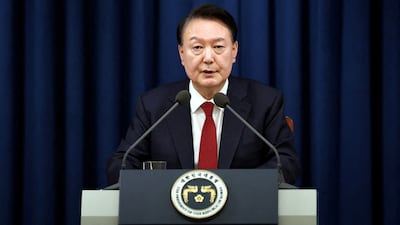
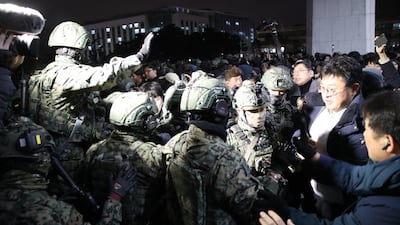
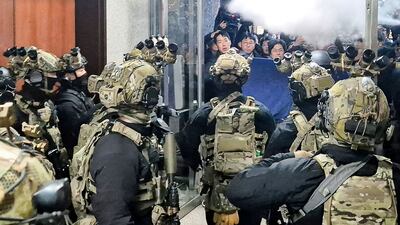
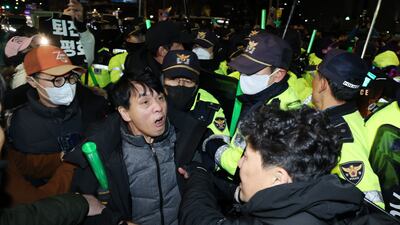
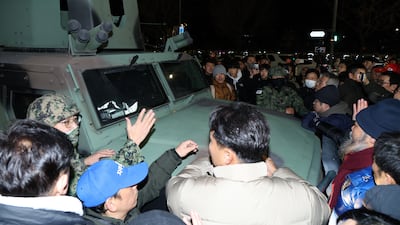
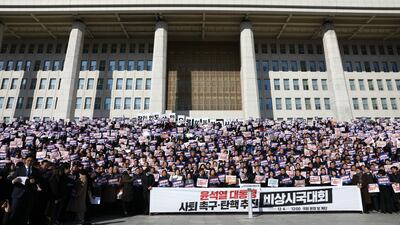
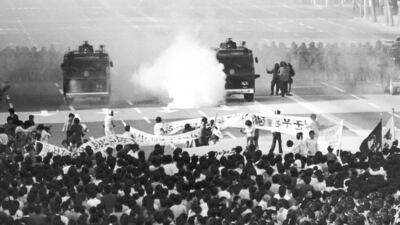
A protester holds a placard to condemn South Korean President Yoon Suk Yeol's surprise declaration of martial law. Reuters


Few believed martial law was the way for South Korea - that's why it failed


  • English
  • Arabic

December 04, 2024

South Korea's declaration of martial law on Tuesday night, and then abrupt reversal a few hours later, came as a shock to the vast majority of the country's population. Martial Law Commander Army General Park Ann-soo had been forthright. The move came, he said in a statement, "to protect liberal democracy and ensure public safety in the Republic of Korea against the threat posed by anti-state forces conspiring to overthrow the nation's system".

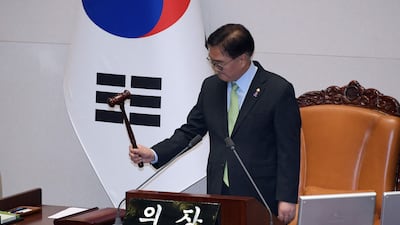
The country’s Parliament disagreed, with lawmakers voting unanimously to lift martial law in the early hours of Wednesday.

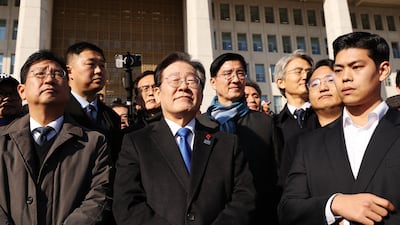
Outside observers may have been surprised by the upheaval; to them, the country may seem to have been a relatively stable democracy since 1988 and the establishment of the Sixth Republic. But its politics have been extraordinarily fractious and, some might claim, vindictive. Since then, five ex-presidents have been subject to criminal investigations; four were sentenced to jail and one died by suicide. The current leadership faces an opposition-controlled National Assembly, which, it says, has "paralysed the administration", impeaching members of its cabinet and blocking legislation. President Yoon Suk-yeol now faces calls to resign, and possible impeachment himself.

Regional leaders will be careful in their responses. South Korea is an important trading partner, and while many do not wish to take sides in any US-China rivalry they do not, in private, object to the country's alliance with America. They may not say so publicly, but if managed carefully, they see that alliance as being able to contribute to balance in the Asia-Pacific. And beyond expressions of "concern", they will not wish to involve themselves in the internal politics of a nearby friend. The principle of "non-interference" is a key pillar of regional organisations such as the Association of South-East Asian Nations (Asean).

Politics have been extraordinarily fractious and, some might claim, vindictive

More widely, however, and especially in foreign policy and security circles, the sentiment will go beyond "concern" about the – albeit brief – establishment of martial law. For the region has extensive experience of variants of this policy, and it has rarely proved to be beneficial in the long run. When Gen Ne Win seized power in Myanmar in 1962, for instance, it may well have been the case that the country was in danger of disintegration. But the "Burmese Way to Socialism" that he pursued until he stepped down in 1988 reduced a state once known as the "rice basket of South-East Asia" to what the UN called a "least developed country". The February 2021 military coup, after a decade of hybrid democracy, has led to a prolonged civil war, a humanitarian crisis and more than three million people displaced.

Similarly, when then president Sukarno declared martial law in Indonesia in 1957, it was partly in reaction to the grave instability in the country at the time. But it also served to further empower the armed forces that effectively forced him from power in 1966 and then ran the country under the New Order regime until 1998. In the Philippines, when then president Ferdinand Marcos instituted martial law in 1972, it was the turning point after which a formerly popular politician moved to what he called an ideology of "constitutional authoritarianism". Others would use stronger words to describe his subsequent rule.

In Cambodia, then prime minister Lon Nol introduced martial law in 1970, but was so brutal in suppressing a rebellion that had broken out, that he “inadvertently” drove “many peasants into supporting the Communist Party of Kampuchea, also known as the Khmer Rouge”, as a US Department of Defence study put it. The Khmer Rouge would later drive him from power in 1975 and led a genocidal regime that led to the deaths of nearly 25 per cent of the population, until Vietnam invaded and toppled the administration in 1979.

Thailand has a history of military coups d’etat, with the most recent imposition of martial law being from 2014 to 2015. Again, the reason given may have been "to preserve law and order", but most analysts believe that military rule can only ever freeze the country’s deep political divisions, not resolve them.

South Korea has its own experiences of martial law as well, but it had not, until Tuesday, been declared for 44 years. The country has in fact been held up as a model of the democratic system, even hosting the third Summit for Democracy in May this year. Not everyone would put it on quite such a pedestal, but a Chatham House report in 2022 nevertheless concluded that “the challenges of contemporary South Korean politics are neither intractable nor a sign of irreconcilable differences”.

However, whatever troubles the country and its current leadership may be facing, and whatever uncharted waters may lie ahead, there appear to be few, either in South Korea or the wider region, who believe that martial law is a realistic solution. South-East and East Asia have undergone lengthy periods of such rule. Most believe it belongs, and deserves to belong, in the history books.


UAE currency: the story behind the money in your pockets
Why are asylum seekers being housed in hotels?

The number of asylum applications in the UK has reached a new record high, driven by those illegally entering the country in small boats crossing the English Channel.

A total of 111,084 people applied for asylum in the UK in the year to June 2025, the highest number for any 12-month period since current records began in 2001.

Asylum seekers and their families can be housed in temporary accommodation while their claim is assessed.

The Home Office provides the accommodation, meaning asylum seekers cannot choose where they live.

When there is not enough housing, the Home Office can move people to hotels or large sites like former military bases.

THE BIO

Born: Mukalla, Yemen, 1979

Education: UAE University, Al Ain

Family: Married with two daughters: Asayel, 7, and Sara, 6

Favourite piece of music: Horse Dance by Naseer Shamma

Favourite book: Science and geology

Favourite place to travel to: Washington DC

Best advice you’ve ever been given: If you have a dream, you have to believe it, then you will see it.

Mercer, the investment consulting arm of US services company Marsh & McLennan, expects its wealth division to at least double its assets under management (AUM) in the Middle East as wealth in the region continues to grow despite economic headwinds, a company official said.

Mercer Wealth, which globally has $160 billion in AUM, plans to boost its AUM in the region to $2-$3bn in the next 2-3 years from the present $1bn, said Yasir AbuShaban, a Dubai-based principal with Mercer Wealth.

Within the next two to three years, we are looking at reaching $2 to $3 billion as a conservative estimate and we do see an opportunity to do so,” said Mr AbuShaban.

Mercer does not directly make investments, but allocates clients’ money they have discretion to, to professional asset managers. They also provide advice to clients.

“We have buying power. We can negotiate on their (client’s) behalf with asset managers to provide them lower fees than they otherwise would have to get on their own,” he added.

Mercer Wealth’s clients include sovereign wealth funds, family offices, and insurance companies among others.

From its office in Dubai, Mercer also looks after Africa, India and Turkey, where they also see opportunity for growth.

Wealth creation in Middle East and Africa (MEA) grew 8.5 per cent to $8.1 trillion last year from $7.5tn in 2015, higher than last year’s global average of 6 per cent and the second-highest growth in a region after Asia-Pacific which grew 9.9 per cent, according to consultancy Boston Consulting Group (BCG). In the region, where wealth grew just 1.9 per cent in 2015 compared with 2014, a pickup in oil prices has helped in wealth generation.

BCG is forecasting MEA wealth will rise to $12tn by 2021, growing at an annual average of 8 per cent.

Drivers of wealth generation in the region will be split evenly between new wealth creation and growth of performance of existing assets, according to BCG.

Another general trend in the region is clients’ looking for a comprehensive approach to investing, according to Mr AbuShaban.

“Institutional investors or some of the families are seeing a slowdown in the available capital they have to invest and in that sense they are looking at optimizing the way they manage their portfolios and making sure they are not investing haphazardly and different parts of their investment are working together,” said Mr AbuShaban.

Some clients also have a higher appetite for risk, given the low interest-rate environment that does not provide enough yield for some institutional investors. These clients are keen to invest in illiquid assets, such as private equity and infrastructure.

“What we have seen is a desire for higher returns in what has been a low-return environment specifically in various fixed income or bonds,” he said.

“In this environment, we have seen a de facto increase in the risk that clients are taking in things like illiquid investments, private equity investments, infrastructure and private debt, those kind of investments were higher illiquidity results in incrementally higher returns.”

The Abu Dhabi Investment Authority, one of the largest sovereign wealth funds, said in its 2016 report that has gradually increased its exposure in direct private equity and private credit transactions, mainly in Asian markets and especially in China and India. The authority’s private equity department focused on structured equities owing to “their defensive characteristics.”

Ways to control drones

Countries have been coming up with ways to restrict and monitor the use of non-commercial drones to keep them from trespassing on controlled areas such as airports.

"Drones vary in size and some can be as big as a small city car - so imagine the impact of one hitting an airplane. It's a huge risk, especially when commercial airliners are not designed to make or take sudden evasive manoeuvres like drones can" says Saj Ahmed, chief analyst at London-based StrategicAero Research.

New measures have now been taken to monitor drone activity, Geo-fencing technology is one.

It's a method designed to prevent drones from drifting into banned areas. The technology uses GPS location signals to stop its machines flying close to airports and other restricted zones.

The European commission has recently announced a blueprint to make drone use in low-level airspace safe, secure and environmentally friendly. This process is called “U-Space” – it covers altitudes of up to 150 metres. It is also noteworthy that that UK Civil Aviation Authority recommends drones to be flown at no higher than 400ft. “U-Space” technology will be governed by a system similar to air traffic control management, which will be automated using tools like geo-fencing.

The UAE has drawn serious measures to ensure users register their devices under strict new laws. Authorities have urged that users must obtain approval in advance before flying the drones, non registered drone use in Dubai will result in a fine of up to twenty thousand dirhams under a new resolution approved by Sheikh Hamdan bin Mohammed, Crown Prince of Dubai.

Mr Ahmad suggest that "Hefty fines running into hundreds of thousands of dollars need to compensate for the cost of airport disruption and flight diversions to lengthy jail spells, confiscation of travel rights and use of drones for a lengthy period" must be enforced in order to reduce airport intrusion.

The Cockroach

 (Vintage)

Ian McEwan 
 

Key figures in the life of the fort

Sheikh Dhiyab bin Isa (ruled 1761-1793) Built Qasr Al Hosn as a watchtower to guard over the only freshwater well on Abu Dhabi island.

Sheikh Shakhbut bin Dhiyab (ruled 1793-1816) Expanded the tower into a small fort and transferred his ruling place of residence from Liwa Oasis to the fort on the island.

Sheikh Tahnoon bin Shakhbut (ruled 1818-1833) Expanded Qasr Al Hosn further as Abu Dhabi grew from a small village of palm huts to a town of more than 5,000 inhabitants.

Sheikh Khalifa bin Shakhbut (ruled 1833-1845) Repaired and fortified the fort.

Sheikh Saeed bin Tahnoon (ruled 1845-1855) Turned Qasr Al Hosn into a strong two-storied structure.

Sheikh Zayed bin Khalifa (ruled 1855-1909) Expanded Qasr Al Hosn further to reflect the emirate's increasing prominence.

Sheikh Shakhbut bin Sultan (ruled 1928-1966) Renovated and enlarged Qasr Al Hosn, adding a decorative arch and two new villas.

Sheikh Zayed bin Sultan (ruled 1966-2004) Moved the royal residence to Al Manhal palace and kept his diwan at Qasr Al Hosn.

Sources: Jayanti Maitra, www.adach.ae

Who's who in Yemen conflict

Houthis: Iran-backed rebels who occupy Sanaa and run unrecognised government

Yemeni government: Exiled government in Aden led by eight-member Presidential Leadership Council

Southern Transitional Council: Faction in Yemeni government that seeks autonomy for the south

Habrish 'rebels': Tribal-backed forces feuding with STC over control of oil in government territory

Women’s World T20, Asia Qualifier, in Bangkok

UAE fixtures Mon Nov 20, v China; Tue Nov 21, v Thailand; Thu Nov 23, v Nepal; Fri Nov 24, v Hong Kong; Sun Nov 26, v Malaysia; Mon Nov 27, Final

(The winners will progress to the Global Qualifier)

What the law says

Micro-retirement is not a recognised concept or employment status under Federal Decree Law No. 33 of 2021 on the Regulation of Labour Relations (as amended) (UAE Labour Law). As such, it reflects a voluntary work-life balance practice, rather than a recognised legal employment category, according to Dilini Loku, senior associate for law firm Gateley Middle East.

“Some companies may offer formal sabbatical policies or career break programmes; however, beyond such arrangements, there is no automatic right or statutory entitlement to extended breaks,” she explains.

“Any leave taken beyond statutory entitlements, such as annual leave, is typically regarded as unpaid leave in accordance with Article 33 of the UAE Labour Law. While employees may legally take unpaid leave, such requests are subject to the employer’s discretion and require approval.”

If an employee resigns to pursue micro-retirement, the employment contract is terminated, and the employer is under no legal obligation to rehire the employee in the future unless specific contractual agreements are in place (such as return-to-work arrangements), which are generally uncommon, Ms Loku adds.

Harry%20%26%20Meghan
%3Cp%3E%3Cstrong%3EDirector%3A%20%3C%2Fstrong%3ELiz%20Garbus%26nbsp%3B%3C%2Fp%3E%0A%3Cp%3E%3Cstrong%3EStars%3A%3C%2Fstrong%3E%20Duke%20and%20Duchess%20of%20Sussex%0D%3Cbr%3E%0D%3Cbr%3E%3Cstrong%3ERating%3A%20%3C%2Fstrong%3E3%2F5%3C%2Fp%3E%0A
Votes

Total votes: 1.8 million

Ashraf Ghani: 923,592 votes

Abdullah Abdullah: 720,841 votes 

The biog

Age: 23

Occupation: Founder of the Studio, formerly an analyst at Cleveland Clinic Abu Dhabi

Education: Bachelor of science in industrial engineering

Favourite hobby: playing the piano

Favourite quote: "There is a key to every door and a dawn to every dark night"

Family: Married and with a daughter

Gulf Under 19s final

Dubai College A 50-12 Dubai College B

Results

Female 49kg: Mayssa Bastos (BRA) bt Thamires Aquino (BRA); points 0-0 (advantage points points 1-0).

Female 55kg: Bianca Basilio (BRA) bt Amal Amjahid (BEL); points 4-2.

Female 62kg: Beatriz Mesquita (BRA) v Ffion Davies (GBR); 10-2.

Female 70kg: Thamara Silva (BRA) bt Alessandra Moss (AUS); submission.

Female 90kg: Gabreili Passanha (BRA) bt Claire-France Thevenon (FRA); submission.

Male 56kg: Hiago George (BRA) bt Carlos Alberto da Silva (BRA); 2-2 (2-0)

Male 62kg: Gabriel de Sousa (BRA) bt Joao Miyao (BRA); 2-2 (2-1)

Male 69kg: Paulo Miyao (BRA) bt Isaac Doederlein (USA); 2-2 (2-2) Ref decision.

Male 77kg: Tommy Langarkar (NOR) by Oliver Lovell (GBR); submission.

Male 85kg: Rudson Mateus Teles (BRA) bt Faisal Al Ketbi (UAE); 2-2 (1-1) Ref decision.

Male 94kg: Kaynan Duarte (BRA) bt Adam Wardzinski (POL); submission.

Male 110kg: Joao Rocha (BRA) bt Yahia Mansoor Al Hammadi (UAE); submission.

Kandahar%20
%3Cp%3E%3Cstrong%3EDirector%3A%3C%2Fstrong%3E%20Ric%20Roman%20Waugh%3C%2Fp%3E%0A%3Cp%3E%3Cstrong%3EStars%3A%C2%A0%3C%2Fstrong%3EGerard%20Butler%2C%20Navid%20Negahban%2C%20Ali%20Fazal%3C%2Fp%3E%0A%3Cp%3E%3Cstrong%3ERating%3A%3C%2Fstrong%3E%202.5%2F5%3C%2Fp%3E%0A
The specs

Engine: 6.2-litre supercharged V8

Power: 712hp at 6,100rpm

Torque: 881Nm at 4,800rpm

Transmission: 8-speed auto

Fuel consumption: 19.6 l/100km

Price: Dh380,000

On sale: now 

The biog

Favourite pet: cats. She has two: Eva and Bito

Favourite city: Cape Town, South Africa

Hobby: Running. "I like to think I’m artsy but I’m not".

Favourite move: Romantic comedies, specifically Return to me. "I cry every time".

Favourite spot in Abu Dhabi: Saadiyat beach

States of Passion by Nihad Sirees,
Pushkin Press

War 2

Director: Ayan Mukerji

Stars: Hrithik Roshan, NTR, Kiara Advani, Ashutosh Rana

Rating: 2/5

Three tips from La Perle's performers

1 The kind of water athletes drink is important. Gwilym Hooson, a 28-year-old British performer who is currently recovering from knee surgery, found that out when the company was still in Studio City, training for 12 hours a day. “The physio team was like: ‘Why is everyone getting cramps?’ And then they realised we had to add salt and sugar to the water,” he says.

2 A little chocolate is a good thing. “It’s emergency energy,” says Craig Paul Smith, La Perle’s head coach and former Cirque du Soleil performer, gesturing to an almost-empty open box of mini chocolate bars on his desk backstage.

3 Take chances, says Young, who has worked all over the world, including most recently at Dragone’s show in China. “Every time we go out of our comfort zone, we learn a lot about ourselves,” she says.

Company profile

Name: Tratok Portal

Founded: 2017

Based: UAE

Sector: Travel & tourism

Size: 36 employees

Funding: Privately funded

Updated: December 04, 2024, 12:09 PM