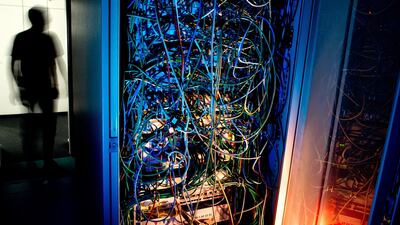
An employee works in a server room in Hanover, Germany. Data centres provide storage space and computing resources but demand a lot of energy. EPA


Wisdom as well as watts are needed to power the AI revolution


Karim Amin
Karim Amin
  • English
  • Arabic

November 05, 2024

It is a bit like the chicken and the egg question, but tri-faceted: we need AI to unlock new innovations, AI needs massive energy to run, and the energy sector needs massive investments to meet this demand. So, what comes first in this equation?

Let's begin at the end. AI has taken over the world. Not in a literal sense, but in every other sense of the word. The reason for the obsession with this relatively new technology is simple.

As humans, we are innately driven to seek tools that can enhance the quality of our lives and help us unlock new productivity levels. From the primitive stone axe to cars, all the way to the internet. It is no wonder, then, that we are so fixated on bots that can perform tasks beyond the capacity of human cognitive power, at a rate previously unimaginable.

But like everything else in the world, this advancement comes at a cost. And the cost for artificial intelligence is high. To understand that cost, we must first understand how AI operates.

At its core, AI is a very smart computer program that can analyse data, learn from it, and make predictions. The key word here is data; AI applications are only as good as the data you feed them. And they need to be fed a lot of data to reach the level they’re at now. This data then needs to be processed and stored somewhere. This is where data centres come into play.

Data centres provide this storage space and have the necessary computing resources required to analyse this huge amount of data. But in return, these facilities require a lot of energy to run, and they must run reliably and round-the-clock.

This may not seem that different from how the internet has worked for a very long time, but it is actually very different in its implications. The internet primarily functions as a global network that connects computers, enabling the exchange of information and communication. But AI can mimic a human brain, understanding context and recognising patterns through complex computations and large-scale data processing. And that is a very energy-intensive process that consumes about 10 to 15 times the electricity of a search on the web.

So how much does it cost to manufacture intelligence? We probably won’t have a definitive answer to this for years to come. Like any new technology, the AI revolution has yet to show us all its cards. But we have many projections and potential scenarios to go by.

The world does not have enough power generation or transmission capacity to fuel the data centres that are in the pipeline

The first undisputed fact is that it will cost an enormous amount of energy. Global energy consumption by data centres is projected to more than double before 2030. In some parts of the world, this increased demand will drive a surge in electricity growth not seen since the turn of the century. In the US alone, which hosts a third of the world’s data centres, an additional 50 gigawatts of data centre capacity is needed by the end of the decade. According to the International Energy Agency (IEA), data centres are expected to use up 6 per cent of the country’s power by 2026, compared to 3 per cent in 2022.

The world does not have enough power generation or transmission capacity to fuel the data centres that are in the pipeline. A recent McKinsey report estimates that generative AI could help create between $2.6 trillion and $4.4 trillion in economic value throughout the global economy. But these figures will not go beyond being futuristic estimations if the necessary investments in the power infrastructure don’t take place. And these investments are of magnificent proportions. In other words, AI will cost a lot of money.

To put it into perspective, these additional 50 gigawatts needed in the US would require an investment of more than $500 billion. Europe, which has the oldest power grid in the world, would need about $850 billion to $1 trillion to transform its grid for AI.

So what does this mean for the energy industry?

In a sector that already demands urgent financing solutions for the uphill battle of reaching net zero emissions, this is of course an added challenge. The rapid increase in energy demand must be balanced with the clean energy goals and climate pledges that took decades to cement.

A view of an operations nerve center at a data centre in Singapore on July 3, 2023. Global energy consumption by data centres is projected to more than double before 2030. Reuters

But this also opens new doors for the industry, particularly the once-disregarded doors of gas and nuclear. These data centres don’t just need energy. They need energy that is 99.9 per cent reliable and that cannot afford intermittency or weather-dependency. This reality is pushing more and more tech companies towards gas and nuclear-powered solutions.

It is already anticipated that the incremental data centre power consumption will bring about a massive wave of new natural gas demand by 2030, which will require new pipeline capacity to be built. Nuclear is already taking centre-stage, with tech giants like Google and Amazon recently turning to it to cater for their increasing electricity needs.

These are major industry pivots that were probably not foreseen a few years ago, influenced heavily by technology trends. This goes to show that, even in a globalised and vastly growing world, energy, data and finance are more interlinked and interdependent than ever before.

At the centre of it all are energy companies (like ours, Siemens Energy), which are up for big opportunities, and equally big responsibilities. With a new wave of customers hungry for (electric) power, and a growing strain on the grid, we have a big role to play in striking the right balance for all.

We should not let the AI frenzy get the best of us. Meeting the world’s towering demand for energy is essential, but we must do so in a sustainable manner that doesn’t compromise on the needs of our planet. We must balance the needs of a digital world with the imperatives of a sustainable future, ensuring that our advancements in technology are powered by wisdom just as much as by watts.


Disclaimer

Director: Alfonso Cuaron 

Stars: Cate Blanchett, Kevin Kline, Lesley Manville 

Rating: 4/5

The specs

Engine: 3-litre twin-turbo V6

Power: 400hp

Torque: 475Nm

Transmission: 9-speed automatic

Price: From Dh215,900

On sale: Now

Results
  • Brock Lesnar retained the WWE Universal title against Roman Reigns
  • Braun Strowman and Nicolas won the Raw Tag Team titles against Sheamus and Cesaro
  • AJ Styles retained the WWE World Heavyweight title against Shinsuke Nakamura
  • Nia Jax won the Raw Women’s title against Alexa Bliss
  • Daniel Bryan and Shane McMahon beat Kevin Owens and Sami Zayn
  • The Undertaker beat John Cena
  • The Bludgeon Brothers won the SmackDown Tag Team titles against the Usos and New Day
  • Ronda Rousey and Kurt Angle beat Triple H and Stephanie McMahon
  • Jinder Mahal won the United States title against Randy Orton, Rusev and Bobby Roode
  • Charlotte retained the SmackDown Women’s title against Asuka
  • Seth Rollins won the Intercontinental title against The Miz and Finn Balor
  • Naomi won the first WrestleMania Women’s Battle Royal
  • Cedric Alexander won the vacant Cruiserweight title against Mustafa Ali
  • Matt Hardy won the Andre the Giant Battle Royal
The specs

Engine: 2.0-litre 4cyl turbo

Power: 261hp at 5,500rpm

Torque: 405Nm at 1,750-3,500rpm

Transmission: 9-speed auto

Fuel consumption: 6.9L/100km

On sale: Now

Price: From Dh117,059

Islamophobia definition

A widely accepted definition was made by the All Party Parliamentary Group on British Muslims in 2019: “Islamophobia is rooted in racism and is a type of racism that targets expressions of Muslimness or perceived Muslimness.” It further defines it as “inciting hatred or violence against Muslims”.

How to join and use Abu Dhabi’s public libraries

• There are six libraries in Abu Dhabi emirate run by the Department of Culture and Tourism, including one in Al Ain and Al Dhafra.

• Libraries are free to visit and visitors can consult books, use online resources and study there. Most are open from 8am to 8pm on weekdays, closed on Fridays and have variable hours on Saturdays, except for Qasr Al Watan which is open from 10am to 8pm every day.

• In order to borrow books, visitors must join the service by providing a passport photograph, Emirates ID and a refundable deposit of Dh400. Members can borrow five books for three weeks, all of which are renewable up to two times online.

• If users do not wish to pay the fee, they can still use the library’s electronic resources for free by simply registering on the website. Once registered, a username and password is provided, allowing remote access.

• For more information visit the library network's website.

Farasan Boat: 128km Away from Anchorage

Director: Mowaffaq Alobaid 

Stars: Abdulaziz Almadhi, Mohammed Al Akkasi, Ali Al Suhaibani

Rating: 4/5

VEZEETA PROFILE

Date started: 2012

Founder: Amir Barsoum

Based: Dubai, UAE

Sector: HealthTech / MedTech

Size: 300 employees

Funding: $22.6 million (as of September 2018)

Investors: Technology Development Fund, Silicon Badia, Beco Capital, Vostok New Ventures, Endeavour Catalyst, Crescent Enterprises’ CE-Ventures, Saudi Technology Ventures and IFC

Dengue%20fever%20symptoms
%3Cp%3EHigh%20fever%20(40%C2%B0C%2F104%C2%B0F)%3Cbr%3ESevere%20headache%3Cbr%3EPain%20behind%20the%20eyes%3Cbr%3EMuscle%20and%20joint%20pains%3Cbr%3ENausea%3Cbr%3EVomiting%3Cbr%3ESwollen%20glands%3Cbr%3ERash%26nbsp%3B%3C%2Fp%3E%0A
What is dialysis?

Dialysis is a way of cleaning your blood when your kidneys fail and can no longer do the job.

It gets rid of your body's wastes, extra salt and water, and helps to control your blood pressure. The main cause of kidney failure is diabetes and hypertension.

There are two kinds of dialysis — haemodialysis and peritoneal.

In haemodialysis, blood is pumped out of your body to an artificial kidney machine that filter your blood and returns it to your body by tubes.

In peritoneal dialysis, the inside lining of your own belly acts as a natural filter. Wastes are taken out by means of a cleansing fluid which is washed in and out of your belly in cycles.

It isn’t an option for everyone but if eligible, can be done at home by the patient or caregiver. This, as opposed to home haemodialysis, is covered by insurance in the UAE.

Difference between fractional ownership and timeshare

Although similar in its appearance, the concept of a fractional title deed is unlike that of a timeshare, which usually involves multiple investors buying “time” in a property whereby the owner has the right to occupation for a specified period of time in any year, as opposed to the actual real estate, said John Peacock, Head of Indirect Tax and Conveyancing, BSA Ahmad Bin Hezeem & Associates, a law firm.

25%20Days%20to%20Aden
%3Cp%3EAuthor%3A%20Michael%20Knights%3C%2Fp%3E%0A%3Cp%3EPages%3A%20256%3C%2Fp%3E%0A%3Cp%3EAvailable%3A%20January%2026%3C%2Fp%3E%0A
Updated: November 05, 2024, 6:42 AM