


For all its global reach, modern UK is a country that has almost unique troubles in defining its message to other nations around the planet.
British foreign policy most recently embraced the need for improving relations the Global South, but for some time it has been apparent that this is not working as an organising principle for London.
There are good historical reasons for the frequently rediscovered difficulties that the UK encounters in relations with poorer or ideologically diverse countries. In a way, nothing better exemplifies this challenge than the Commonwealth.
The UK doesn’t own or run this international grouping, despite it often misleadingly being reported as the “British Commonwealth”. Among the 50-plus members, no other country has come to the fore as the top player either. Instead, disinterest is a bigger issue.
Exemplifying this point was the absence of India’s leader at the Commonwealth meeting in Samoa last week. Prime Minister Narendra Modi was in Russia, instead, representing the globe’s most populous nation at the Brics gathering.
President Cyril Ramaphosa of South Africa, another Brics member-state, also skipped the Samoa conference even though the Commonwealth was a leading forum for the abolishment of apartheid in his country. On display at the Kazan meeting was a nine-member bloc that, in gross domestic product terms, is now bigger than Western Europe and rivals the US.
-

Russian President Vladimir Putin, right, and Turkish President Recep Tayyip Erdogan shake hands on the sidelines of the Brics summit. AFP -
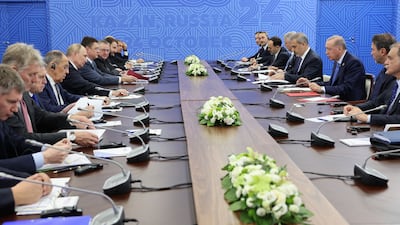
Mr Putin and Mr Erdogan on the sidelines of the Brics summit. AFP -
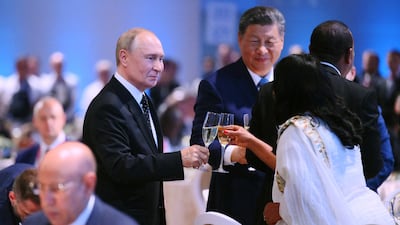
Mr Putin, left, and Chinese President Xi Jinping with Zinash Tayachew, wife of Ethiopian Prime Minister Abiy Ahmed, during a reception at the summit. EPA -

Palestinian President Mahmoud Abbas, centre, and Mauritania's President Mohamed Ould Ghazouani at the reception. EPA -
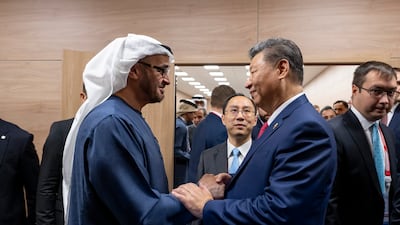
President Sheikh Mohamed meets Mr Xi during the Brics summit in Kazan, Russia, on Wednesday October 23. Photo: UAE Presidential Court -
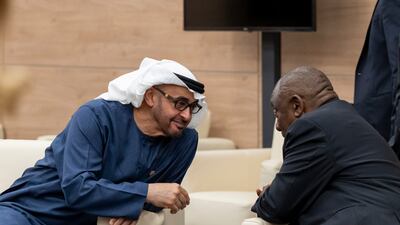
Sheikh Mohamed in discussions with Cyril Ramaphosa, President of South Africa. Photo: UAE Presidential Court -
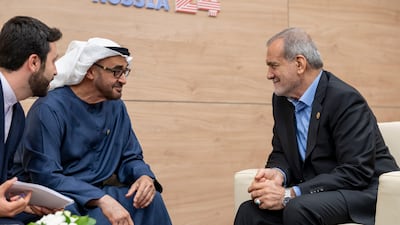
Sheikh Mohamed with Iranian President Masoud Pezeshkian. Photo: UAE Presidential Court -
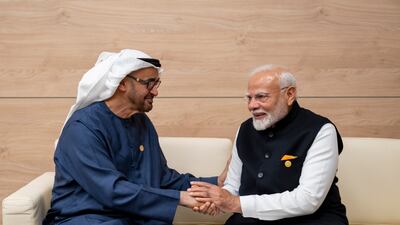
Sheikh Mohamed greets Narendra Modi, Prime Minister of India. Photo: UAE Presidential Court -
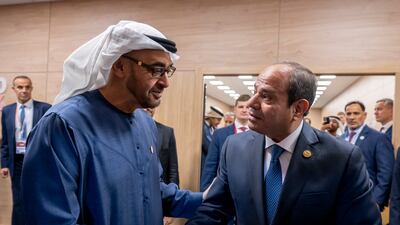
Sheikh Mohamed with Egyptian President Abdel Fattah El Sisi. Photo: UAE Presidential Court -
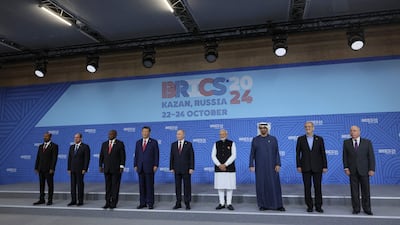
Sheikh Mohamed and other Brics leaders, from left, Ethiopian Prime Minister Abiy Ahmed, Egyptian President Abdel Fattah El Sisi, South African President Cyril Ramaphosa, Chinese President Xi Jinping, Russian President Vladimir Putin, Indian Prime Minister Narendra Modi, Iranian President Masoud Pezeshkian and Brazilian Foreign Minister Mauro Vieira, pose for a family photo at the Brics summit. AFP -
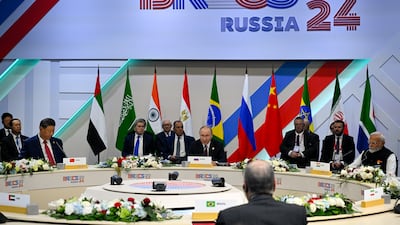
Chinese President Xi Jinping, Russian President Vladimir Putin and Indian Prime Minister Narendra Modi, at a Brics summit session. AP -
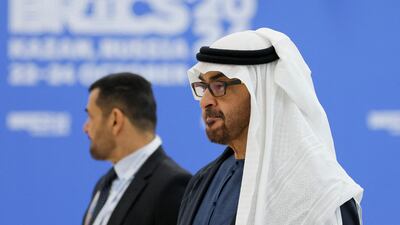
President Sheikh Mohamed arrives at the Brics summit. Reuters -

Sheikh Mohamed at the Brics summit which is being staged in Kazan, Russia. Reuters -

Russian President Vladimir Putin, right, and Sheikh Abdullah bin Zayed, Deputy Prime Minister and Minister of Foreign Affairs shake hands during the welcoming ceremony prior to an informal dinner on the sidelines of the Brics Summit. AP -
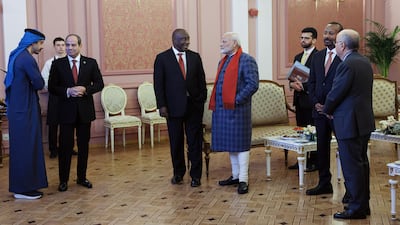
From left, Sheikh Abdullah bin Zayed, Egyptian President Abdel Fattah El Sisi, South African President Cyril Ramaphosa, Indian Prime Minister Narendra Modi, Ethiopian Prime Minister Abiy Ahmed and Brazilian Foreign Minister Mauro Vieira attend the welcoming ceremony. AP -
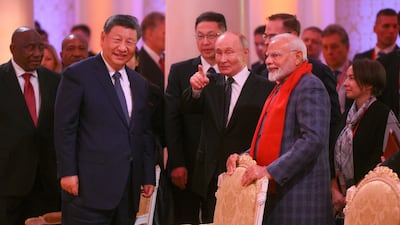
Chinese President Xi Jinping, left, Mr Putin, centre, and Mr Modi attend a concert before an informal dinner on the sidelines of the Brics Summit in Kazan. EPA -
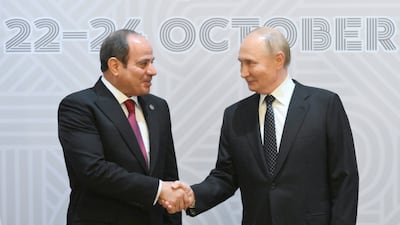
Mr Putin, right, and Mr El Sisi shake hands during their meeting on the sidelines of the summit at Kazan City Hall in Kazan, Russia. AP -
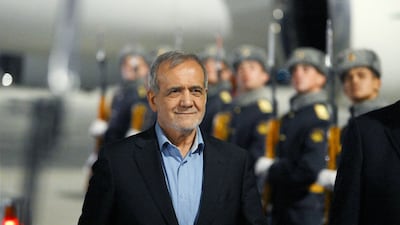
Iranian President Masoud Pezeshkian attends a welcoming ceremony at Kazan Airport upon his arrival to participate in the summit. Reuters -
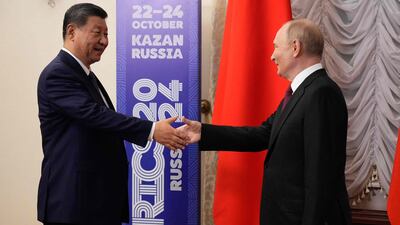
Mr Putin meets Mr Xi on the sidelines of the event. AFP -

Mr Putin meets Dilma Rousseff, chairwoman of the New Development Bank and former president of Brazil. Reuters -
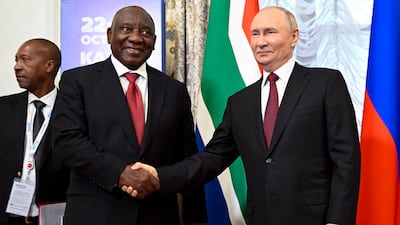
Mr Putin greets South African President Cyril Ramaphosa on the sidelines of the summit. EPA


One of the problems with Commonwealth meetings is that they frequently teeter on the brink of failure over deep-rooted clashes that revolve around identity. The Samoa meeting was a textbook example of this.
UK Prime Minister Keir Starmer was there to introduce himself as a new global actor. Courting goodwill as a fresh dose of centrist politics should have been the focus of the nearly weeklong trip. Instead, the Labour leader found himself addressing the issue of reparations for the Atlantic slave trade. The joint discussion of the issue was even adopted as Commonwealth business in clause 34 of the communique.
Mr Starmer said that reparations, both financial and non-financial, are off the table. But he added that he understood the hard, shared history of the Commonwealth meant accepting that there are calls to “face up to the harms of the past”.
However, in fending off the idea of reparations, Mr Starmer had a paradox on his side.
Foreign Secretary David Lammy is the first descendant of slaves to represent the UK abroad. He had justified the call for reparations before he came into office. And now that he is the UK’s top diplomat, it is his mission to make his country a friend of the Global South through dialogue and accommodation. Therein lies the problem.
A report recently published by the conservative Policy Exchange think tank makes a cogent argument that the Labour government’s foreign policy reset persists with building relations with the Global South – a policy that has been described as a pillar of its “progressive realism” platform. In fact, one of the three reviews of the UK’s foreign policy that was announced by Mr Lammy looks into the promotion of soft power within the overall global outlook.
The paper, however, argues that the problem with this thinking is the new government will be compelled by its own definition of a concessions-based diplomatic policy, shying away from openly pursuing its own interests. “This soft power focus circumscribes our strategic engagement with crucial non-aligned regions which are increasingly governed by hard power logic,” the report says.

It is true that the UK isn’t the only western power to give the Global South agenda higher priority in recent years, particularly since Russia launched its full-scale war against Ukraine in 2022.
The West’s strategy to court developing countries was partially based on an understanding that, over time, many of these countries had become more reluctant to support Kyiv as that would have meant prolonging a conflict that could have threatened the breadbasket supplies of wheat and oils to them.
But this panicked embrace of the Global South agenda ignores the fact that lumping together 85 per cent of the global population is necessarily incoherent. That certainly explains why it has appeared to be of little bridging value during last week’s Commonwealth summit.
The question posed by the Policy Exchange paper is: Why would the West play on this field? That is doubly true since it is observable that geopolitical ambushes by China and Russia, perhaps even Iran, are common in this context.
The success of the Brics summit has effectively delivered a bruising week for the West. And with Americans voting for their 47th president next month, the very direction of travel for the western world is at stake.
As Mr Starmer made the long flight home across the Pacific Ocean, it is highly improbable that he had many positive thoughts to cobble together in his head. Perhaps, then, a new approach is in order?

