


Even before the latest escalations – Israel’s invasion of Lebanon and Iran’s missile barrage, which it said was in retaliation for Israeli attacks – conflict in the Middle East was the top security issue for people in South-East Asia.
Published in April, the State of South-East Asia 2024 Survey found that 46.5 per cent of respondents named Israel’s war in Gaza as their government’s top geopolitical concern – higher even than the aggressive behaviour in the South China Sea. The latter may be far closer to home, but as 250 million Muslims constitute 40 per cent of the region’s overall population, the result should not have been too surprising.
Over the weekend, Bernama, Malaysia’s national news agency, published a report saying that the country “expressed deep regret over Israel’s barbaric actions following the assassination of Hezbollah leader Hassan Nasrallah”. Speaking at the UN in New York, Malaysian Foreign Minister Mohamad Hassan demanded that the Security Council impose an immediate arms embargo against Israel. “They have already crossed the line, and we need to take drastic action to curb their barbarism,” he said.
Also speaking at the UN after the bombings that killed the Hezbollah leader, Indonesian Foreign Minister Retno Marsudi asked if the Security Council would take action to stop “Israel’s atrocities” only when all Palestinians were displaced or if 100,000 had been killed. Referring to what she called the “unprecedented massive air-attacks on Beirut”, she said “[Israeli] Prime Minister [Benjamin] Netanyahu wants the war to continue”. She was echoing Indonesian President Joko Widodo, who had already called on the UN “to provide a quick response to prevent more victims from Israeli attacks”.
-
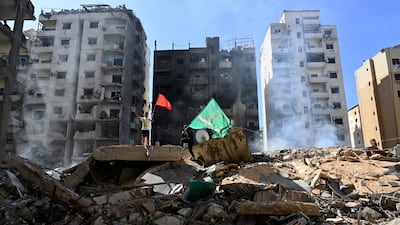
Damage in Beirut after an overnight Israeli strike. EPA -
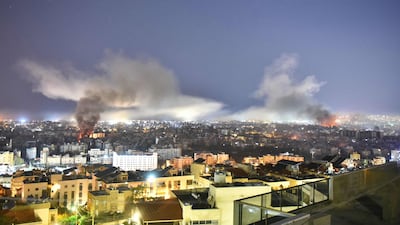
Smoke rises from the site of an Israeli strike in the south of Lebanon's capital. AFP -
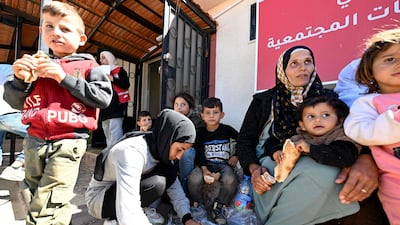
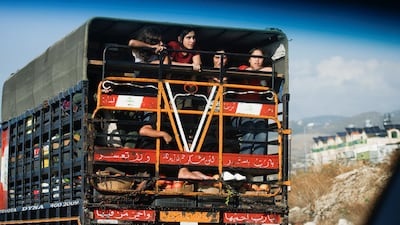
Displaced Syrians and Lebanese enter Syria from Lebanon at the Jusiyah border crossing. AFP -

The site of the Israeli air strike that killed Hezbollah leader Hassan Nasrallah, in Beirut. AP -
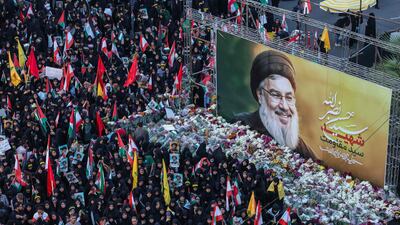
Iranians lay flowers before a portrait of Nasrallah. AFP -

Smoke billows over Tyre, southern Lebanon following an Israeli strike. Reuters -
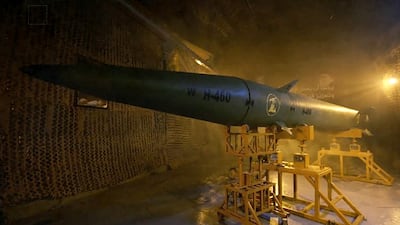
A Qader 1 ballistic missile from Hezbollah's arsenal. AFP -
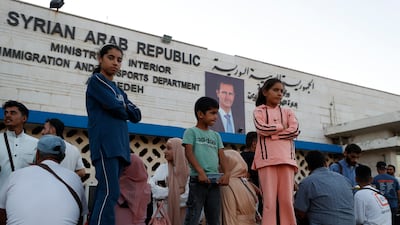
Syrians fleeing the war in Lebanon arrive at the Syrian-Lebanese border crossing in Jdeidet Yabous. AP -
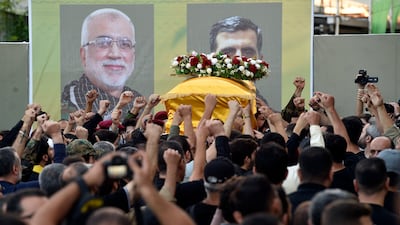
Hezbollah fighters carry the coffin of Hezbollah commander Ibrahim Qubaisi during his funeral in Beirut. EPA -
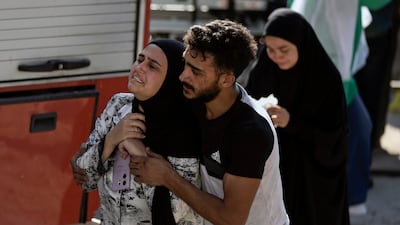
People react at the scene of an Israeli air strike in the town of Maisara, north of Beirut. AP -

Civil defence workers carry an elderly man who fled from the south of Lebanon, as he arrives at a school turned into a displaced shelter in Beirut. AP -
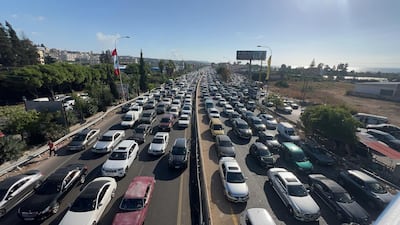
A traffic jam in Ghazieh as people fleeing from the south of Lebanon drive towards Sidon and Beirut. EPA -
People in heavy traffic drive north from Lebanon's southern coastal city of Sidon, as they flee Israeli bombardment. Reuters -
Smoke billows over southern Lebanon following Israeli strikes, as seen from Tyre. Reuters -
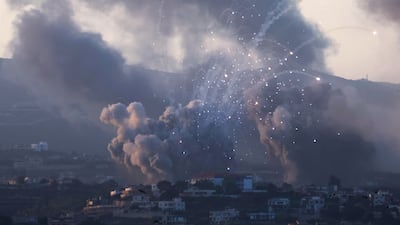
Smoke billows over southern Lebanon following Israeli strikes, as seen from Tyre. Reuters -

Medics move patients at Rambam Hospital's underground emergency centre, in Haifa, northern Israel. EPA -
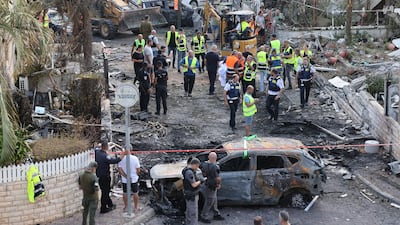
Israeli emergency teams work at the scene of a missile strike on a residential neighbourhood in Kiryat Bialik, northern Israel. EPA -
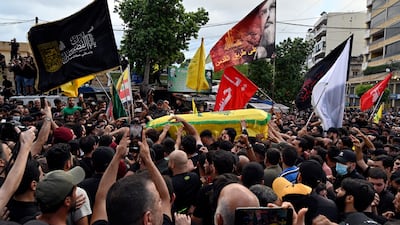
Hezbollah fighters carry the coffin of the group's senior commander Ibrahim Aqil, who was killed in an Israeli strike on September 20, in Beirut. EPA -
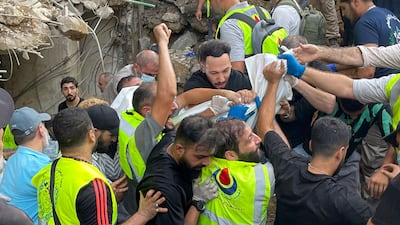
Rescuers carry a body at the scene of a missile strike in the southern suburbs of Beirut. AP


Lebanon does not have quite the resonance that Palestine does in South-East Asia. And there is considerable ambivalence about Hezbollah. Nevertheless, there have been several voices of criticism of the killing of Nasrallah.
The widespread consternation and anger felt about Israel’s murderous campaigns in Gaza and the West Bank have only been deepened by the horrors it is now inflicting upon Lebanon. No one here would describe Israel’s explosion of Hezbollah members’ handheld devices that blinded, maimed and killed people as “that amazing thing with the pagers”, as the UK Conservative party’s leadership contender Kemi Badenoch did so tastelessly on Monday.
The question is what effect all this will have on the region as a whole. Israel has diplomatic relations with most of the 10-member Association of South-East Asian Nations, and a strong security partnership with Singapore, in particular. It has been reported that Indonesia was planning to normalise ties, beginning with the proposed establishment of mutual trade offices last October. That is off the table in the current atmosphere. Only on Monday, the Indonesian Ulema Council issued a statement urging people to “never stop the boycott” of Israeli goods “because the genocide has not stopped either”.
As for Brunei and Malaysia, anti-Israel sentiment – always strong – is now so vehement that even if Israel agreed to establish a Palestinian state on pre-1967 borders, and all the other Arab states normalised ties, it wouldn’t surprise me if Kuala Lumpur delayed joining them.
Asean’s foreign ministers issued a strong statement in July expressing “grave concern over the dire humanitarian situation in Gaza”, condemning the attacks on civilians and civilian infrastructure, calling for a ceasefire, and bringing to an end “as rapidly as possible the unlawful presence of the state of Israel in the occupied Palestinian territory”. At the end of this year, Malaysia will become the group’s chair, and Prime Minister Anwar Ibrahim – at his most confident and commanding in foreign affairs – is likely to use the opportunity to push the association to take an even stronger stance against Israel.

He can’t, and won’t, try to interfere with any member country’s internal politics. That is neither the Asean nor the Malaysian way. But expect those wielding the pen in Kuala Lumpur to draft far harsher Asean statements on Israel and for Mr Anwar to use the platform to urge more concerted international action against what he has called “a rogue and pariah state”. On Wednesday, he posted on social media: “This escalation is plainly aimed at keeping Israel’s current political leaders in power and out of prison, sacrificing innocent lives at the altar of one man’s political career.”
Mr Anwar will doubtless face opposition in Asean meetings from members with beneficial ties with Israel. But the tide may be in his favour, and among South-East Asians of all faiths. Older generations in Vietnam are said to see a parallel between the destruction of Gaza and that visited on them by the US decades ago. In July, Singaporean Defence Minister Ng Eng Hen said of Israel and its apparently limitless backing by the US: “I think across many countries, we’ve lost the young on this.” Even in Singapore, he said, “the young are particularly incensed about the violence and the fact that nothing is done to stop it”.
Why should they think otherwise? And what on earth could persuade them to take a more benign view of either Israel’s actions or Washington’s enabling? The young people in Malaysia I have talked to view the issue as completely black and white. Over the past year, I have heard only one (older) South-East Asian tell me they discovered they had a friend who was pro-Israel. Her response? “I blocked her immediately.”
Israel’s expansion of its war to Lebanon and Mr Netanyahu’s recklessness will only firm up her conviction, and almost certainly persuade others to accept Mr Anwar’s characterisation of Israel: as “a rogue and pariah state”. Israel is losing ground badly in South-East Asia – and it’s dragging the US with it.

