


With less than four months left to go for the US presidential election, the Republican Party seems quietly confident about it chances of victory.
This is due in part to the miraculous survival of its leader, former president Donald Trump, from an assassination attempt at a campaign rally, at a time when President Joe Biden’s fortunes appear to be sagging. The nomination of JD Vance as Mr Trump’s running mate has given the party new energy, as has the just-concluded Republican National Convention.
Mr Vance’s candidacy is interesting, particularly as he is just 39 years old and a first-term senator. Despite his relative inexperience in politics, he is an acclaimed author and a proclaimed champion of “Middle America”. He will, therefore, be tasked with campaigning on domestic issues – which matter more to American voters – such as immigration, abortion, taxes and national security.
Most election campaigns in the US are huge machines run by thousands of people, but it is obvious that Mr Trump is the mastermind of the Republican operation.
Having been a divisive figure ever since he formally entered the American political arena in 2016, it remains to be seen if his near-death experience will persuade him to portray himself as a wise leader who can bring people together. Given his recent remarks about certain leaders in the Democratic Party, this is unlikely to be the case.
-
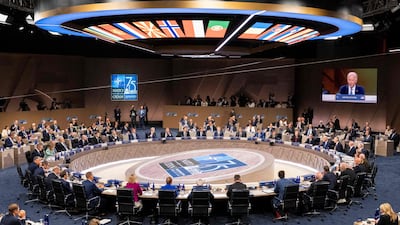
US President Joe Biden speaks during the Nato summit in Washington. AFP -
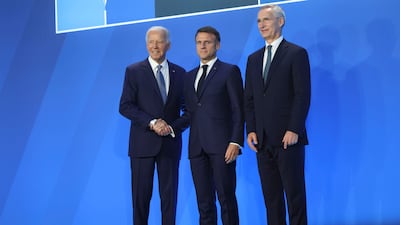
From left, Mr Biden, French President Emmanuel Macron and Nato Secretary General Jens Stoltenberg. Bloomberg -
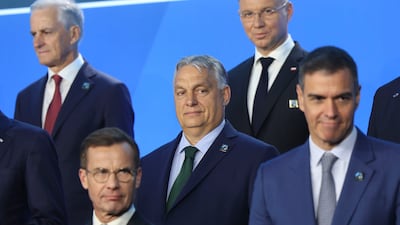
Viktor Orban, Hungary's Prime Minister, stands for a photo. Mr Orban made a recent visit to Moscow to meet Russian President Vladimir Putin. Bloomberg -
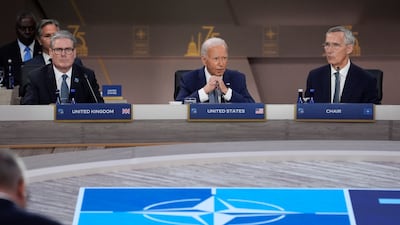
Mr Biden speaks during the opening session of the summit. AP -
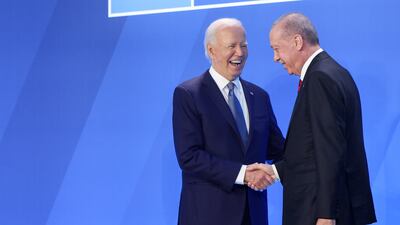
Mr Biden greets Turkey's President Recep Tayyip Erdogan. Bloomberg -
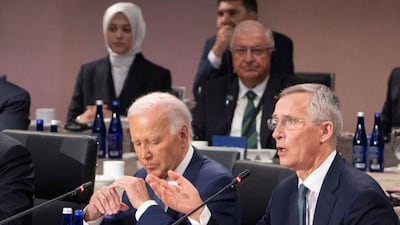
Mr Stoltenberg speaks during the summit. AFP -
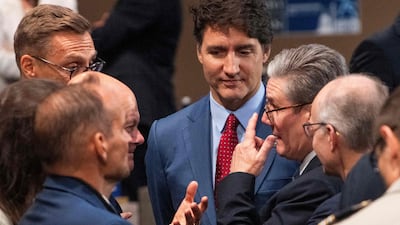
British Prime Minister Keir Starmer, right, speaks with Canadian Prime Minister Justin Trudeau, centre, and German Chancellor Olaf Scholz before the first working meeting of the Nato summit. AFP -
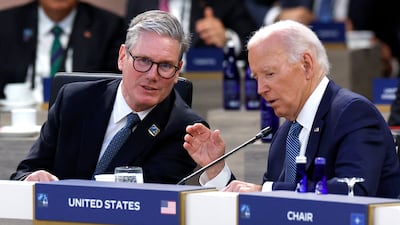
Mr Starmer speaks with Mr Biden. The UK Prime Minister is visiting Washington following a landslide win for his party in the recent elections. Getty Images / AFP -
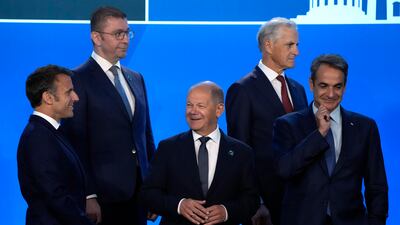
Leaders of allied countries pose for a photo at the summit. AP -
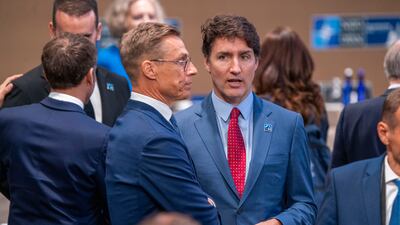
Mr Trudeau and President of Finland Alexander Stubb speak at the summit. EPA -
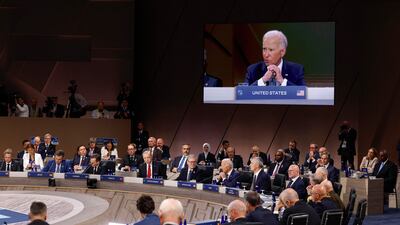
Mr Biden delivers remarks at the summit. Getty Images / AFP -
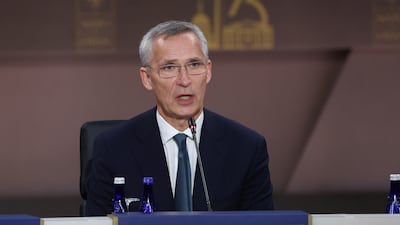
Mr Stoltenberg speaks during the summit. EPA -
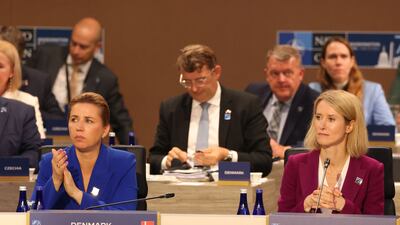
Denmark's Prime Minister Mette Frederiksen and Estonia's Prime Minister Kaja Kallas attend the summit. AFP -
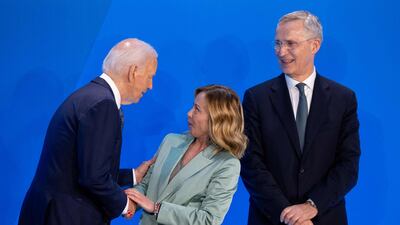
Mr Biden and Mr Stoltenberg greet Italian Prime Minister Giorgia Meloni on stage before a group photo. Getty Images / AFP -
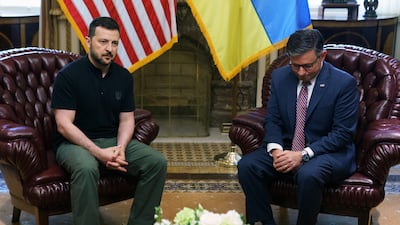
US House Speaker Mike Johnson and Ukrainian President Volodymyr Zelenskyy meet on Capitol Hill in Washington. EPA -
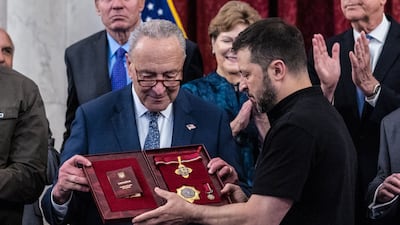
Mr Zelenskyy presents Senate Majority Leader Chuck Schumer with Ukrainian medals at the US Capitol. Getty Images / AFP -
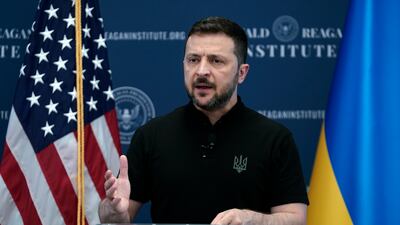
Mr Zelenskyy speaks at the Ronald Reagan Institute on the sidelines of Nato summit. AP -
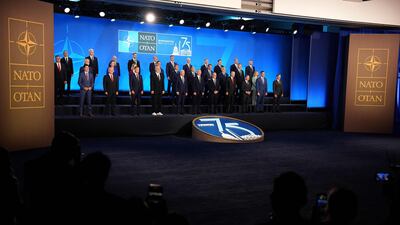
Heads of state pose for a group photo during the summit. Getty Images / AFP -
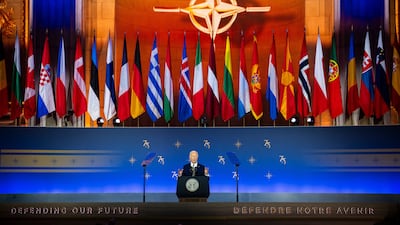
Mr Biden announces new air defence systems for Ukraine at the 75th anniversary event. Bloomberg -
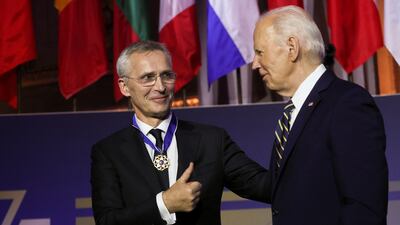
Mr Biden awards Mr Stoltenberg with the Presidential Medal of Freedom. Reuters


On issues of foreign policy, which is of greater interest to our readers, Mr Trump will need to do a lot of the heavy lifting if he wins the presidency. He will, in particular, need to address the war in Ukraine as a top foreign policy priority since it concerns US national security and America’s global leadership.
America’s western allies have come to appreciate Mr Biden’s leadership after the Russian invasion of Ukraine and the subsequent expansion and empowerment of Nato. It is clear that Mr Trump is not popular among many leaders in the West. Yet it is highly unlikely that he will dismantle Nato, as some of his critics are led to believe, given his constant lament over the lack of adequate financial contributions from other member states.
On the contrary, Mr Trump may seek to build on Mr Biden’s efforts in his own trademark ways. Both he and Mr Vance are hawkish in their criticism of Ukrainian President Volodymyr Zelenskyy. But this stance is likely to change over the coming months, and if Mr Trump wins, he will seek solutions for the war by encouraging concessions and compromises between Ukraine and Russia.
This will be challenging and complex, especially since Nato is entering a dangerous phase with Moscow after allowing Ukraine to use western-made weaponry inside Russian territory. We have wait to see what happens in the next four months, but Mr Trump is unlikely to make Mr Zelenskyy his enemy. Instead, he will almost certainly seek to reassure him, perhaps in a phone call soon, that his prospective presidency will not abandon Kyiv.
Mr Trump won’t reveal his supposedly radical solution to end the Ukraine war until later. However, some elements of this solution are likely to involve Ukrainian concessions and Nato’s abandonment of full membership for Kyiv in exchange for Russian withdrawal and finding a solution for the territories claimed by Moscow.
For Mr Trump, the important thing will be to end the war and restore some normality to relations with Russia rather than categorising it as a permanent enemy, as Nato recently did. While some members of the alliance do not trust Mr Trump, the question he will ask Europe’s leaders is whether they really want to continue living on the brink of a nuclear war or seek creative solutions to bring peace to the continent.

The Middle East will prominently be on Mr Trump’s radar, particularly because of the ongoing war in Gaza.
Mr Trump will once again cast his eyes on Iran’s nuclear weapons programme. During his previous stint in the White House, he cancelled the 2015 nuclear deal with Tehran to which his predecessor, Barack Obama, was one of the signatories. He also opposes the Biden administration’s appeasement policy towards Iran as a means to prevent the Gaza conflict from escalating into a regional war.
The former president previously criticised the erstwhile Obama-Biden administration for enabling Tehran to fund and empower militias in Lebanon, Iraq, Yemen and Syria, as well as Hamas, leading up to the October 7 attacks and the war in Gaza. Yet while he knows the problem well, he sometimes offers solutions that bring only temporary relief. Indeed, he is not ready to involve the US in a war against Iran, but instead believes that bankrupting the country is the effective way to limit its capabilities.
Israel will be another issue. Despite his reservations against Israeli Prime Minister Benjamin Netanyahu, Mr Trump has made it clear that he wants to “let Israel finish the job” in Gaza – which means destroying Hamas – leaving the impression that he does not care about the civilian casualties as much as he does about completing the mission.
A common ground between the Biden and Trump camps, however, is their focus on avoiding a war between Israel and Lebanon that could destroy the latter. Yet if such a war does occur, it will be seen as one between Israel and Hezbollah, and neither camp in the US will deter Israel from it. Both will even support it, albeit with different approaches.
It will be crucial who Mr Trump, if he wins a second term, will appoint as national security adviser, defence secretary and secretary of state. But rest assured, he will be the one to lead American foreign policy, as he looks to surround himself with a team loyal to his vision of Make America Great Again.

