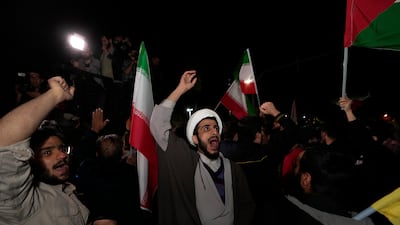
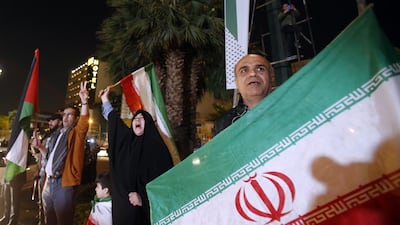
Demonstrators wave Iran's flag and Palestinian flags as they gather in front of the British Embassy in Tehran on Sunday. AFP


Why Tehran's strikes are unlikely to lead to an all-out Iran-Israel conflict


  • English
  • Arabic

April 14, 2024

Late on Saturday, Iran launched more than 300 drones and missiles at Israel. The attack, which was carried out in response to Israel’s strikes on an Iranian consular building in Syria that killed seven of its commanders earlier this month, was thought to mark the first time that the regime had struck Israel directly from Iran.

However, despite the departure from its years-long practice of relying on proxies across the region for waging conflict against its adversaries, Saturday’s attack is likely to be little more than a face-saving retaliation for the regime.

In fact, a de-escalation appears to be on the cards. Iran’s mission to the UN has said that the attack would be “deemed concluded” if Israel doesn’t strike back. Jordan, Iraq and even Israel, have all opened their air space.

This should not be altogether surprising, given that Iran and Israel have historically maintained a delicate detente.

One common denominator in the regional and strategic interests of both countries is their desire to limit the influence of Arab powers in the Middle East. In this context, the 2003 US-led invasion of Iraq served both entities. It neutralised Iraq as a significant regional power, leaving Israel as the only country in the region with nuclear capabilities and giving Iran decisive influence over Baghdad.

Even though the recent escalation will be seen by some in the context of the ongoing Gaza war, the fundamental disagreement between Iran and Israel does not revolve around Palestine’s future, as the Axis of Resistance tries to portray it. Instead, it centres on the possession of nuclear weapons.

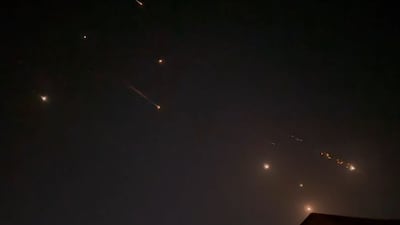
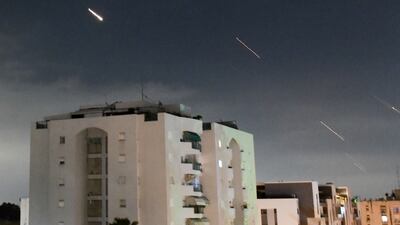
  • Israel's air defence system intercepts projectiles amid an attack by Iran, as seen from Ramallah in the occupied West Bank. Screengrab from AFPTV / AFP
    Israel's air defence system intercepts projectiles amid an attack by Iran, as seen from Ramallah in the occupied West Bank. Screengrab from AFPTV / AFP
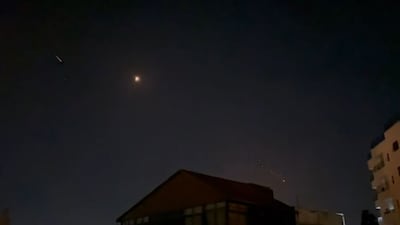
  • Missiles fired from Iran towards Israel are intercepted over the northern part of the country. AFP
    Missiles fired from Iran towards Israel are intercepted over the northern part of the country. AFP
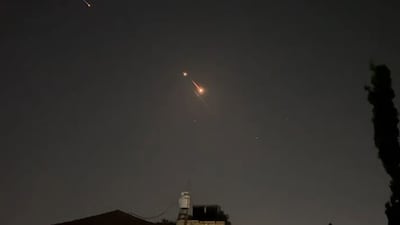
  • Explosions light up the sky in Hebron in the Palestinian territories during the attack. Screengrab from AFPTV / AFP
    Explosions light up the sky in Hebron in the Palestinian territories during the attack. Screengrab from AFPTV / AFP
  • Explosions occur over Hebron. Screengrab from AFPTV / AFP
    Explosions occur over Hebron. Screengrab from AFPTV / AFP
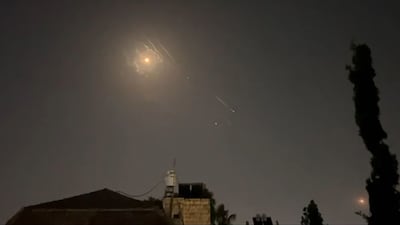
  • Explosions light up the skies over Jerusalem during the attack. Screengrab from AFPTV / AFP
    Explosions light up the skies over Jerusalem during the attack. Screengrab from AFPTV / AFP
  • Explosions occur over Jerusalem. Screengrab from AFPTV / AFP
    Explosions occur over Jerusalem. Screengrab from AFPTV / AFP
  • Israel's Iron Dome air defence system moves to intercept missiles fired from Iran. AP
    Israel's Iron Dome air defence system moves to intercept missiles fired from Iran. AP
  • Iranian demonstrators chant slogans during an anti-Israel gathering in Tehran. AP
    Iranian demonstrators chant slogans during an anti-Israel gathering in Tehran. AP
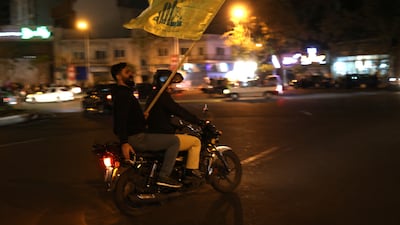
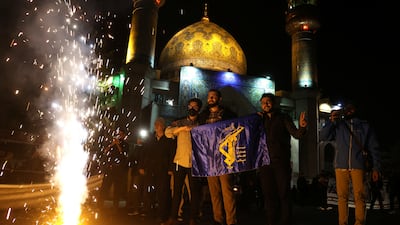
  • People in Tehran appear to celebrate in the street after the attack on Israel. Wana (West Asia News Agency) / Reuters
    People in Tehran appear to celebrate in the street after the attack on Israel. Wana (West Asia News Agency) / Reuters
  • Iranians appear to celebrate in the street after the attack. Wana (West Asia News Agency) / Reuters
    Iranians appear to celebrate in the street after the attack. Wana (West Asia News Agency) / Reuters
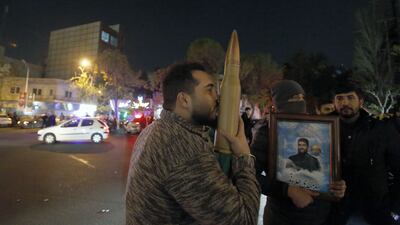
  • A man kisses a mock rocket during an anti-Israel rally in Tehran after Iran launched the attack. EPA
    A man kisses a mock rocket during an anti-Israel rally in Tehran after Iran launched the attack. EPA
  • People hold Iranian and Palestinian flags at Palestine Square in Tehran. EPA
    People hold Iranian and Palestinian flags at Palestine Square in Tehran. EPA
  • US President Joe Biden meets members of his national security team about the attack on Israel by Iran. The White House / AP
    US President Joe Biden meets members of his national security team about the attack on Israel by Iran. The White House / AP
Regardless of its boasts, Iran cannot win a war against the combined American-Israeli might

Israel seeks to maintain its regional monopoly as a nuclear power and aims to sabotage Iran’s own programme before it reaches the level of enrichment necessary for nuclear weapons. Despite its repeated denials, the Iranian regime seeks to develop nuclear weapons as a strategic necessity worth sacrificing the well-being of its people for.

This nuclear priority will have been at the forefront of Tehran’s considerations when exploring retaliation options in recent days. This is because it does not seek a war with Israel that would give the latter, as well as the US, the pretext to destroy or degrade its nuclear reactors.

Another reason for Iran to not seek further escalation with Israel, beyond its drone and missile attack, is that it does not want to risk the ongoing engagement with the US administration under President Joe Biden. Backchannel talks are still under way, with the aim of completing a grand bargain that would revive the 2015 nuclear agreement and lift economic sanctions against Iran.

Third, it knows that the US won’t idly stand by in the event of a direct war between Iran and Israel, and that it will intervene in favour of Israel. Indeed, US forces stationed in the region said they shot down several Iranian drones targeting Israel over the weekend.

Regardless of its boasts, Iran cannot win a war against the combined American-Israeli might. Raising the ceiling of its rhetoric is one thing, but engaging in a war with Israel amid the Biden administration’s warnings would be suicidal for the regime.

Iran’s justifications for caution factor in a number of other considerations.

Wisdom dictates that its rulers refrain from any action that could alleviate the increasing pressure on Israel due to its inhumane and unlawful treatment of civilians in Gaza. Tehran probably wants to avoid taking any action that would switch the Biden administration’s current sentiment towards Israel from anger to sympathy. Finally, negotiations between Israel and Hamas have not entirely ceased and could yet succeed, and thus, save Hamas, which is a crucial objective for Tehran and the Axis of Resistance.

For their part, both Russia and China have signalled to Iran that there is little justification for a direct conflict. Both powers are averse to a global war breaking out, each prioritising its economic and strategic interests. They do not wish for their Iranian ally to lead them where they have no say in the unfolding or conclusion of events.

The Biden administration is exerting maximum effort to navigate cautiously through these turbulent waters.

It has been keen to convey to Iran that it was not informed beforehand about the Israeli attack on the Iranian consular building in Damascus and that Washington remains committed to its secret negotiations with Tehran. Additionally, the administration has felt compelled to assert its commitment to protecting its Israeli ally in the event of a direct war with Iran, while continuing to warn Israel about the repercussions of any reckless behaviour, particularly concerning its planned Rafah operation.

The administration is also striving to maintain balance amid mounting pressures from both the Democratic and Republican parties in the US. On the left, there’s opposition to continued American military support for Israel, coupled with discontent over Israeli transgressions. Conversely, the right claims that Mr Biden is effectively extending a lifeline to Hamas and overlooking Iran’s policy of using proxies in the Middle East that serve its expansionist agenda and pose a threat to American interests.

The fact of the matter is, the region is caught between the leadership of one country (Israel) that continues down the path of provocation and recklessness and that of the other (Iran), which dares speak of sovereignty over the Damascus consulate attack, despite the existence of an operations room inside the facility that was being managed by the Quds Force (which oversees the functions of Iran’s proxies in the region).

Nonetheless, the Biden administration is maintaining its faith in diplomacy, preferring dialogue over confrontation. The expectation, then, is that the two rival powers will dial back their rhetoric and resist further escalation.


Director: Laxman Utekar

Cast: Vicky Kaushal, Akshaye Khanna, Diana Penty, Vineet Kumar Singh, Rashmika Mandanna

Rating: 1/5

Dust and sand storms compared

Sand storm

  • Particle size: Larger, heavier sand grains
  • Visibility: Often dramatic with thick "walls" of sand
  • Duration: Short-lived, typically localised
  • Travel distance: Limited 
  • Source: Open desert areas with strong winds

Dust storm

  • Particle size: Much finer, lightweight particles
  • Visibility: Hazy skies but less intense
  • Duration: Can linger for days
  • Travel distance: Long-range, up to thousands of kilometres
  • Source: Can be carried from distant regions
Who has been sanctioned?

Daniella Weiss and Nachala
Described as 'the grandmother of the settler movement', she has encouraged the expansion of settlements for decades. The 79 year old leads radical settler movement Nachala, whose aim is for Israel to annex Gaza and the occupied West Bank, where it helps settlers built outposts.

Harel Libi & Libi Construction and Infrastructure
Libi has been involved in threatening and perpetuating acts of aggression and violence against Palestinians. His firm has provided logistical and financial support for the establishment of illegal outposts.

Zohar Sabah
Runs a settler outpost named Zohar’s Farm and has previously faced charges of violence against Palestinians. He was indicted by Israel’s State Attorney’s Office in September for allegedly participating in a violent attack against Palestinians and activists in the West Bank village of Muarrajat.

Coco’s Farm and Neria’s Farm
These are illegal outposts in the West Bank, which are at the vanguard of the settler movement. According to the UK, they are associated with people who have been involved in enabling, inciting, promoting or providing support for activities that amount to “serious abuse”.

Mercer, the investment consulting arm of US services company Marsh & McLennan, expects its wealth division to at least double its assets under management (AUM) in the Middle East as wealth in the region continues to grow despite economic headwinds, a company official said.

Mercer Wealth, which globally has $160 billion in AUM, plans to boost its AUM in the region to $2-$3bn in the next 2-3 years from the present $1bn, said Yasir AbuShaban, a Dubai-based principal with Mercer Wealth.

Within the next two to three years, we are looking at reaching $2 to $3 billion as a conservative estimate and we do see an opportunity to do so,” said Mr AbuShaban.

Mercer does not directly make investments, but allocates clients’ money they have discretion to, to professional asset managers. They also provide advice to clients.

“We have buying power. We can negotiate on their (client’s) behalf with asset managers to provide them lower fees than they otherwise would have to get on their own,” he added.

Mercer Wealth’s clients include sovereign wealth funds, family offices, and insurance companies among others.

From its office in Dubai, Mercer also looks after Africa, India and Turkey, where they also see opportunity for growth.

Wealth creation in Middle East and Africa (MEA) grew 8.5 per cent to $8.1 trillion last year from $7.5tn in 2015, higher than last year’s global average of 6 per cent and the second-highest growth in a region after Asia-Pacific which grew 9.9 per cent, according to consultancy Boston Consulting Group (BCG). In the region, where wealth grew just 1.9 per cent in 2015 compared with 2014, a pickup in oil prices has helped in wealth generation.

BCG is forecasting MEA wealth will rise to $12tn by 2021, growing at an annual average of 8 per cent.

Drivers of wealth generation in the region will be split evenly between new wealth creation and growth of performance of existing assets, according to BCG.

Another general trend in the region is clients’ looking for a comprehensive approach to investing, according to Mr AbuShaban.

“Institutional investors or some of the families are seeing a slowdown in the available capital they have to invest and in that sense they are looking at optimizing the way they manage their portfolios and making sure they are not investing haphazardly and different parts of their investment are working together,” said Mr AbuShaban.

Some clients also have a higher appetite for risk, given the low interest-rate environment that does not provide enough yield for some institutional investors. These clients are keen to invest in illiquid assets, such as private equity and infrastructure.

“What we have seen is a desire for higher returns in what has been a low-return environment specifically in various fixed income or bonds,” he said.

“In this environment, we have seen a de facto increase in the risk that clients are taking in things like illiquid investments, private equity investments, infrastructure and private debt, those kind of investments were higher illiquidity results in incrementally higher returns.”

The Abu Dhabi Investment Authority, one of the largest sovereign wealth funds, said in its 2016 report that has gradually increased its exposure in direct private equity and private credit transactions, mainly in Asian markets and especially in China and India. The authority’s private equity department focused on structured equities owing to “their defensive characteristics.”

The specs

Engine: Dual 180kW and 300kW front and rear motors

Power: 480kW

Torque: 850Nm

Transmission: Single-speed automatic

Price: From Dh359,900 ($98,000)

On sale: Now

Formula%204%20Italian%20Championship%202023%20calendar
%3Cp%3EApril%2021-23%3A%20Imola%3Cbr%3EMay%205-7%3A%20Misano%3Cbr%3EMay%2026-28%3A%20SPA-Francorchamps%3Cbr%3EJune%2023-25%3A%20Monza%3Cbr%3EJuly%2021-23%3A%20Paul%20Ricard%3Cbr%3ESept%2029-Oct%201%3A%20Mugello%3Cbr%3EOct%2013-15%3A%20Vallelunga%3C%2Fp%3E%0A
Spec%20sheet
%3Cp%3E%3Cstrong%3EDisplay%3A%3C%2Fstrong%3E%204.7%22%20Retina%20HD%2C%201334%20x%20750%2C%20625%20nits%2C%201400%3A1%2C%20True%20Tone%2C%20P3%3Cbr%3E%3Cstrong%3EChip%3A%3C%2Fstrong%3E%20Apple%20A15%20Bionic%2C%206-core%20CPU%2C%204-core%20GPU%2C%2016-core%20Neural%20Engine%3Cbr%3E%3Cstrong%3ECamera%3A%3C%2Fstrong%3E%2012MP%2C%20f%2F1.8%2C%205x%20digital%20zoom%2C%20Smart%20HDR%2C%20Deep%20Fusion%3Cbr%3E%3Cstrong%3EVideo%3A%3C%2Fstrong%3E%204K%2B%40%2024%2F30%2F60fps%2C%20full%20HD%2B%40%2030%2F60fps%2C%20HD%2B%40%2030%20fps%3Cstrong%3E%3Cbr%3EFront%20camera%3A%20%3C%2Fstrong%3E7MP%2C%20f%2F2.2%2C%20Smart%20HDR%2C%20Deep%20Fusion%3B%20HD%20video%2B%40%2030fps%3Cbr%3E%3Cstrong%3EBattery%3A%3C%2Fstrong%3E%20Up%20to%2015%20hours%20video%2C%2050%20hours%20audio%3B%2050%25%20fast%20charge%20in%2030%20minutes%20with%2020W%20charger%3B%20wireless%20charging%3Cbr%3E%3Cstrong%3EBiometrics%3A%3C%2Fstrong%3E%20Touch%20ID%3Cbr%3E%3Cstrong%3EDurability%3A%3C%2Fstrong%3E%20IP67%2C%20dust%2C%20water%20resistant%20up%20to%201m%20for%2030%20minutes%3Cbr%3E%3Cstrong%3EPrice%3A%3C%2Fstrong%3E%20From%20Dh1%2C849%3C%2Fp%3E%0A
Ten tax points to be aware of in 2026

1. Domestic VAT refund amendments: request your refund within five years

If a business does not apply for the refund on time, they lose their credit.

2. E-invoicing in the UAE

Businesses should continue preparing for the implementation of e-invoicing in the UAE, with 2026 a preparation and transition period ahead of phased mandatory adoption. 

3. More tax audits

Tax authorities are increasingly using data already available across multiple filings to identify audit risks. 

4. More beneficial VAT and excise tax penalty regime

Tax disputes are expected to become more frequent and more structured, with clearer administrative objection and appeal processes. The UAE has adopted a new penalty regime for VAT and excise disputes, which now mirrors the penalty regime for corporate tax.

5. Greater emphasis on statutory audit

There is a greater need for the accuracy of financial statements. The International Financial Reporting Standards standards need to be strictly adhered to and, as a result, the quality of the audits will need to increase.

6. Further transfer pricing enforcement

Transfer pricing enforcement, which refers to the practice of establishing prices for internal transactions between related entities, is expected to broaden in scope. The UAE will shortly open the possibility to negotiate advance pricing agreements, or essentially rulings for transfer pricing purposes. 

7. Limited time periods for audits

Recent amendments also introduce a default five-year limitation period for tax audits and assessments, subject to specific statutory exceptions. While the standard audit and assessment period is five years, this may be extended to up to 15 years in cases involving fraud or tax evasion. 

8. Pillar 2 implementation 

Many multinational groups will begin to feel the practical effect of the Domestic Minimum Top-Up Tax (DMTT), the UAE's implementation of the OECD’s global minimum tax under Pillar 2. While the rules apply for financial years starting on or after January 1, 2025, it is 2026 that marks the transition to an operational phase.

9. Reduced compliance obligations for imported goods and services

Businesses that apply the reverse-charge mechanism for VAT purposes in the UAE may benefit from reduced compliance obligations. 

10. Substance and CbC reporting focus

Tax authorities are expected to continue strengthening the enforcement of economic substance and Country-by-Country (CbC) reporting frameworks. In the UAE, these regimes are increasingly being used as risk-assessment tools, providing tax authorities with a comprehensive view of multinational groups’ global footprints and enabling them to assess whether profits are aligned with real economic activity. 

Contributed by Thomas Vanhee and Hend Rashwan, Aurifer

Updated: April 15, 2024, 8:52 AM