

Late on Saturday, Iran launched more than 300 drones and missiles at Israel. The attack, which was carried out in response to Israel’s strikes on an Iranian consular building in Syria that killed seven of its commanders earlier this month, was thought to mark the first time that the regime had struck Israel directly from Iran.
However, despite the departure from its years-long practice of relying on proxies across the region for waging conflict against its adversaries, Saturday’s attack is likely to be little more than a face-saving retaliation for the regime.
In fact, a de-escalation appears to be on the cards. Iran’s mission to the UN has said that the attack would be “deemed concluded” if Israel doesn’t strike back. Jordan, Iraq and even Israel, have all opened their air space.
This should not be altogether surprising, given that Iran and Israel have historically maintained a delicate detente.
One common denominator in the regional and strategic interests of both countries is their desire to limit the influence of Arab powers in the Middle East. In this context, the 2003 US-led invasion of Iraq served both entities. It neutralised Iraq as a significant regional power, leaving Israel as the only country in the region with nuclear capabilities and giving Iran decisive influence over Baghdad.
Even though the recent escalation will be seen by some in the context of the ongoing Gaza war, the fundamental disagreement between Iran and Israel does not revolve around Palestine’s future, as the Axis of Resistance tries to portray it. Instead, it centres on the possession of nuclear weapons.
-

Israel's air defence system intercepts projectiles amid an attack by Iran, as seen from Ramallah in the occupied West Bank. Screengrab from AFPTV / AFP -

Missiles fired from Iran towards Israel are intercepted over the northern part of the country. AFP -

Explosions light up the sky in Hebron in the Palestinian territories during the attack. Screengrab from AFPTV / AFP -

Explosions occur over Hebron. Screengrab from AFPTV / AFP -

Explosions light up the skies over Jerusalem during the attack. Screengrab from AFPTV / AFP -

Explosions occur over Jerusalem. Screengrab from AFPTV / AFP -

Israel's Iron Dome air defence system moves to intercept missiles fired from Iran. AP -
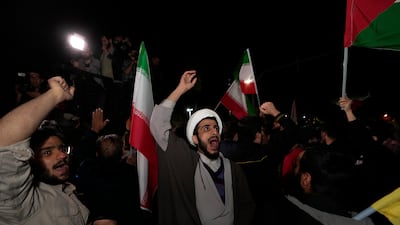
Iranian demonstrators chant slogans during an anti-Israel gathering in Tehran. AP -

People in Tehran appear to celebrate in the street after the attack on Israel. Wana (West Asia News Agency) / Reuters -
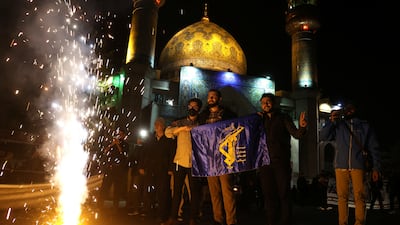
Iranians appear to celebrate in the street after the attack. Wana (West Asia News Agency) / Reuters -

A man kisses a mock rocket during an anti-Israel rally in Tehran after Iran launched the attack. EPA -
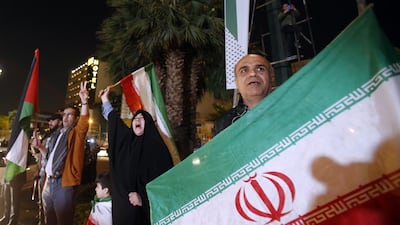
People hold Iranian and Palestinian flags at Palestine Square in Tehran. EPA -

US President Joe Biden meets members of his national security team about the attack on Israel by Iran. The White House / AP


Israel seeks to maintain its regional monopoly as a nuclear power and aims to sabotage Iran’s own programme before it reaches the level of enrichment necessary for nuclear weapons. Despite its repeated denials, the Iranian regime seeks to develop nuclear weapons as a strategic necessity worth sacrificing the well-being of its people for.
This nuclear priority will have been at the forefront of Tehran’s considerations when exploring retaliation options in recent days. This is because it does not seek a war with Israel that would give the latter, as well as the US, the pretext to destroy or degrade its nuclear reactors.
Another reason for Iran to not seek further escalation with Israel, beyond its drone and missile attack, is that it does not want to risk the ongoing engagement with the US administration under President Joe Biden. Backchannel talks are still under way, with the aim of completing a grand bargain that would revive the 2015 nuclear agreement and lift economic sanctions against Iran.
Third, it knows that the US won’t idly stand by in the event of a direct war between Iran and Israel, and that it will intervene in favour of Israel. Indeed, US forces stationed in the region said they shot down several Iranian drones targeting Israel over the weekend.
Regardless of its boasts, Iran cannot win a war against the combined American-Israeli might. Raising the ceiling of its rhetoric is one thing, but engaging in a war with Israel amid the Biden administration’s warnings would be suicidal for the regime.
Iran’s justifications for caution factor in a number of other considerations.
Wisdom dictates that its rulers refrain from any action that could alleviate the increasing pressure on Israel due to its inhumane and unlawful treatment of civilians in Gaza. Tehran probably wants to avoid taking any action that would switch the Biden administration’s current sentiment towards Israel from anger to sympathy. Finally, negotiations between Israel and Hamas have not entirely ceased and could yet succeed, and thus, save Hamas, which is a crucial objective for Tehran and the Axis of Resistance.
For their part, both Russia and China have signalled to Iran that there is little justification for a direct conflict. Both powers are averse to a global war breaking out, each prioritising its economic and strategic interests. They do not wish for their Iranian ally to lead them where they have no say in the unfolding or conclusion of events.
The Biden administration is exerting maximum effort to navigate cautiously through these turbulent waters.
It has been keen to convey to Iran that it was not informed beforehand about the Israeli attack on the Iranian consular building in Damascus and that Washington remains committed to its secret negotiations with Tehran. Additionally, the administration has felt compelled to assert its commitment to protecting its Israeli ally in the event of a direct war with Iran, while continuing to warn Israel about the repercussions of any reckless behaviour, particularly concerning its planned Rafah operation.
The administration is also striving to maintain balance amid mounting pressures from both the Democratic and Republican parties in the US. On the left, there’s opposition to continued American military support for Israel, coupled with discontent over Israeli transgressions. Conversely, the right claims that Mr Biden is effectively extending a lifeline to Hamas and overlooking Iran’s policy of using proxies in the Middle East that serve its expansionist agenda and pose a threat to American interests.
The fact of the matter is, the region is caught between the leadership of one country (Israel) that continues down the path of provocation and recklessness and that of the other (Iran), which dares speak of sovereignty over the Damascus consulate attack, despite the existence of an operations room inside the facility that was being managed by the Quds Force (which oversees the functions of Iran’s proxies in the region).
Nonetheless, the Biden administration is maintaining its faith in diplomacy, preferring dialogue over confrontation. The expectation, then, is that the two rival powers will dial back their rhetoric and resist further escalation.

