


A man limps through the door of a Baghdad hospital. In the crowded entrance, a child comes up to him and pointing to the man's bandaged leg, asks in all innocence, if he had hurt himself playing football.
At first the question puzzles the man. His brow furrowed, he suddenly remembers he is wearing sports clothes and understands the reason for the boy’s odd query.
You see, in July 2003, a bullet wound would have been the likeliest reason someone went to hospital in Iraq, so a bona fide sports injury really would have been news.

Offering a small smile, the man shakes his head in response. Seemingly satisfied, the child runs off into the throng.
It is a true story. Looking back, I find it to be a bittersweet recollection from a time of confusion and turmoil.
Although it was 10 weeks after the official end of the US invasion of Iraq, from the look of things at Al Kindi General Hospital, the war seemed still in full swing.
Already in April, at the height of the invasion, the International Committee of the Red Cross had warned that Baghdad’s hospitals were overwhelmed by the flow of war-wounded patients. Access to clean water was also a major concern. By the summer, the situation had not greatly improved, as far as I could tell.
Al Kindi was one of Baghdad’s main hospitals. It would not have been my choice to go there, or to any hospital at all – given my seemingly minor injury, received during an armed robbery at the house where I had been staying while living in the Iraqi capital. But I had been sent there by the police who were investigating the crime. And I was told that it was correct procedure for me to visit a government hospital.
A history of Al Kindi Hospital in this century is also a part of the history of Iraq. As well as the casualties of war, the hospital has served anti-corruption protesters of 2019 targeted for demanding their rights, the infected during the Covid-19 pandemic, and the victims of ISIS terror attacks.

Staff have been attacked by the angry and grieving relatives of the deceased. Two decades ago, its doctors also defended the hospital during the post-invasion looting. There was also a high-profile case of staff being accused of rape in recent years.
Chatham House research shows that even today Iraqis struggle to get adequate access to medicine and treatment due to the corruption that has held back the country from overcoming decades of conflict.
While I waited to be seen by a doctor, who eventually confirmed that an X-ray showed my knee only required a course of physiotherapy to heal, I listened to the agonised screams of a child being sutured without anaesthetic. I was told there was a shortage of it. Brutal times. I considered myself lucky I didn’t need surgery or pain killers.
Throughout the main corridor of the hospital, I heard the lamentations of people grieving their loved ones. In the gloom – electricity was rationed there too – I felt as if I was in a place of purgatory. In such circumstances, it is painfully ironic to note that the origins of the word hospital imply a place of shelter.
For those of us who enjoy lives in peaceful countries, a hospital is where we go to get better in the hope of improving well-being. More often than not it fulfils our needs.

In wartime, for civilians, a hospital can be a sanctuary and a place of suffering. If you need medical treatment, where else can you go but to a hospital? And what happens when a hospital is caught up in conflict and hit by ordnance or rockets? Where should you go instead? And when patients' mental health deteriorates, because it cannot be separated from physical health, then the damage can last a lifetime. Even when the fighting stops, recovering physically and mentally is not easy.
The only solution then is to protect hospitals at all times, but especially in war. To never take medical services for granted, and to make sure the talented and dedicated people who staff hospitals, anywhere in the world, are as cared for as they care for patients. This course of action would serve humanity well, be it in Iraq, Ukraine or Gaza.
Live updates: Follow the latest news on Israel-Gaza
-
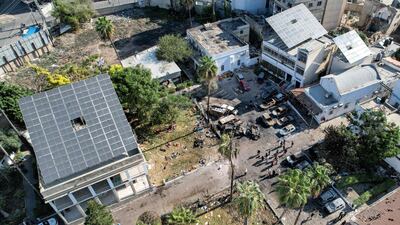
An aerial view of the complex housing the Al Ahli Arab hospital in Gaza City in the aftermath of Tuesday night's blast. AFP -

People inspect a church on the premises of Al Ahli Hospital in Gaza City where hundreds of Palestinians were killed in a blast that Israeli and Palestinian officials blamed on each other. Reuters -
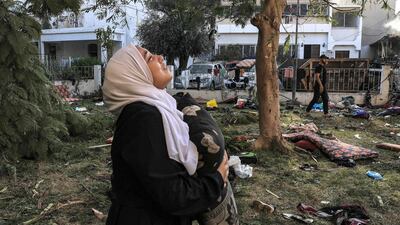
A woman among the debris outside Al Ahli Arab Hospital in central Gaza. AFP -

People at Al Ahli Arab Hospital in central Gaza. AFP -
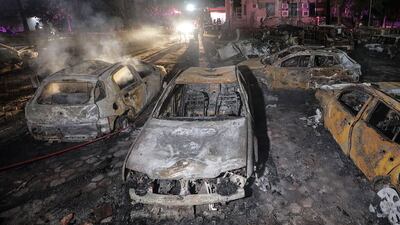
The scene at Al Ahli Hospital after an air strike in Gaza City. EPA -

A doctor at Al Ahli Hospital after an air strike in Gaza city. EPA -
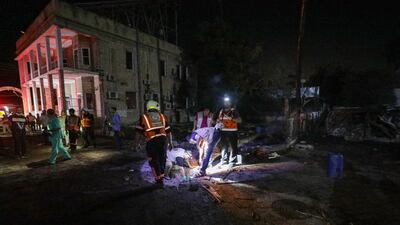
Emergency services search the rubble at Al Ahli Hospital after an air strike in Gaza city. EPA -
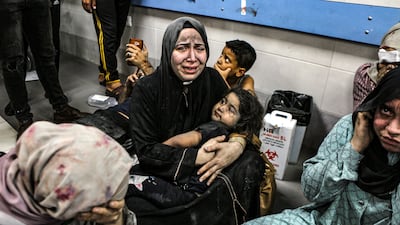
Palestinians wait for treatment at Al Shifa Hospital in Gaza city after being wounded in an air strike that killed at least 500 people at Al Ahli Hospital. AP -
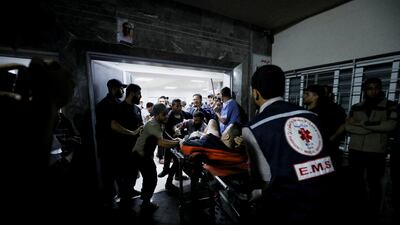
Ambulances and private cars rushed about 350 casualties from the blast at Al Ahli to Al Shifa, Gaza City's main hospital. Reuters -

Children in an ambulance on the way to Al Shifa Hospital. Reuters -

Al Shifa Hospital was already overwhelmed with wounded from other strikes. Reuters -
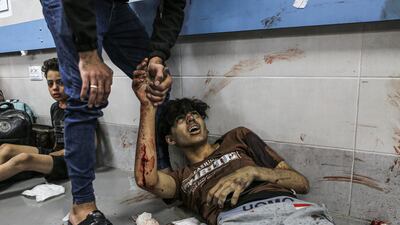
A wounded Palestinian on the floor in Al Shifa Hospital in Gaza City. AP -
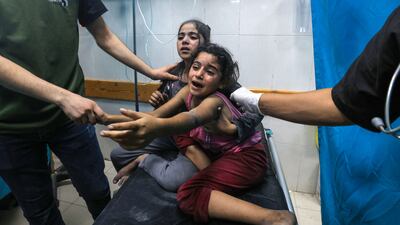
Hundreds of Palestinians had taken refuge in Al Ahli and other hospitals in Gaza City, hoping they would be spared bombardment. AFP -
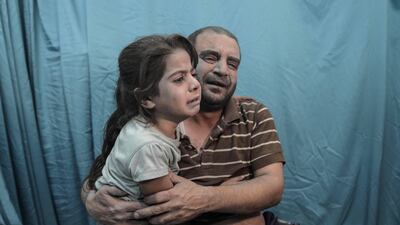
The explosion at Al Ahli Hospital left gruesome scenes. EPA -
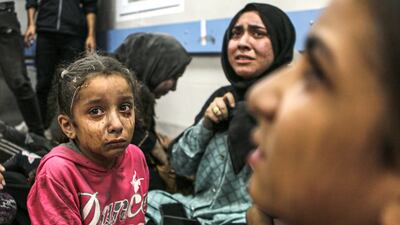
Many of the victims of the blast at Al Ahli Hospital were young children. AP -
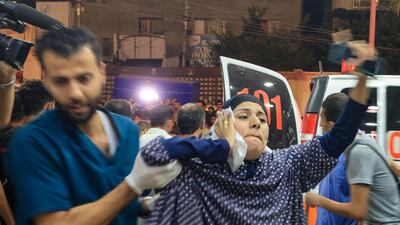
A wounded Palestinian woman is taken for treatment. AFP -
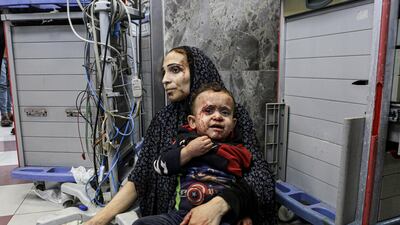
Wounded Palestinians wait for treatment. AP



